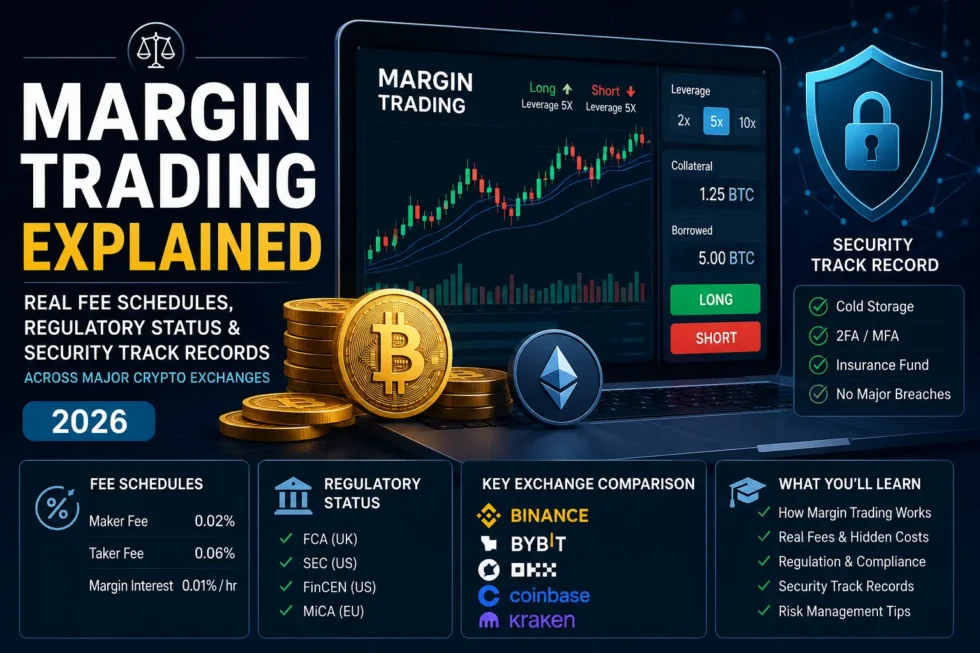
Margin Trading Explained Real Fee Schedules, Regulatory Status & Security Track Records Across Major Crypto Currency Exchanges 2026
This article is part of our Advanced Crypto Trading Features Explained for Serious Investors cluster, which breaks down leverage, derivatives, and order types for traders who’ve moved past spot buying and holding. For a side-by-side comparison of the exchanges named below — including their overall fee structure, liquidity depth, and withdrawal speed — see our pillar guide, The Global Crypto Exchange Cost Map 2026: 12 Trusted Platforms Compared by Trading Fees, Liquidity, Security, Withdrawal Speed & Regulatory Compliance.
Margin trading lets you borrow funds from an cryptocurrency exchange to open a position larger than your own capital would allow. It’s one of the most misunderstood products in crypto — partly because most explainers describe it in the abstract (“borrow money, trade bigger, pay interest”) without showing what it actually costs on a real platform, under a real regulatory regime, with a real security track record behind it.
This guide fixes that. Every number below comes from cryptocurrency exchange fee-schedule pages, exchange help-center documentation, or regulatory filings, current as of mid-2026. Rates change — margin interest in particular is dynamic and can move daily — so treat the figures as a snapshot of how each platform prices margin, not a locked-in quote.
How Margin Trading Fees Actually Work
Regardless of which exchange you use, a margin position layers three to four separate costs on top of each other:
- The opening/trading fee — the standard maker/taker commission charged on the trade itself, exactly as it would be on a spot order.
- Borrow interest (or a rollover fee) — the cost of the capital you’ve borrowed, typically accrued hourly or charged in a fixed block every few hours.
- A liquidation fee — an extra penalty charged only if your position gets force-closed for falling below the maintenance margin requirement.
- On some platforms, a funding fee if you’re using a perpetual futures contract rather than spot margin (technically a different product, but often confused with margin trading).
The two numbers that matter most for cost comparison are the base trading fee and the borrow interest rate, since the liquidation fee only applies if things go wrong and funding fees are specific to perpetuals rather than spot margin.
Fee Schedules by Platform
Binance
Binance charges the standard spot maker/taker rate — 0.1% for regular (non-VIP) users, dropping to 0.075% if fees are paid in BNB — on top of an hourly-accrued margin interest rate that varies by asset. Binance’s own margin fee documentation lists BTC borrowing around 0.012% per day and USDT borrowing around 0.03% per day for base-tier users, with both rates dropping at higher VIP tiers and with the BNB discount. Binance also runs cross-margin and isolated-margin modes, letting you decide whether a single position’s losses stay contained or can draw on your full account balance.
Kraken
Kraken’s margin structure is unusual in that it separates the trading fee from two dedicated margin charges: an opening fee (0.01%–0.02% depending on the pair, charged when you open the position) and a rollover fee of the same size, charged every four hours the position stays open — not hourly like Binance. Spot trading fees on top of that run higher than Binance’s base rate, in the 0.25%/0.40% maker/taker range before volume discounts, though Kraken’s rollover-based margin pricing means a short-lived trade can actually work out cheaper than a platform charging interest by the hour. Kraken also applies a distinct 3% liquidation fee if a margin position is force-closed at the index price.
Bybit
Bybit mirrors its 0.1% spot maker/taker fee for spot margin trades and layers hourly-accrued interest on top, which resets based on your account’s UTA borrowing tier and the asset borrowed. Bybit separates Spot Margin (borrowing an asset to trade it, with interest) from Futures Margin (posting collateral against a derivatives contract, with a funding rate instead of interest) — the two products get bundled together under “margin trading” in casual use but have different cost mechanics and, on the futures side, leverage up to 100x–125x on certain pairs.
OKX
OKX prices spot at 0.08%/0.10% maker/taker and derivatives at 0.02%/0.05%, with margin borrowing available up to roughly 10x on spot pairs and up to 125x on select perpetuals. OKX’s fee schedule includes negative maker fees at its highest VIP tiers, a rebate structure aimed squarely at high-volume derivatives desks rather than casual margin users.
Bottom line on cost: there’s no single “cheapest” exchange for margin — it depends on how long you hold the position (Kraken’s 4-hour rollover model rewards short holds; hourly-interest models on Binance/Bybit/OKX scale more predictably with duration) and how much volume you trade (VIP-tier discounts compound quickly at scale). For the full 12-platform fee comparison across spot, futures, and withdrawal costs, see the Global Crypto Exchange Cost Map.
Regulatory Status: What “Licensed” Actually Means Here
Margin trading is regulated more strictly than spot trading in most jurisdictions, because borrowed capital and leverage introduce systemic risk. Here’s where each platform actually stands, not just what their marketing claims:
- Binance operates margin trading globally but not for U.S. retail users on its main platform; Binance.US offers a separate, more limited product set under U.S. money-transmitter licensing.
- Kraken offers margin through its main international cryptocurrency exchange, and in the U.S. offers a separate regulated product — spot margin through Kraken Derivatives US, which operates as a CFTC-registered Futures Commission Merchant and NFA member, with financing provided by a separate Kraken-affiliated entity. This dual structure exists specifically because U.S. margin/leverage products face closer CFTC oversight than simple spot trading.
- Bybit does not serve U.S. users at all. It holds a Markets in Cryptocurrency -Assets Regulation (MiCA) license from Austria’s Financial Market Authority (obtained mid-2025), giving it passportable access across the EEA, and a Virtual Asset Platform Operator license from the UAE’s Securities and Commodities Authority (obtained late 2025). It was also publicly reprimanded by Malaysia’s Securities Commission in December 2024 for operating without local registration, and paid a fine to India’s Financial Intelligence Unit around the same period for anti-money-laundering non-compliance — both are matters of public regulatory record, not rumor.
- OKX re-entered the U.S. market in April 2025 following a $505 million settlement with the U.S. Department of Justice, but its U.S. entity does not currently offer margin, futures, or derivatives — only spot trading — pending further regulatory approval. Internationally, OKX holds the first full MiCA license issued to a global cryptocurrency exchange (from Malta’s MFSA) and a provisional VARA license in Dubai.
- Coinbase does not offer traditional retail margin trading on its core U.S. platform; leveraged and margin-style products are largely routed through Coinbase’s institutional arm or its derivatives/futures products, reflecting deliberately conservative positioning after its multi-year SEC dispute. That case — SEC v. Coinbase, alleging Coinbase operated as an unregistered cryptocurrency exchange, broker, and clearing agency — was formally dismissed with prejudice in February 2025, following a broader shift in U.S. enforcement posture toward crypto that year.
The pattern across all five: the cryptocurrency exchange offering the lowest headline fee is often the one least willing to let U.S. retail users near margin at all, because that product specifically draws CFTC/SEC-style scrutiny that simple spot trading doesn’t. When you’re choosing a platform for margin specifically, checking whether your jurisdiction is even eligible for the product matters more than comparing basis points.
Security Track Record: The Number That Actually Matters
Fee schedules are reversible if you switch exchanges. A security failure while you’re holding a leveraged position — where you can’t withdraw collateral during an incident — is not. Here’s the documented history:
- Bybit, February 21, 2025: Attackers compromised the signing interface of a third-party multisig wallet tool (Safe{Wallet}) during a routine transfer, tricking Bybit’s authorized signers into approving a transaction that handed control of an Ethereum cold wallet to the attacker. Roughly 401,000 ETH — over $1.4 billion at the time — was drained in the single largest crypto exchange theft on record. Blockchain forensics firms including Elliptic and Arkham Intelligence attributed the attack to North Korea’s Lazarus Group with high confidence. Bybit kept withdrawals open throughout, secured bridge financing from firms including Galaxy Digital and Wintermute to cover the shortfall, and a subsequent proof-of-reserves audit by Hacken confirmed reserves were fully restored within days. Independent forensic reports from Sygnia and Verichains concluded the exploit originated in the third-party wallet interface, not Bybit’s own infrastructure — an important but easily lost distinction, since it means the same interface risk could in principle affect any exchange using the same tooling.
- OKX: The $505 million April 2025 settlement with the DOJ was tied to compliance and anti-money-laundering failures rather than a hack of user funds, but it’s a material part of the platform’s risk record and directly explains why margin and derivatives remain unavailable to its new U.S. entity.
- Coinbase: Has no history of a large-scale exchange hack draining customer crypto; its risk history is regulatory (the SEC case above) rather than a custody failure, and it has since become the first crypto-native company added to the S&P 500.
- Binance and Kraken: Neither has suffered a comparable exchange-level breach in the past several years; Binance maintains SAFU (Secure Asset Fund for Users), an insurance reserve funded from trading fees specifically earmarked to cover user losses in an extreme event, while Kraken has never had a reported exchange-level hack since its 2011 founding.
None of this means “never use Bybit” or “always use Kraken” — it means the platform’s incident response (did they keep withdrawals open, did they cover the shortfall, was there an independent audit afterward) is at least as informative as whether an incident happened at all. Every exchange is a target; not every cryptocurrency exchange responds the same way when it’s hit.
Practical Risk Management for Margin Traders
A few rules that hold regardless of which platform you choose:
- Match margin type to your risk tolerance. Isolated margin caps your loss to the collateral in that one position; cross margin can draw on your whole account balance to avoid liquidation, which cuts both ways.
- Model the rollover/interest cost into your breakeven, not just the entry spread. A position held for days on an hourly-interest exchange accrues cost differently than the same position on Kraken’s 4-hour rollover model — run the math before you assume a platform is “cheap.”
- Treat regulatory eligibility as a pre-condition, not a footnote. If margin isn’t legally available to you on a platform’s main product (as with OKX US or Coinbase’s retail app), don’t route around that through smaller, unregulated mirrors of the same brand.
- Check the exchange’s incident history and its response, not just its uptime marketing. A platform that has been breached and demonstrably made users whole (with an independent audit to prove it) has different risk characteristics than one that has never disclosed an incident at all.
Where to Go Next
If you haven’t yet decided which of the twelve platforms fits your trading style, start with the full comparison in The Global Crypto Exchange Cost Map 2026, which ranks all twelve on trading fees, liquidity, security, withdrawal speed, and regulatory compliance side by side. And if margin is just one piece of the advanced toolkit you’re building, the rest of that picture — order types, derivatives, portfolio margin, and more — is covered in Advanced Cryptocurrency Trading Features Explained for Serious Investors.