Coinbase vs Binance vs Kraken: Which Exchange Is Best for Beginners
Picking your first crypto exchange feels a lot riskier than picking your first brokerage account, and for good reason — the industry’s history includes Mt. Gox, FTX, and a $1.5 billion Bybit hack in February 2025. If you’re new to crypto, the three names you’ll hear most often are Coinbase, Binance, and Kraken. All three are legitimate, heavily used platforms, but they differ sharply on what actually matters to a beginner: how much you’ll pay in fees, how solid their regulatory footing is, and whether your money has ever been at risk on their watch.
This article is part of our broader research into exchange selection. For the full 12-platform breakdown across fees, liquidity, security, and compliance, see our pillar guide, The Global Crypto Exchange Cost Map 2026. If you want a wider view of how different exchanges suit different investor profiles — active traders, long-term holders, institutional users — check out our cluster page, Best Crypto Exchanges in 2026: Which Platform Offers the Best Value for Different Types of Investors?. This piece narrows that comparison down to the three most beginner-relevant platforms and backs every claim with a real fee schedule, a real regulatory filing, or a real security incident report.
Quick Verdict
| Coinbase | Binance | Kraken | |
|---|---|---|---|
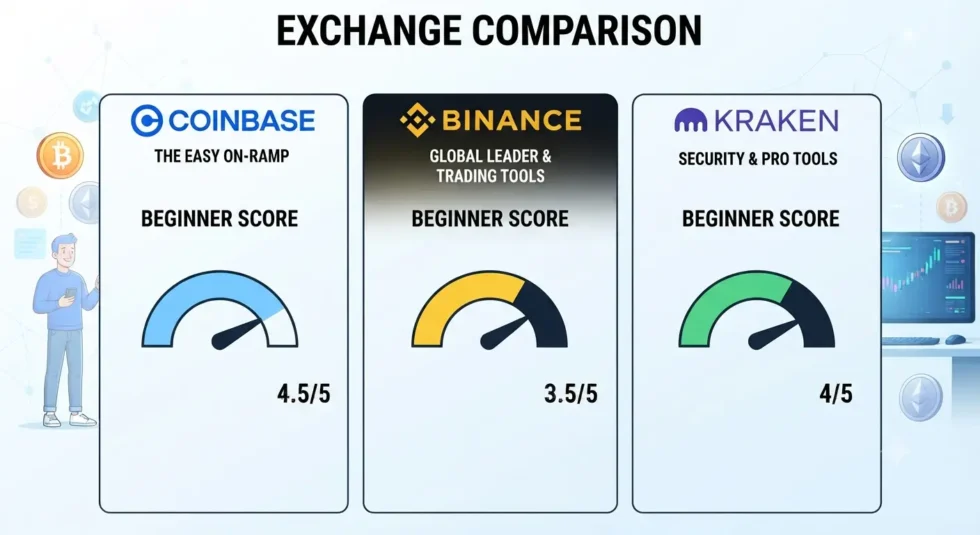
| Best for | First-time buyers who want simplicity and a US public-company track record | Cost-conscious traders who want the deepest liquidity and asset selection | Beginners who plan to grow into active trading without switching platforms |
| Beginner-tier trading fee | Up to 3.99% on card purchases via the simple app; 0.60%/0.80% maker/taker on Advanced Trade at low volume | 0.10% spot maker/taker (Binance.US: 0%/0.01%) | 1% flat + spread on Instant Buy; 0.25%/0.40% maker/taker on Kraken Pro |
| Major security breach | May 2025 customer-data breach via bribed support contractors ($180M–$400M in remediation costs disclosed) | May 2019 hack, $40M in Bitcoin stolen from a hot wallet | No confirmed customer-fund loss from a breach in 14+ years of operation |
| Regulatory posture | NASDAQ-listed (COIN); paid $100M NYDFS settlement in 2023 for AML program failures | Paid $4.3B in combined US settlements (DOJ, CFTC, FinCEN, OFAC) in 2023 for BSA and sanctions violations | SEC lawsuit dismissed with prejudice in March 2025; holds a Wyoming bank charter and MiCA authorization in the EU |
Trading Fees: What You’ll Actually Pay
Fee comparisons across crypto exchanges are usually misleading because each platform runs at least two pricing tiers: a simplified “beginner” interface with fees baked into a spread, and a professional order-book interface with transparent maker-taker pricing. The gap between the two is enormous, and it matters more for beginners than any other factor on this list, because beginners are the ones most likely to use the expensive default interface without realizing it.
Coinbase illustrates this best. The standard Coinbase app charges a spread of roughly 0.50% baked directly into the quoted price, on top of a separate transaction fee that can run from a flat $0.99 on very small purchases up to nearly 4% on larger ones. Paying with a linked debit card adds a further 3.99% charge. Stack those together and a several-hundred-dollar purchase on the default app can carry an effective cost between 2% and 4.5%. Switching to Coinbase Advanced Trade (its professional order-book product) drops this substantially: fees there run from 0.60% maker/0.80% taker under $10,000 in 30-day volume down toward 0.00% maker/0.04% taker for institutional-scale volume above $100 million a month. Coinbase also offers Coinbase One, a paid membership that waives standard-app trading fees up to a monthly cap and adds staking and insurance perks, but it does not eliminate the underlying spread.
Binance runs a much flatter and lower fee structure from the start. Standard spot trading fees are 0.10% for both maker and taker orders, with a further 25% discount available if you pay fees in BNB, Binance’s native token. Volume-based VIP tiers push this down to roughly 0.0083% maker / 0.017% taker at the very top, though that requires billions in monthly volume that no beginner will hit. US residents can’t use global Binance directly; they use Binance.US instead, which as of April 2026 overhauled its pricing to a flat 0% maker / 0.01% taker on core USD pairs like BTC/USD and ETH/USD, with no volume requirement — among the cheapest headline rates of any US-regulated exchange.
Kraken sits in between. Its simple “Instant Buy” flow, the default for new users, charges a flat 1% trading fee plus a spread — cheaper than Coinbase’s default app but still expensive for frequent buying. Kraken Pro, the same account on a different interface, uses a maker-taker schedule starting at 0.25% maker / 0.40% taker for balances or volume under $10,000, falling to 0.00% maker / 0.05% taker at the highest published tier. As of July 9, 2026, Kraken changed how tiers are calculated: your rate is now based on whichever is higher — your 30-day trading volume or the real-time USD value of assets you hold on the platform — so a beginner who deposits and holds a meaningful balance can qualify for a lower tier without needing to trade actively.
The practical takeaway: all three exchanges are dramatically cheaper once you move off their default “simple” interface. If fees are your main concern as a beginner, the actual comparison isn’t Coinbase vs. Binance vs. Kraken — it’s “am I using the beginner app or the pro interface,” because that choice affects your costs more than which exchange you picked.
Regulatory Status: A Genuinely Different Picture for Each
This is where the three platforms diverge the most, and it’s worth understanding in plain terms rather than marketing language.
Coinbase is a NASDAQ-listed public company (ticker: COIN), which means it publishes audited financials and is subject to SEC reporting requirements as a company, even though the legal status of individual crypto assets it lists remains a live regulatory question in the US. It holds a New York BitLicense and money transmitter licenses across most US states, plus a Virtual Currency Business License in Louisiana. In January 2023, Coinbase agreed to pay a $100 million settlement with the New York Department of Financial Services after a supervisory exam found deficiencies in its Bank Secrecy Act and anti-money-laundering program, its transaction monitoring, and a delayed report of a cybersecurity incident. That settlement is now several years old and doesn’t reflect an ongoing enforcement action, but it’s a material data point on the exchange’s compliance history.
Binance carries the heaviest regulatory history of the three by a wide margin. In November 2023, Binance and then-CEO Changpeng Zhao pleaded guilty to violations of the Bank Secrecy Act and the International Emergency Economic Powers Act. The combined resolution across the Department of Justice, the CFTC, FinCEN, and the Treasury’s Office of Foreign Assets Control totaled roughly $4.3 billion, covering criminal fines, forfeitures, and civil penalties for failing to register as a money-transmitting business, processing transactions tied to sanctioned jurisdictions, and knowingly allowing US customers onto an unregistered derivatives platform. Zhao personally paid a $150 million penalty and stepped down; Richard Teng, a former Singapore and Abu Dhabi financial regulator, has run the exchange since. The settlement installed a five-year independent compliance monitor with access to Binance’s books and systems. Binance now publishes quarterly proof-of-reserves attestations and, as of 2025, secured its first full Markets in Crypto-Assets (MiCA) authorization in the EU. For US beginners specifically, this history matters less in a direct sense, since US users interact with the separately regulated Binance.US entity, but it’s relevant context for anyone evaluating the parent company’s overall trustworthiness.
Kraken has the cleanest recent regulatory record of the three, though it wasn’t always guaranteed. The SEC sued Kraken in November 2023, alleging it operated as an unregistered securities exchange and commingled customer and corporate assets. That case was dismissed with prejudice in March 2025, following a broader shift in the SEC’s approach to crypto enforcement — meaning the same claims cannot be refiled. Separately, Kraken holds a Wyoming Special Purpose Depository Institution charter, making it the first digital-asset company in US history to receive a state bank charter, and it maintains a Federal Reserve master account. In the EU, Kraken holds MiCA authorization through the Central Bank of Ireland and a MiFID derivatives license through Cyprus’s CySEC — regulatory coverage the company points to as some of the deepest available to any crypto exchange in Europe. Kraken has also faced smaller regulatory actions, including an $8 million fine from Australia’s Federal Court in December 2024 over its margin-trading product’s design and distribution obligations.
Security Track Record: What’s Actually Been Verified
Marketing pages love the phrase “bank-level security.” What matters for a beginner is the platform’s actual incident history.
Coinbase had not suffered a hack resulting in stolen customer crypto since its 2012 founding — until May 2025, when the company disclosed that cybercriminals had bribed a group of overseas customer-service contractors to extract account data (names, addresses, partial account information) affecting under 1% of monthly active users. No passwords, private keys, or funds were directly exposed in the breach itself, but attackers then attempted to extort the company for $20 million, which Coinbase refused to pay, instead offering a $20 million bounty for information on the attackers. The company disclosed an expected $180–400 million in combined remediation costs and customer reimbursements. It’s a real breach, but a different category than a hot-wallet hack: no crypto was stolen directly off the platform.
Binance was hacked in May 2019, when attackers used phishing and other methods to compromise API keys and two-factor codes tied to a hot wallet, draining roughly 7,000 BTC (about $40 million at the time). Binance reimbursed affected users in full through its SAFU insurance fund. Separately, in 2022, the BNB Chain cross-chain bridge — infrastructure adjacent to but distinct from the Binance exchange itself — was exploited for roughly $570 million, one of the largest bridge hacks on record; that funds pool is a different system from Binance’s own custodial exchange wallets, but it’s frequently cited in exchange security comparisons because of the shared branding.
Kraken has no confirmed customer-fund loss from an external security breach across more than a decade of operation, and independent trackers of exchange hacks consistently list it as clean on this specific metric. Kraken did face one notable internal-security incident: in 2024, a security researcher exploited a bug that briefly allowed fraudulent withdrawals of close to $3 million from Kraken’s own treasury funds — not customer deposits — and then, according to Kraken’s Chief Security Officer, attempted to extort the company rather than disclose the flaw responsibly. No client assets were affected, and Kraken says it patched the vulnerability within about an hour of discovery. Kraken has published quarterly, independently verified proof-of-reserves audits since 2014, using a Merkle-tree method that lets individual users cryptographically verify their balance is included in the audited total — a transparency feature neither Coinbase nor Binance currently offers in the same form.
It’s worth noting that in May 2025, both Binance and Kraken were separately targeted by the same style of social-engineering attack that hit Coinbase — bribery attempts aimed at customer-support staff, reported by Bloomberg. Both exchanges say they blocked the attempts before any customer data was exposed.
Beginner Usability: Where Each Platform Actually Shines
Fees and security explain what you’ll pay and what’s at risk. Day-to-day usability explains whether you’ll actually stick with the platform.
- Coinbase has the gentlest onboarding of the three. Its default app is built for people who have never bought crypto before, with a simple buy/sell flow, built-in education (Coinbase Earn), and a debit-card option for instant purchases — at a real cost, as covered above. For a beginner who wants to buy $50 of Bitcoin without learning what a limit order is, Coinbase’s default experience is the least intimidating.
- Binance offers the widest asset selection and the deepest liquidity of the three globally, which matters once a beginner starts exploring beyond Bitcoin and Ethereum. Binance.US, the US-facing entity, is more limited in asset selection than global Binance but has become notably cheap on its core pairs. The tradeoff is a steeper learning curve if you go beyond the basic buy/sell screen — the full Binance interface is built for active traders first.
- Kraken positions itself as the platform you can grow into. Its default Instant Buy flow is beginner-friendly but not the cheapest, while Kraken Pro — the same account, a different tab — gives you the full maker-taker order book without requiring you to open a separate account or pass additional verification. For a beginner who expects to get more serious about trading within the first year, this removes a switching-cost problem the other two platforms don’t solve as cleanly.
Which Exchange Should a Beginner Actually Choose?
- Choose Coinbase if you want the simplest possible first purchase, value being on a regulated, NASDAQ-listed public company, and are willing to either accept the default app’s higher fees for convenience or learn Advanced Trade fairly quickly to avoid them.
- Choose Binance (or Binance.US if you’re in the US) if minimizing trading fees and maximizing asset selection matters more to you than a completely clean regulatory history, and you’re comfortable that the 2023 settlement reflects a resolved, monitored compliance program rather than an ongoing risk.
- Choose Kraken if you want the strongest combination of security track record and regulatory standing among the three, don’t mind a slightly less polished beginner interface, and want room to grow into active trading without migrating platforms later.
None of these are mutually exclusive — plenty of experienced users hold accounts on more than one exchange specifically to diversify counterparty risk, a strategy worth considering once you’re past your first few trades. For how these three stack up against the other nine platforms we track — including fee tiers at higher volumes, withdrawal speed benchmarks, and jurisdiction-by-jurisdiction compliance — see the full comparison in The Global Crypto Exchange Cost Map 2026, and for guidance based on your specific investor profile, visit Best Crypto Exchanges in 2026: Which Platform Offers the Best Value for Different Types of Investors?
Frequently Asked Questions
Is Coinbase, Binance, or Kraken safest for a first-time crypto buyer?
By pure breach history, Kraken has the cleanest record — no confirmed customer-fund loss from an external hack in over a decade. Coinbase’s 2025 breach exposed customer data but not funds or private keys directly. Binance’s 2019 hack resulted in stolen customer Bitcoin, which was fully reimbursed through its insurance fund.
Which exchange has the lowest fees for beginners?
On default “simple” interfaces, Binance.US is currently the cheapest at 0% maker / 0.01% taker on core pairs. On professional order-book interfaces, Binance’s base 0.10% and Kraken Pro’s tiered 0.25%/0.40% (falling with volume or holdings) both undercut Coinbase Advanced Trade’s 0.60%/0.80% starting tier.
Is Binance legal to use in the United States?
Global Binance does not serve US residents directly. US-based users access Binance.US, a separately operated, US-regulated entity with its own fee schedule and asset list.
Did Kraken ever get hacked?
No confirmed breach has resulted in the loss of customer funds at Kraken. A 2024 incident allowed a researcher to briefly withdraw close to $3 million from Kraken’s own treasury (not customer deposits) by exploiting a bug; Kraken says it was patched within about an hour and describes the researcher’s subsequent conduct as extortion rather than responsible disclosure.