Centralized vs Decentralized Exchanges: Which Is Better in 2026?
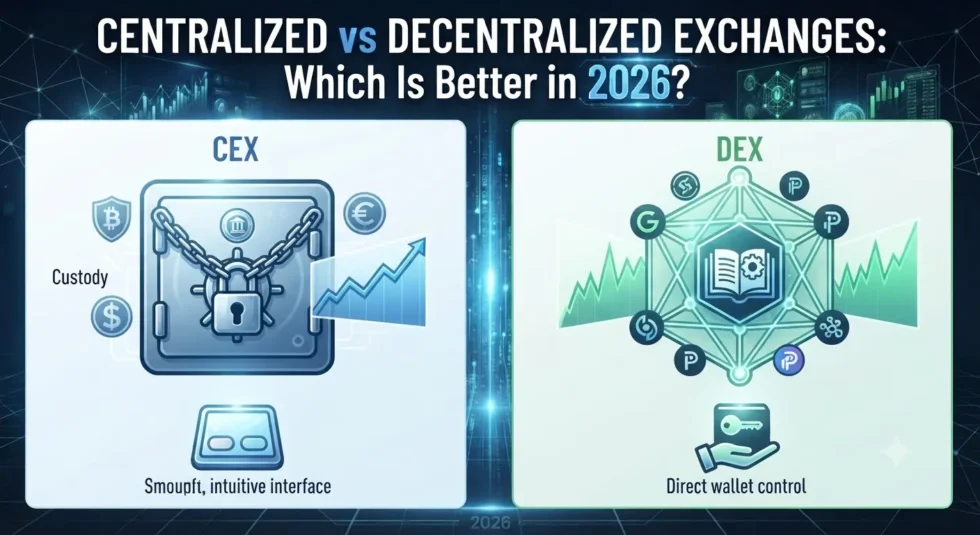
The honest answer is that they’re not competing for the same job. A centralized exchange (CEX) like Coinbase, Binance, or Kraken holds your funds, matches your trade against other users’ orders on an internal system, and gives you fiat on/off-ramps, customer support, and a recovery path if you lock yourself out. A decentralized exchange (DEX) like Uniswap or Hyperliquid never takes custody of your assets at all — you trade directly from your own wallet through a smart contract, with no company standing between you and the trade.
In 2026, that distinction still drives most of the practical differences: who gets hacked and how, what happens to your funds if the platform fails, how much you pay per trade, and how much regulatory protection — or regulatory exposure — you’re operating under. This article breaks down the actual 2026 numbers on each front rather than repeating the “DEXs are riskier but more free” cliché.
This piece is part of our exchange-research series. For the full comparison across 12 major centralized platforms, see our pillar guide, The Global Crypto Exchange Cost Map 2026. For how exchange choice should map to your specific goals as an investor, see Best Crypto Exchanges in 2026: Which Platform Offers the Best Value for Different Types of Investors? And if you’re evaluating platform safety more broadly, our companion guide, How to Choose a Safe Cryptocurrency Exchange Without Losing Your Funds, applies directly to the CEX side of this comparison.
The Market Share Reality: CEXs Still Dominate, But the Gap Is Closing
Centralized exchanges processed roughly 86% of global spot trading volume and about 90% of perpetual futures volume in Q1 2026, according to exchange-tracking data compiled across major analytics firms. That’s still clear dominance — but the trend line matters more than the snapshot. DEX spot market share has more than doubled over two years, from roughly 6.9% in January 2024 to around 13–14% by early 2026, with absolute DEX spot volume growing from about $96 billion to over $230 billion a month over the same period. On the derivatives side, the shift has been even sharper: DEX share of the perpetual futures market grew roughly fivefold in two years, from about 2% to just over 10%, driven largely by one platform, Hyperliquid, which posted $1.59 trillion in cumulative trading volume between August 2025 and January 2026 — enough to rank it among the ten largest perpetuals venues in the world, centralized or not.
Two DEXs, Uniswap and PancakeSwap, broke into the global top-10 spot exchange rankings by volume during that same window, each clearing over $500 billion in cumulative six-month volume — ahead of established centralized platforms like OKX, Coinbase, and Bitget on that specific measure. In other words, the “DEXs are a niche” framing is increasingly out of date at the platform level, even though centralized venues still carry the large majority of total dollar volume.
Fees: Cheaper on the Surface, More Variable in Practice
Centralized exchanges typically charge a flat percentage per trade, disclosed upfront: 0.10% maker/taker at Binance’s base tier, 0.16–0.60% depending on volume tier at Kraken and Coinbase, with no separate network fee since the trade never touches the blockchain until you withdraw.
Decentralized exchanges charge a protocol fee built into the pool — commonly 0.01% to 0.05% on stablecoin pairs and 0.30% to 1.00% on more volatile pairs — plus a separate gas fee paid to the underlying blockchain for every transaction, regardless of trade size. On Ethereum mainnet, that gas fee typically runs $1 to $5 per swap; on faster, cheaper chains like Base or Solana, it can fall under $0.05. This means the real cost of a DEX trade depends heavily on which chain you’re using, not just which protocol. A $50 swap on Ethereum mainnet, where gas can exceed the trade’s own fee several times over, is a fundamentally different cost proposition than the same swap on a low-fee Layer 2.
There’s a second, less visible DEX cost worth understanding: MEV (maximal extractable value). Because most DEX trades sit briefly in a public mempool before being confirmed on-chain, automated bots can detect a pending trade and “sandwich” it — buying ahead of it and selling immediately after — extracting value from the price movement your own trade causes. This isn’t a fee in the traditional sense, but it functions like one, and it’s specific to the DEX model; a centralized exchange’s internal matching engine has no equivalent public mempool to exploit. Traders who care about this route orders through private transaction channels (such as Flashbots Protect or MEV Blocker) rather than the public mempool, though most retail DEX users don’t do this by default.
Security: Two Completely Different Failure Modes
This is the comparison that matters most, and the data for 2026 is unusually clean because of one event: the February 2025 Bybit hack, in which attackers drained $1.4–1.5 billion from a centralized exchange’s cold-wallet infrastructure during a routine transfer — the largest single exchange hack in crypto’s history. That one incident accounted for roughly 71% of all centralized-exchange hack losses tracked over the following twelve months, with total CEX losses exceeding $2 billion in that window. By comparison, aggregate DEX exploit losses over a comparable period were smaller, with the largest single DEX exploit around $223 million — typically the result of a smart contract vulnerability or price-oracle manipulation rather than a stolen private key.
That comparison tells you the two models fail differently, not that one is categorically safer:
- CEX risk is custodial. Your funds sit in the exchange’s wallets, which means you’re exposed to whatever happens to those wallets — hot-wallet hacks, insider fraud, or, as with FTX, outright misuse of customer deposits by the company itself. The protection is that reputable exchanges maintain cold storage, insurance funds, and increasingly, regulatory oversight and audited reserves. The risk is concentrated in a single counterparty.
- DEX risk is technical and self-inflicted. Because you hold your own keys, no exchange can lose your funds in a custodial hack or go bankrupt with your deposits on its balance sheet. But you take on smart contract risk (a bug or exploit in the protocol’s code can drain a liquidity pool), approval risk (granting a malicious contract permission to move your tokens is one of the most common ways DEX users actually lose funds), and the total absence of a support line if you send funds to the wrong address or interact with a fraudulent pool. There is no customer service to call.
Neither model has “solved” security. A DEX user who reuses a compromised wallet, signs a malicious approval, or trades on a copycat contract impersonating a real token can lose funds just as completely as a CEX user whose exchange gets hacked — the difference is that the point of failure moves from the platform to the individual.
Regulation: The Gap Has Narrowed, But Isn’t Closed
For most of 2023 and 2024, DEXs occupied a genuinely uncertain regulatory position in the US. That changed materially in February 2025, when the SEC closed its investigation into Uniswap Labs — the developer of the largest DEX in the world — without filing any enforcement action, following a Wells notice issued in April 2024 that had alleged Uniswap operated as an unregistered securities exchange and broker. The closure came in the same week the agency dropped or paused several other crypto enforcement actions, including against Coinbase and Robinhood, reflecting a broader shift in the SEC’s posture that year. Legal commentators have noted the outcome may reflect Uniswap’s specifically non-custodial structure: unlike a centralized exchange, Uniswap Labs doesn’t hold user funds, match orders through a centralized system, or control which trades can occur on its underlying smart contracts — factors that make the traditional “exchange” and “broker” definitions harder to apply.
That said, DEXs aren’t regulation-free. Protocols themselves remain permissionless and typically don’t require identity verification (KYC) to trade, which is precisely what makes them attractive to some users and legally uncertain in aggregate. In the EU, MiCA’s July 2026 enforcement deadline applies most directly to centralized, custodial service providers (CASPs); pure DEX protocols sit in a comparatively less-defined space, though the fiat on/off-ramps and interfaces built around them can still fall under scrutiny. And regulatory risk isn’t limited to the exchange layer — the 2022 US sanctioning of the Tornado Cash smart contract (a privacy protocol, not an exchange, but a comparable “immutable code” precedent) showed regulators are willing to act against decentralized software itself in cases involving alleged money laundering, even when no company controls it.
The practical read for 2026: trading on a major DEX like Uniswap carries meaningfully less acute regulatory overhang than it did two years ago, but “decentralized” doesn’t mean “outside all regulatory reach” — it means the enforcement mechanisms and targets look different.
Custody: The One Difference That Doesn’t Depend on the Platform’s Quality
This is worth isolating because it’s the single clearest, least debatable distinction between the two models. On a CEX, you don’t hold your private keys — the exchange does, on your behalf, which is what makes it a custodial platform. This is convenient (password recovery, no seed phrase to lose, easy fiat conversion) but means your assets are only as safe as the exchange’s solvency and security practices, regardless of how good those practices are on any given day. On a DEX, you connect your own wallet and retain your private keys throughout the trade. No exchange failure, freeze, or bankruptcy can take those assets from you — but there’s also no password reset if you lose your seed phrase, and no support ticket if you send funds to a scam contract.
This is why serious evaluations of exchange safety (see our full framework in How to Choose a Safe Cryptocurrency Exchange Without Losing Your Funds) treat self-custody as the one protection that removes counterparty risk entirely — and it’s also the core reason DEXs exist as a category in the first place.
Which Should You Actually Use in 2026?
- Choose a CEX if: you’re new to crypto, need to convert between fiat currency and crypto, want customer support and account recovery options, plan to trade with advanced order types (stop-loss, margin, options), or are trading amounts where a 0.1–0.6% fee matters less than the safety net of a regulated, audited counterparty.
- Choose a DEX if: you already hold crypto and want to swap between tokens without ever giving up custody, need access to a long-tail token that hasn’t been listed on any centralized exchange (DEXs like Uniswap have listed over 13 million tokens versus the low hundreds most CEXs list), or specifically want to avoid identity verification requirements.
- Use both, deliberately: the most common pattern among experienced crypto users in 2026 is a hybrid one — buying crypto with fiat on a regulated CEX, then moving a portion into self-custody and using a DEX for on-chain swaps, yield strategies, or access to newer tokens. This mirrors the general safety principle of not concentrating all your holdings with a single counterparty, whether that counterparty is a company or a piece of smart contract code.
Frequently Asked Questions
Are decentralized exchanges safer than centralized exchanges?
Neither is categorically safer — they fail in different ways. CEXs concentrate risk in a single custodian (hot-wallet hacks, insolvency, insider fraud); the February 2025 Bybit hack alone accounted for the majority of all centralized-exchange losses over the following year. DEXs eliminate custodial risk but expose users to smart contract bugs, approval scams, and the complete absence of a support line if something goes wrong.
Do I need to complete KYC (identity verification) to use a DEX?
Generally no — DEX protocols themselves are typically permissionless and don’t require identity verification, since you’re trading directly from your own wallet rather than opening an account with a company. This is a core structural difference from centralized exchanges, which are legally required to verify identity in most jurisdictions.
Is Uniswap legal in the United States?
Yes. The SEC closed its multi-year investigation into Uniswap Labs in February 2025 without filing any enforcement action, following a Wells notice issued the prior year. This doesn’t mean DeFi is entirely free of regulatory risk going forward, but it removed the most direct legal threat the largest DEX had faced.
Why are DEX trading fees sometimes higher than advertised?
The protocol fee (often 0.01–1%) is only part of the cost. You also pay a separate blockchain gas fee for every transaction, which varies enormously by network — a few dollars on Ethereum mainnet versus fractions of a cent on some Layer 2s — and can exceed the protocol fee itself on smaller trades.