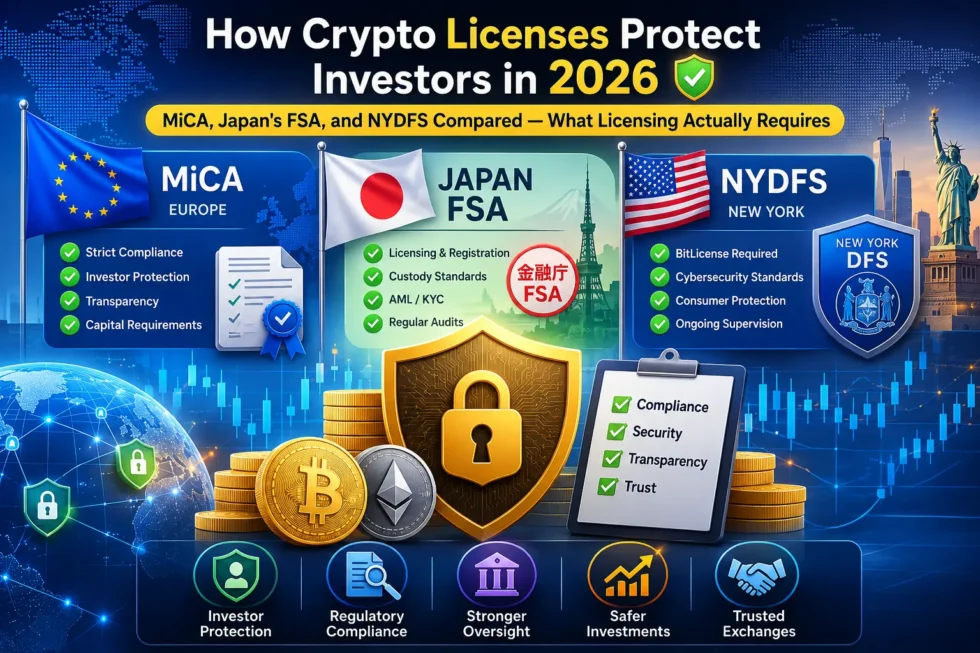
How Crypto Licenses Protect Investors: MiCA, Japans FSA, and NYDFS Compared What Licensing Actually Requires
Why licensing deserves its own explanation
Our pillar guide, The Global Crypto Exchange Cost Map 2026: 12 Trusted Platforms Compared by Trading Fees, Liquidity, Security, Withdrawal Speed & Regulatory Compliance, scores each of the 12 platforms on regulatory compliance as one weighted factor. This article unpacks what that score actually represents — not “regulated: yes/no,” but a specific bundle of enforceable rules that either exist or don’t, and either get audited or don’t.
It complements Crypto Exchange Regulations Around the World: What Investors Need to Know in 2026, which maps the global jurisdictional landscape, and Are Offshore Crypto Exchanges Safe?, which showed that licensing quality varies enormously even among nominally “regulated” jurisdictions. This piece goes one level deeper: what specific mechanisms in a real license are doing the protective work, and what evidence do we have that they actually work.
The four protective mechanisms, and the failures that created each one
Every meaningful crypto license bundles the same four investor-protection mechanisms, in different combinations. Each one exists because a specific, documented failure showed what happens without it.
1. Client asset segregation — the direct answer to FTX
<cite index=”21-1″>Asset segregation is probably the most tangible protection change of the last several years. The absence of this separation caused billions in losses during the FTX collapse in November 2022, when client funds were commingled with those of Alameda Research</cite>. As covered in our offshore exchange safety article, <cite index=”64-1″>FTX customer funds were used for venture investments, real estate, political donations, and to cover Alameda’s trading losses</cite> — all of which should have been structurally blocked if the exchange were required to keep client assets legally separate from its own operating capital.
Under MiCA, this is now a specific, auditable rule rather than a promise: <cite index=”24-1″>if a CASP receives client fiat, it must place it with an EU credit institution or central bank by the end of the next business day, and must never use client assets for its own account</cite>. <cite index=”28-1″>Client crypto-assets have to be held separately from the CASP’s own assets, recorded on a register, and reconciled daily</cite> — and <cite index=”28-1″>if client assets are lost through operational failure, the CASP is liable</cite>. <cite index=”21-1″>MiCA makes a FTX-style scenario structurally less likely in the EU</cite>, precisely because daily reconciliation would surface a shortfall long before it reached FTX’s scale.
Japan built the same protection into its rules a decade earlier, following its own version of this failure. <cite index=”34-1″>After the 2014 Mt. Gox collapse, Japan implemented Payment Services Act amendments in 2017, establishing the world’s first comprehensive cryptocurrency exchange licensing regime. The 2018 Coincheck hack, which resulted in approximately $530 million in losses, revealed remaining vulnerabilities, prompting further regulatory enhancements throughout 2019–2023, including stricter capital requirements and improved segregation of customer funds</cite>.
2. Cold-storage and custody minimums — the direct answer to hot-wallet hacks
<cite index=”37-1″>After the Coincheck hack in 2018, Japan’s FSA now requires exchanges to keep at least 95% of user assets in cold wallets — an offline storage system that’s airtight is a precondition for getting a license at all</cite>. This is a mechanical, checkable rule, not a governance aspiration: a regulator can walk into a licensed exchange and verify what percentage of assets sit in cold storage versus hot wallets.
This rule has a measurable track record. <cite index=”31-1″>Since 2017, Japan has shut down over 15 unlicensed exchanges, and there have been zero major hacks of properly registered platforms, with no customer fund losses from exchange failures</cite> — a claim worth treating with appropriate skepticism as a single source’s framing, but one consistent with the fact that Japan’s major post-2018 breaches — <cite index=”36-1″>DMM Bitcoin’s loss of $305 million (48.2 billion yen) in May 2024</cite> — <cite index=”32-1″>traced back to a third-party vendor (Ginco) that DMM had outsourced trading management to, not a failure of the cold-storage rule itself</cite>. That distinction matters: it shows custody rules protect against direct custodial theft specifically, not against every category of operational risk, including vendor and supply-chain compromise — the same category of attack that hit Bybit in 2025, discussed in our KYC vs. Anonymous Crypto Exchanges article.
Japan’s response to the DMM gap illustrates how licensing regimes evolve reactively: <cite index=”32-1″>the FSA is now planning to require local exchanges to establish dedicated liability reserves for incidents such as hacks — something not previously mandated even though cold-wallet storage was — with a bill expected in the 2026 Diet session</cite>. <cite index=”34-1″>A separate 2025 FSA policy update now mandates improved cold storage protocols, regular penetration testing, real-time monitoring systems, and mandatory cybersecurity insurance, with exchanges required to submit compliance plans within 90 days</cite>.
3. Minimum capital requirements — the buffer for insolvency, not just theft
Capital requirements exist to ensure an exchange has enough of its own money at stake, and enough of a financial cushion, that a bad quarter or a partial loss doesn’t cascade into a full customer-fund shortfall. The tiers vary by activity risk:
| Jurisdiction | Regulator | Minimum capital | Tied to activity |
|---|---|---|---|
| EU (MiCA) | National regulators / ESMA | <cite index=”27-1″>€50,000 for advisory/execution, €125,000 for exchange/custody, €150,000 for operating a trading platform</cite> | <cite index=”27-1″>Per Article 111, penalties for operating without authorization reach €5,000,000 for individuals or 12.5% of annual turnover for legal entities</cite> |
| Japan | FSA | <cite index=”37-1″>Minimum 10 million yen (~$68,000), plus a requirement of positive net assets</cite> | Baseline registration; capital scrutiny increases with scale |
| Singapore | MAS | <cite index=”8-1″>SGD 250,000 for Major Payment Institution (MPI) status</cite> | Higher for larger payment volumes |
| Hong Kong | SFC | <cite index=”8-1″>HKD 5 million paid-up plus HKD 3 million liquid capital for VATP license</cite> | Applies to virtual asset trading platforms specifically |
| Cayman Islands / BVI | CIMA / FSC | <cite index=”8-1″>No statutory minimum</cite> | Case-by-case risk assessment instead of a fixed floor |
The gap between “no statutory minimum” and a six-figure hard floor is not a technicality — it’s the difference between a regulator that can force a wind-down before a shortfall becomes public and one that has no capital trigger to act on until it’s too late.
4. Disclosure, complaint-handling, and audit obligations — the mechanism that surfaces problems early
The other three protections are structural; this one is procedural, and it’s what makes the others enforceable rather than theoretical. <cite index=”20-1″>CASPs must follow conduct-of-business rules and put safeguards in place for market integrity, customer disclosures, and complaint handling</cite>. <cite index=”22-1″>Once the July 2026 deadline passes, CASPs must maintain ongoing compliance including regular submission of detailed transaction and trading volume reports, prompt reporting of security incidents, and comprehensive documentation of all compliance activities</cite>. <cite index=”21-1″>Every CASP must implement an accessible, documented complaint-handling process, and platforms are prohibited from trading against their own clients without strict controls</cite>.
<cite index=”24-1″>Trading platforms must monitor for market abuse, keep complete order and traceability records, and publish pre- and post-trade data in near real-time, kept available for two years</cite>. This is the layer that, applied at FTX, would have made an $8 billion shortfall visible to regulators well before a bank-run scenario forced disclosure.
Side-by-side: what each major license actually mandates
| Requirement | MiCA (EU) | Japan FSA | NYDFS BitLicense (US, NY state) |
|---|---|---|---|
| Client asset segregation | <cite index=”28-1″>Mandatory; daily reconciliation, liability for losses from operational failure</cite> | <cite index=”34-1″>Mandatory since post-Coincheck reforms (2019–2023)</cite> | Required under NY trust/custody rules |
| Cold storage minimum | Not a fixed percentage; custody security is assessed under governance/DORA requirements | <cite index=”37-1″>95% of user assets in cold wallets, mandatory precondition for licensing</cite> | Custody standards enforced case-by-case via exam |
| Minimum capital | <cite index=”27-1″>€50,000–€150,000 depending on service tier</cite> | <cite index=”37-1″>¥10 million (~$68,000) plus positive net assets</cite> | Case-by-case, tied to bonding/trust requirements |
| Liability reserve for hacks | Not a separate line item; covered under own-funds and segregation rules | <cite index=”32-1″>Newly proposed (2026 bill) — not previously mandated despite cold-storage rule</cite> | Not a uniform statutory requirement |
| Passporting / single-market access | <cite index=”20-1″>Yes — one CASP authorization covers all 27 EU member states</cite> | No — Japan-only | No — New York only; other US states require separate money-transmitter licenses |
| Enforcement penalty for operating unlicensed | <cite index=”27-1″>Up to €5,000,000 (individuals) or 12.5% of annual turnover (legal entities)</cite> | <cite index=”31-1″>License revocation; over 100 unqualified applicants rejected since 2017</cite> | Civil and criminal enforcement under NY Financial Services Law |
What licensing does not protect against
It’s worth being precise here, because overclaiming licensing’s protective scope is as misleading as dismissing it. The record shows three gaps clearly:
It doesn’t prevent third-party vendor compromise. <cite index=”32-1″>DMM Bitcoin met Japan’s cold-storage requirement and was still drained of roughly $305 million because the breach originated at an outsourced trading-management vendor</cite>, not at DMM’s own custody layer. A license regulates the entity holding the primary custodial relationship with the customer; it doesn’t automatically extend the same rigor to every vendor in that entity’s supply chain unless the license explicitly requires vendor oversight — which is exactly the gap Japan’s 2026 reforms are now trying to close.
It doesn’t prevent state-sponsored or sophisticated supply-chain attacks against fully compliant platforms. As detailed in our KYC vs. Anonymous article, Bybit — a licensed, KYC-compliant exchange — lost $1.5 billion to a signing-infrastructure compromise in February 2025. Licensing regimes mandate governance and custody processes; they cannot by themselves defeat a sufficiently sophisticated attacker who compromises the humans or software authorizing a transaction.
It offers weaker protection during transition periods. <cite index=”19-1″>During MiCA’s transitional phase, crypto holders have had limited protections, with National Competent Authorities primarily focused on existing AML regulations rather than the full CASP rulebook</cite>, and <cite index=”25-1″>this “mix of regimes” coexisting across member states may result in disparate levels of protection for consumers</cite> until the July 1, 2026 deadline fully closes the gap. A license granted under a grandfathering clause is not necessarily equivalent, in practice, to one issued under the full post-deadline regime.
What this means when you’re actually choosing a platform
A license is doing real protective work when it includes, at minimum: enforced client-asset segregation with regular reconciliation, a cold-storage minimum you can verify (not just claim), a capital floor large enough to absorb a partial shortfall without immediate insolvency, and a track record of the regulator actually enforcing these rules rather than just publishing them. Japan’s regime scores highest on the custody-specific metric — <cite index=”37-1″>a hard 95% cold-storage floor</cite> is unusually concrete compared to most frameworks’ governance-based language. MiCA scores highest on breadth and single-market reach — <cite index=”20-1″>one authorization covering all 27 EU states</cite> — plus the most detailed disclosure and segregation rules currently in force anywhere. Neither is complete on its own, which is why the practical answer, cross-referenced with our offshore safety and KYC vs. anonymous articles, is the same: check what the specific license requires, not just whether one exists, and treat licensing as reducing — not eliminating — the risk categories it’s actually designed to address.
For the full jurisdiction-by-jurisdiction rules referenced throughout this piece, see Crypto Exchange Regulations Around the World: What Investors Need to Know in 2026, and for how regulatory compliance weighs against fees, liquidity, and security across specific platforms, see the Global Crypto Exchange Cost Map 2026.