Copy Trading Platforms Compared Real Profit Share Rates, Regulatory Limits and Security Records on Binance, Bybit, OKX and Bitget July 2026
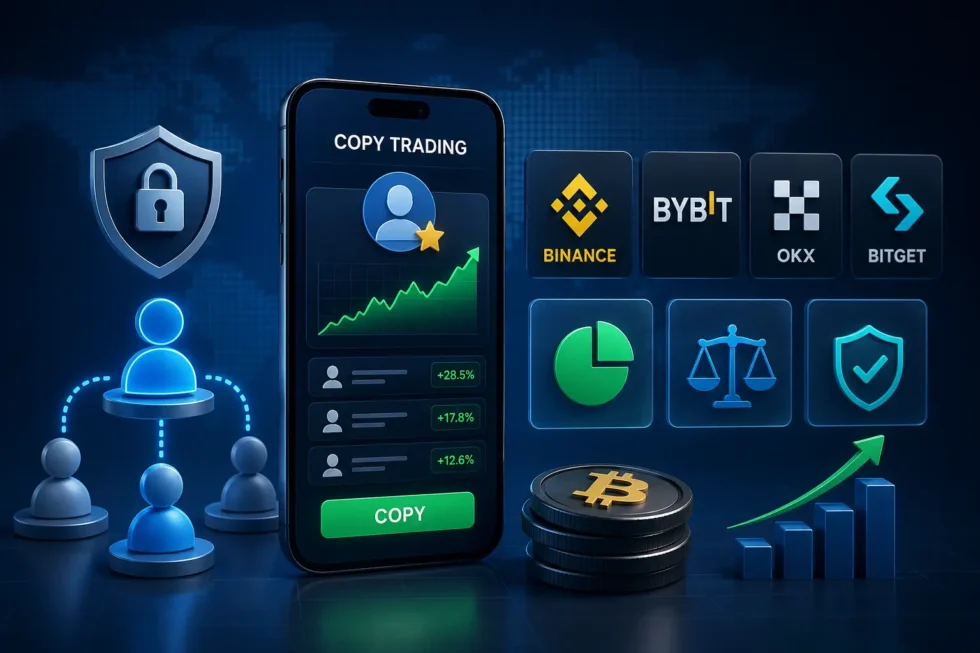
Copy trading lets you mirror another trader’s positions in your own account, in real time, without placing the orders yourself. It’s marketed as a shortcut to expert-level returns. In practice, it’s a fee structure wrapped around someone else’s risk-taking — and the platform you pick determines how much of your profit that structure actually keeps.
This guide compares the mechanics that matter: what each platform actually charges (not the headline “free to copy” claim), where copy trading is legally unavailable, and what each exchange’s security and regulatory record looks like. Figures are pulled from each exchange’s own help-center documentation and fee schedules as of mid-2026; profit-share rates in particular are set per-trader within a platform’s allowed range, so treat the ranges below as what you’ll actually see on a leaderboard, not a single fixed number.
This article is part of our Advanced Crypto Trading Features Explained for Serious Investors cluster, which breaks down leverage, derivatives, and order types for traders moving past simple spot buying. For the full side-by-side on trading fees, liquidity, security, withdrawal speed, and regulatory compliance across all twelve platforms, see our pillar guide, The Global Crypto Exchange Cost Map 2026: 12 Trusted Platforms Compared.
How Copy Trading Fees Actually Work
Every platform in this comparison charges the same two layers, just in different proportions:
- Standard trading fees on every order your account mirrors — the same maker/taker rate (and, on futures, the same funding-rate exposure) you’d pay placing the trade yourself. Copying doesn’t add a markup here, but it doesn’t waive the fee either.
- A profit share paid to the lead trader — a percentage of your net realized profit only. If the trade loses money, no profit share is owed; you still ate the trading fees and the loss itself.
The profit share is where platforms actually differentiate, because it’s set per-trader (often tiered by the trader’s own rank or volume) rather than fixed platform-wide. That means the same exchange can cost you 5% on one leader and 20% on another — the number that matters is the one shown on the specific trader’s profile before you copy, not the exchange’s advertised range.
Fee Comparison by Platform
Binance
Binance charges standard spot fees (0.1%, down to 0.075% paying in BNB) or futures fees (0.02%/0.05%) on every copied trade, with no separate copy-trading subscription. On top of that, lead traders take a profit share: 10% on spot copy trading, plus a further 10% commission on the trading fees you generate, while futures profit share is tiered up to 30% depending on the lead trader’s rank — the highest ceiling of the four platforms compared here. A $1,000 profitable spot copy that nets 20% ($200 profit) costs roughly $20 to the lead trader under the spot model; the same profit run through a top-tier futures leader could cost up to $60. Binance’s copy trading product is not available to Binance.US customers, and access has been paused for some EEA users during MiCA-compliance transitions.
Bybit
Bybit runs three separate copy products with different fee mechanics: Classic (live perpetual/futures mirroring, weekly settlement cycle, profit share tiered roughly 10%–15% by Master Trader rank), Pro (a fund-like structure where you buy “shares” of a strategy and pay profit share on redemption via NAV, rate set by the Pro Master), and a TradFi copy product routed through MT5. Classic settles weekly — net P&L is calculated Saturday to Friday, with profit share pre-deducted daily and finalized the following Monday, and only if all same-day positions have closed; losing weeks return the pre-deducted amount in full. Standard VIP-tier trading fees and funding rates apply on top; there’s no separate copy-trading surcharge.
OKX
OKX prices copy trading the most simply of the four: standard trading fees for your tier, plus a profit share of roughly 8%–13%, set by the individual lead trader’s level and shown on their profile. There’s no separate copy fee beyond that. OKX’s own documentation lists a long roster of jurisdictions where copy trading is unavailable, including Hong Kong, Singapore, Malaysia, the UK, Canada, and the United States — a notably longer restricted list than its spot trading availability, because copy trading (mirroring another party’s investment decisions) draws its own regulatory classification in several of those markets.
Bitget
Bitget is the copy trading market leader by roster size — independent trader counts put it well ahead of Bybit and OKX on verified lead-trader history — and runs three copy formats: spot, futures, and bot copy. Spot profit share is typically 5%–10%, capped at 10% for most elite traders; futures profit share is tiered up to roughly 20% by trader class; bot copy uses a flat rate the bot’s creator sets at 0%, 10%, 20%, or 30%. Standard spot (0.1%, discountable to 0.08% with BGB) and futures (0.02%/0.06%) trading fees apply on top of the profit share, same as every platform here. Bitget maintains a Protection Fund reported above $300 million and publishes monthly proof-of-reserves snapshots, but like OKX and Bybit, it has no U.S.-licensed retail entity offering copy trading — American traders are excluded from the core product entirely, not just rate-limited.
Regulatory Status: Why Copy Trading Gets Blocked More Than Spot Trading
Copy trading occupies an odd regulatory space. Simply buying and selling crypto is generally treated as a commodity transaction in most jurisdictions; automatically mirroring another individual’s investment decisions starts to resemble unlicensed portfolio management or investment advice, which is regulated far more heavily. That’s why the restricted-jurisdiction lists for copy trading are consistently longer than the restricted lists for spot trading on the same exchanges:
- None of the four platforms compared here — Binance, Bybit, OKX, or Bitget — offers copy trading to U.S. retail users, even where the same exchange offers some form of spot or limited derivatives access domestically.
- Regulators have started treating this as a distinct risk category rather than an extension of ordinary trading: the European Securities and Markets Authority published a supervisory briefing on copy trading’s investor-protection risks in 2023, and IOSCO issued its own guidance on “online imitative trading” in 2024 — both aimed specifically at the practice of automatically replicating another person’s trades, separate from crypto-specific rulemaking.
- OKX’s own FAQ lists Malaysia and the UK as blocked for copy trading specifically, both markets where the exchange has faced broader regulatory friction.
- Binance’s copy trading access for EEA users has been affected by the same MiCA-compliance transition that has reshaped its broader European product line since 2025.
If you’re evaluating copy trading specifically — as opposed to spot or margin trading on the same exchange — check that product’s own jurisdiction list, not just the exchange’s general terms of service. They are not always the same list.
Security and Track Record
Copy trading inherits the custody risk of the underlying exchange, since your capital sits in that exchange’s account structure while a strategy is active — the same considerations covered in more depth in our Margin Trading Explained article apply here. A quick summary relevant to the four platforms above:
- Bybit disclosed a $1.4–1.5 billion cold-wallet breach in February 2025, later attributed with high confidence to North Korea’s Lazarus Group. Withdrawals stayed open throughout, and a subsequent Hacken audit confirmed reserves were fully restored. Independent forensic reports concluded the exploit originated in a compromised third-party wallet interface rather than Bybit’s own infrastructure. Any capital allocated to active copy trades on Bybit during a comparable future incident would carry the same exposure as any other balance on the platform.
- OKX re-entered the U.S. market in April 2025 after a $505 million settlement with the U.S. Department of Justice tied to compliance failures, not a theft of user funds; it holds the first full MiCA license issued to a global exchange, from Malta’s MFSA.
- Bitget has no reported exchange-level hack of user funds since its 2018 founding and publishes recurring proof-of-reserves snapshots alongside its Protection Fund, though independent reserve claims should be read as periodic snapshots, not continuous guarantees.
- Binance maintains SAFU, an insurance reserve funded from trading fees, and has not suffered a major exchange-level breach in recent years, though it paid over $4 billion in U.S. settlements in 2023 tied to compliance and sanctions violations rather than a hack.
None of this ranks the platforms — it’s context for weighing “biggest lead-trader roster” against “how has this platform behaved when something went wrong.”
Practical Rules Before You Copy
- Read the profit-share rate on the specific trader’s profile, not the platform’s advertised range. A 5% Bitget spot leader and a 20% Bitget futures leader are both “Bitget copy trading,” with very different economics.
- Model trading fees and funding drag into your breakeven, separately from the profit share. A leveraged futures copy carried through a sustained funding period can lose money on fees alone even if the underlying trade is directionally right.
- Check the settlement mechanics, not just the rate. Bybit’s Classic model pre-deducts and settles weekly with same-day-close requirements; understand when you’re actually paid out or charged before assuming a rate applies instantly per trade.
- Verify copy trading is legally available in your jurisdiction on that specific product — not just that the exchange operates where you live. All four platforms compared here exclude U.S. retail copy trading even where other products remain accessible.
- Filter leaders by track record length and drawdown, not headline ROI. Across independent samples on these platforms, well under half of listed leaders stay net-positive over a rolling six-to-twelve-month window; a strong 30-day return says little about a leader’s risk discipline in a drawdown.
Where to Go Next
For the full twelve-platform comparison on trading fees, liquidity, security, withdrawal speed, and regulatory compliance, see The Global Crypto Exchange Cost Map 2026. If leverage and borrowed capital are part of your strategy alongside copy trading, our companion piece, Margin Trading Explained, covers real fee schedules and security records for margin specifically. Both sit within the broader Advanced Crypto Trading Features Explained for Serious Investors cluster.