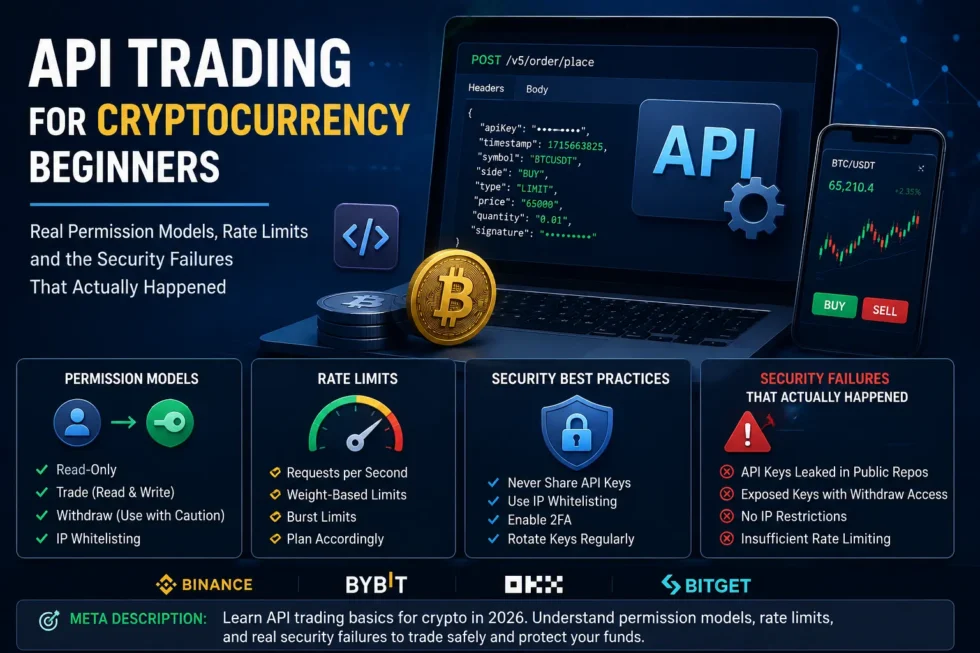
API Trading for Cryptocurrency Beginners Real Permission Models, Rate Limits and the Security Failures That Actually Happened
API trading means letting a program — a bot, a script, or a third-party tool — place orders on an exchange on your behalf, using a key instead of your login. It’s the backbone of every trading bot, copy-trading engine, and portfolio tracker in crypto. It’s also the single most common way retail traders have actually lost money to something other than a bad trade: a leaked or over-permissioned API key.
This guide covers what beginners need before generating their first key: how the fee structure actually works (spoiler — there usually isn’t a separate one), what permission models the major exchanges offer, and a real incident that shows exactly what goes wrong when those permissions aren’t set correctly.
This article is part of our Advanced Crypto Trading Features Explained for Serious Investors cluster, which breaks down leverage, derivatives, and automated tools for traders moving past the standard buy/sell interface. For the full comparison of trading fees, liquidity, security, withdrawal speed, and regulatory compliance across twelve exchanges, see our pillar guide, The Global Crypto Exchange Cost Map 2026: 12 Trusted Platforms Compared.
API Trading Doesn’t Have Its Own Fee Structure
This is the first thing to understand and the thing most beginner guides skip: placing a trade via API costs exactly what placing it manually costs. There is no API surcharge and, on the major exchanges, no API discount either. Binance’s own documentation confirms that trades executed via the API endpoint are billed at the same maker/taker rate as the same trade placed through the web interface — 0.1% base spot, down to 0.075% with the BNB discount, or the applicable futures rate, depending on your VIP tier. Kraken and Coinbase follow the same principle: the fee schedule is tied to your account tier and 30-day volume, not to which interface generated the order.
What does change with API trading is volume and frequency. A bot placing hundreds of orders a day accumulates the standard per-trade fee hundreds of times over, which is why high-frequency API strategies live or die on reaching lower VIP tiers, not on finding some hidden API rate. If your strategy depends on tight margins, the fee math to run is the same volume-tier math covered in our margin trading and copy trading breakdowns — just multiplied by trade frequency.
Rate Limits: The Cost Beginners Don’t See Coming
Every major exchange enforces rate limits on API requests, separate from account fees, and exceeding them doesn’t cost money — it gets your key temporarily or permanently blocked. Binance uses a weight-based system rather than a simple requests-per-second count: each endpoint carries a “weight,” and exceeding the rolling weight limit returns an HTTP 429 error with a retryAfter field telling you when you can resume. Order-placement limits are tracked separately and are shared across every API key tied to the same account — so running multiple bots under one account can throttle all of them simultaneously if you’re not tracking cumulative usage. Beginners building their first bot should implement exponential backoff (waiting progressively longer between retries after a failure) rather than hammering a rate-limited endpoint, which is the single most common cause of a bot “randomly” stopping mid-strategy.
Permission Models: What Every Exchange Lets You Restrict
This is the part that actually prevents losses, and every major exchange implements a version of the same idea: an API key can be scoped down to only the actions it needs.
- Binance lets you enable read access, spot trading, margin trading, and futures trading independently, and separately toggle withdrawal permission — which requires IP whitelisting to activate at all. A key with no IP restriction configured automatically expires after 30 days, a safeguard specifically aimed at forgotten or abandoned keys.
- Kraken breaks permissions into granular categories — Query Funds, Deposit Funds, Withdraw Funds, Query Open/Closed Orders, Modify Orders, Cancel/Close Orders — and its own documentation gives the canonical example: a key handed to a third-party bot should get Modify Orders and Cancel/Close Orders, probably Query Open Orders, and almost certainly not Withdraw Funds. Kraken also supports a separate 2FA layer specifically for API key access, distinct from login and withdrawal 2FA, so compromising one factor doesn’t automatically compromise the others.
- Coinbase and other major platforms follow the same read/trade/transfer separation, and industry practice — recommended explicitly in Kraken’s own developer documentation — is to use separate keys per purpose: a read-only key for a market-data or portfolio-tracking tool, a trade-only key (no withdrawal) for a bot, and IP-restricted access for anything with elevated permissions. If one key leaks, the damage is contained to whatever that specific key could do.
The rule that matters most for a beginner: a bot that only needs to place and cancel orders never needs withdrawal permission. Every dollar of loss in the incident below traces back to that permission being available when it didn’t need to be.
What Actually Goes Wrong: The 3Commas API Leak
In late 2022, the third-party trading-bot platform 3Commas — used to connect automated strategies to Binance, KuCoin, and other exchanges via API keys — suffered a breach that exposed roughly 100,000 user API keys. An anonymous account published a portion of the database in December 2022, and 3Commas, after weeks of denying any security failure, confirmed the leak was genuine once Binance CEO Changpeng Zhao publicly urged users to revoke any key ever connected to the platform. Blockchain investigator ZachXBT independently verified more than 80 confirmed victims across multiple exchanges, with total documented losses estimated in the tens of millions of dollars; Binance users made up the largest share of confirmed cases.
Trading Leak
The mechanism is the part beginners should actually absorb: attackers didn’t hack Binance, KuCoin, or Coinbase directly. They obtained API keys that users had granted to a third-party platform, and those keys — many of which had been left with permissions broader than necessary — were then used to place manipulative trades on illiquid altcoin pairs, generating losses for the key owners. Several affected users had created the keys long before the incident, assumed they’d been deleted, and hadn’t checked. Exchanges including Binance largely declined to reimburse affected users on the grounds that the keys had been generated and authorized by the account holder — a decision that underscores a point worth internalizing: when you grant a third-party service API access, you are extending your own account’s trust boundary to that service’s security practices, not just the exchange’s.
The practical lessons that trace directly back to this incident:
- Delete API keys you’re not actively using. Several 3Commas victims had forgotten keys from tools they’d stopped using years earlier.
- Never grant withdrawal permission to a trading bot or third-party service unless it specifically needs to move funds off-exchange — and if it does, isolate that permission to a separate, tightly IP-restricted key.
- Treat third-party platforms that hold your API keys as a second attack surface, not a neutral pass-through. A breach at the connector, not the exchange, is exactly what happened here.
- Exchanges are not obligated to reimburse losses from a key you authorized, even if the compromise happened somewhere else. That risk sits with you, not the exchange, in most terms of service.
A Practical Checklist Before Your First API Key
- Start on testnet. Binance and most major exchanges offer a sandboxed testnet environment with fake funds — build and debug your strategy there before connecting real capital.
- Scope permissions to the minimum the strategy needs. Read-only for trackers, trade-only (no withdrawal) for bots, and a separate key entirely if you ever need programmatic withdrawals.
- Enable IP whitelisting wherever the exchange supports it. This is the single control that stops a leaked key from being usable by anyone outside your own infrastructure — and on Binance, it’s also required before withdrawal permission can even be enabled.
- Store keys in environment variables or a secrets manager, never in source code, and never share them, screenshot them, or paste them into chat tools, support tickets, or third-party “verification” requests.
- Rotate and delete unused keys on a schedule. A key you created two years ago and forgot about is functionally identical to a key that’s already been compromised — you just don’t know it yet.
- Vet third-party bot platforms independently of the exchange’s own security. The exchange being well-secured says nothing about whether a connector service is.
Where to Go Next
For the full comparison of trading fees, liquidity, security, withdrawal speed, and regulatory compliance across twelve exchanges, see The Global Crypto Exchange Cost Map 2026. If you’re building an automated strategy that also involves borrowed capital or mirroring another trader, our companion pieces — Margin Trading Explained and Copy Trading Platforms Compared — cover the fee and security considerations specific to those products. All three sit within the broader Advanced Crypto Trading Features Explained for Serious Investors cluster.