Crypto Exchange Regulations Around the World: What Investors Need to Know in 2026
Crypto exchange regulation is not a single global standard. It is a patchwork of national and regional regimes — several of which are actively changing in 2026 — and a licence held in one jurisdiction says nothing about an exchange’s standing in another. An exchange can be fully licensed in the EU and simultaneously under separate regulatory investigation elsewhere; an exchange can be “registered” in the UK without meeting the higher bar of full “authorisation.” These distinctions materially affect what protection, if any, an investor actually has.
This guide explains what each major regulatory regime requires in 2026, and what that means practically for where investors choose to hold funds. For a snapshot of which of the market’s leading platforms hold which licences, see our Global Crypto Exchange Cost Map 2026.
About the Author
Cristopher Hymon is a financial markets analyst specialising in digital assets, trading infrastructure, exchange cost structures and regulatory developments. His work focuses on how execution quality, hidden fees, liquidity mechanics and licensing regimes shape real-world outcomes for retail traders and investors.
Why “Regulated” Doesn’t Mean the Same Thing in Every Country
Before comparing jurisdictions, it’s worth establishing a principle that applies everywhere: a regulatory licence typically confirms compliance with a specific, defined set of requirements — usually anti-money-laundering controls, and sometimes capital adequacy or conduct rules — at the point it was granted. It is not a continuous, real-time audit of an exchange’s solvency or security, and different regulators set that bar at very different heights. The word “regulated” on an exchange’s marketing page can describe anything from a baseline AML registration to full investment-firm authorisation, and investors need to know which one they’re actually looking at.
United Kingdom: FCA Registration vs. Authorisation
The UK operates a two-tier system that is frequently misunderstood by retail investors.
| Status | What It Confirms | Regulatory Bar |
|---|---|---|
| FCA Registered (Cryptoasset Register) | Anti-money-laundering and counter-terrorist-financing compliance under the Money Laundering Regulations 2017 | Minimum legal requirement to serve UK customers |
| FCA Authorised | Full investment-firm conduct rules, capital adequacy requirements, client-money rules | Materially higher bar; held by a small number of firms |
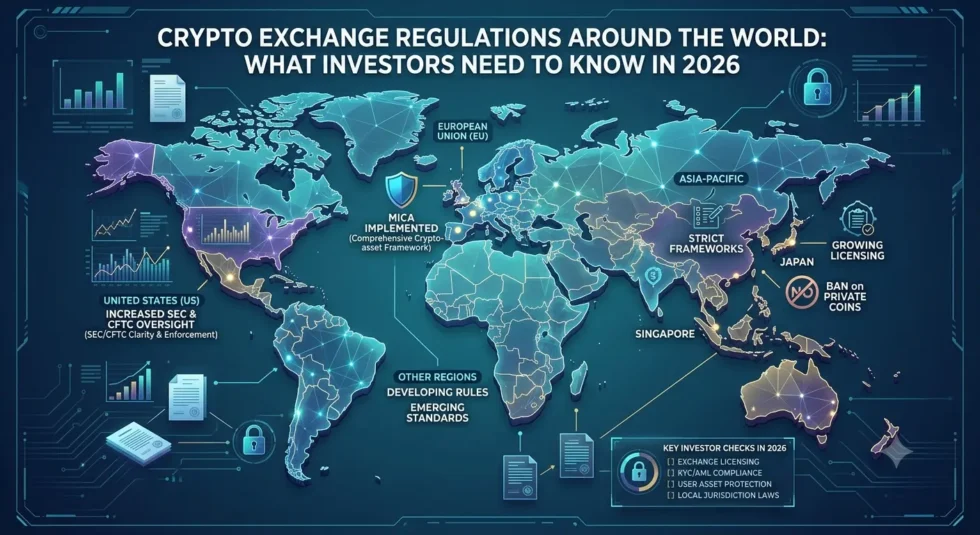
Most major exchanges serving UK customers — including Coinbase, Kraken, Gemini, Crypto.com, Bitstamp and Uphold — hold FCA registration, the baseline requirement. Only a small number of platforms, such as eToro, hold full FCA authorisation as an investment firm. Crucially, neither tier brings Financial Services Compensation Scheme (FSCS) protection for cryptoassets — the FSCS, which protects bank deposits up to £85,000, does not extend to crypto holdings regardless of which FCA-registered exchange is used.
Since October 2023, the FCA’s financial promotion regime has required firms marketing cryptoassets to UK consumers — including overseas firms — to include prominent risk warnings and a mandatory 24-hour cooling-off period for new investors before their first trade. The UK is also mid-transition to a broader regime: the FCA is expected to open applications for the new, fuller cryptoasset authorisation framework from 30 September 2026, with that regime coming fully into force around 25 October 2027. Until then, MLR registration remains the operative requirement.
How to verify: Search the exchange’s name or Firm Reference Number directly on the FCA’s Financial Services Register (register.fca.org.uk), and separately check the FCA Warning List for known unauthorised or clone firms, since scammers frequently copy the name and details of genuine registered businesses.
European Union: MiCA and the July 2026 Deadline
The EU’s Markets in Crypto-Assets Regulation (MiCA) is the most comprehensive crypto-specific licensing framework currently in force globally. A firm licensed as a Crypto-Asset Service Provider (CASP) under MiCA in one EU member state can “passport” that authorisation across all European Economic Area countries, rather than seeking separate approval in each one.
Several major exchanges have already secured MiCA authorisation, including Kraken, OKX (via Malta), Crypto.com and, as of May 2025, Bybit (via Austria, which is establishing its EU headquarters in Vienna). Binance’s MiCA application remained pending as of mid-2026, creating genuine uncertainty about its continued access to EU customers once transitional arrangements expire around 1 July 2026 — a deadline several competitor exchanges have reportedly used to actively court deposits from users on platforms facing restricted EU access.
The MiCA licence is not permanent immunity from scrutiny. The clearest illustration: OKX secured its MiCA licence via Malta in January 2025 and gained EEA passporting rights the following month. By March 2025, EU regulators — including national watchdogs from all 27 member states, meeting under the European Securities and Markets Authority — were examining whether OKX’s Web3 self-custody tools had been used to launder roughly $100 million connected to the Bybit hack, with some officials reportedly discussing potential revocation of OKX’s licence. As of the most recent reporting, no formal revocation had occurred, but the case demonstrates that a MiCA licence remains subject to ongoing review under Article 64 of the regulation, which allows licences to be revoked for anti-money-laundering failures or other serious compliance breaches.
United States: A Rapidly Shifting, Multi-Layered System
US crypto exchange regulation in 2026 is more fragmented than the UK or EU model, split across federal and state layers, and undergoing significant legislative change.
Federal layer:
- The SEC asserts jurisdiction over digital assets it characterises as securities.
- The CFTC holds authority over digital asset derivatives and, following a joint interpretive release with the SEC in March 2026, spot-market jurisdiction over 16 major tokens including Bitcoin, Ethereum, Solana and XRP, which are now treated as digital commodities.
- The GENIUS Act, signed into law in July 2025, created the first dedicated federal framework for payment stablecoins, requiring 1:1 reserves with monthly audited disclosures; implementing rules are due by 18 July 2026.
- The CLARITY Act, a broader market-structure bill that would formally divide SEC/CFTC jurisdiction over digital commodity exchanges, brokers and dealers, passed the House in July 2025 and was under active Senate consideration through mid-2026, but had not yet become law.
- Exchanges operating as money transmitters must register with FinCEN as a Money Services Business — a registration requirement, not a licence — and implement a risk-based anti-money-laundering programme.
State layer: Federal registration does not replace state-level requirements. Exchanges generally also need money-transmitter licences in each state where they operate. New York’s BitLicense regime remains the strictest in the country, and California’s Digital Financial Assets Law took effect on 1 July 2026, requiring a state licence for firms conducting “digital financial asset business activity” with California residents.
Net effect for investors: the US regulatory picture in 2026 is one of active construction rather than settled law. An exchange’s current US compliance position should be checked against both the exchange’s own disclosures and, where relevant, individual state licensing databases — not assumed from federal headlines alone, since major legislation (the CLARITY Act in particular) remained pending as of mid-2026.
Rest of World: A Brief Overview for Context
Beyond the UK, EU and US, several other jurisdictions maintain established crypto exchange licensing regimes that are relevant to platforms operating globally:
- Singapore licenses digital payment token service providers under its Payment Services Act, with the Monetary Authority of Singapore maintaining an active licensing and supervision regime.
- Hong Kong requires virtual asset trading platforms to be licensed by the Securities and Futures Commission, with a framework that has become progressively stricter since 2023.
- United Arab Emirates operates licensing through the Dubai Virtual Assets Regulatory Authority (VARA) and, separately, the Abu Dhabi Global Market, both of which several major exchanges — including Bybit — have pursued as part of their global licensing strategy.
Investors using globally focused exchanges should be aware that a platform’s “home” licensing jurisdiction may not be the one that actually applies to their account, since many exchanges operate through separate legal entities for different regions (as seen with Binance.US operating distinctly from Binance’s global platform).
How to Verify an Exchange’s Licence Yourself
Regulatory claims on an exchange’s marketing pages should always be independently verified:
- UK: Search the FCA Financial Services Register (register.fca.org.uk) by firm name or reference number, and cross-check the FCA Warning List for clone-firm warnings.
- EU: Check the relevant national regulator’s public CASP register (e.g. Malta’s MFSA, Austria’s FMA), which lists MiCA-authorised firms.
- US: Cross-reference FinCEN’s MSB registrant search and the relevant state’s money-transmitter licensee database.
- Entity matching: Confirm the legal entity name matches what’s shown on the exchange’s own terms of service — exchanges frequently register under a different legal entity than their consumer-facing brand name (for example, Coinbase operates in the UK through CB Payments Ltd, and Kraken through Payward Ltd).
Why a Licence Can Be Reviewed or Revoked After the Fact
The OKX case is the clearest 2025–2026 example of a broader principle worth internalising: regulatory status is a snapshot, not a permanent guarantee. A licence granted at one point in time reflects the regulator’s assessment as of that date; it can be reviewed, challenged, or in serious cases revoked, if subsequent events raise compliance concerns. This is precisely why independent verification of an exchange’s current status — not the licence it advertised when you first signed up — matters for any investor holding a meaningful balance over time.
Regulatory Snapshot Across Major Exchanges
| Platform | UK Status | EU (MiCA) Status | Notable Regulatory Events |
|---|---|---|---|
| Binance | Registered entity, limited UK activity | Application pending as of mid-2026 | $4.3B DOJ settlement (2023) |
| Coinbase | FCA registered (CB Payments Ltd) | — | Publicly traded (NASDAQ: COIN); heightened disclosure obligations |
| Kraken | FCA registered | MiCA authorised | US Federal Reserve master account (March 2026) |
| Bybit | — | MiCA authorised (Austria, May 2025) | Authorised same year as its record-breaking hack |
| OKX | — | MiCA licensed (Malta, Jan 2025) | Under EU scrutiny since March 2025; $504M US penalty |
| Gemini | FCA registered | — | $30M SEC fine (2023, Earn programme) |
| eToro | FCA authorised investment firm | — | Highest UK regulatory tier among platforms compared here |
| Crypto.com | FCA registered | MiCA registered | — |
| Bitstamp | — | MiCA licensed | Long operating history (founded 2011) |
| Uphold | FCA registered (since 2023) | — | “Anything-to-anything” trading model |
Full fee, liquidity and security comparison for all twelve platforms in this silo is available in The Global Crypto Exchange Cost Map 2026.
Frequently Asked Questions
Is a MiCA-licensed exchange automatically safe to use? No. MiCA authorisation confirms a firm met the EU’s licensing requirements at the point of approval, but it can be reviewed or challenged afterward, as shown by the regulatory scrutiny OKX faced in 2025 despite holding a valid MiCA licence.
What’s the practical difference between FCA registration and FCA authorisation for a UK investor? Registration confirms baseline anti-money-laundering compliance; authorisation is a materially higher bar covering capital adequacy and conduct-of-business rules. Neither brings FSCS protection for cryptoassets specifically.
Is US crypto regulation settled in 2026? No. While the GENIUS Act created a federal stablecoin framework in 2025, the broader CLARITY Act governing exchange market structure remained pending in the Senate through mid-2026, and state-level requirements (including New York’s BitLicense and California’s new Digital Financial Assets Law) continue to apply on top of any federal framework.
Does regulation in one country protect me if I use an exchange’s global platform? Not necessarily. Many exchanges operate through separate legal entities in different regions with different protections — Binance.US, for example, is a distinct entity from Binance’s global platform. Always confirm which entity your account is actually held with.
How often should I re-check an exchange’s regulatory status? Given how quickly frameworks like MiCA and the UK’s FSMA cryptoasset regime are evolving in 2026, checking at account opening and again periodically — particularly before depositing a significantly larger balance — is a reasonable practice.
Sources and References
- FCA — Cryptoassets Information and Financial Services Register guidance
- FCA — PS23/6: Financial Promotion Rules for Cryptoassets
- CryptoSlate — “Bybit earns MiCA license as hackers keep $644M from its $1.4B exploit out of reach”
- The Block; Bloomberg; Cryptopolitan — OKX MiCA scrutiny reporting, March 2025
- Cleary Gottlieb — “2026 Digital Assets Regulatory Update”
- Sumsub — “US Crypto Regulations: Federal and State Rules (2026)”
- This site’s pillar page: The Global Crypto Exchange Cost Map 2026