Best Crypto Exchanges in 2026: Which Platform Offers the Best Value for Different Types of Investors
“What’s the best crypto exchange?” is the wrong question. There is no single best exchange in 2026 — there is a best exchange for a specific investor, trading a specific way, in a specific jurisdiction. A beginner making an occasional £100 GBP purchase and a professional trader running dozens of leveraged positions a week have almost nothing in common in terms of what “value” actually means.
This guide segments the market by investor type rather than producing a flat top-10 list. For the full underlying data behind every platform mentioned here — trading fees, liquidity, security history and regulatory status across twelve exchanges — see our complete comparison in The Global Crypto Exchange Cost Map 2026, which this article draws on throughout.
About the Author
Cristopher Hymon is a financial markets analyst specialising in digital assets, trading infrastructure, exchange cost structures and regulatory developments. His work focuses on how execution quality, hidden fees, liquidity mechanics and licensing regimes shape real-world outcomes for retail traders and investors.
Why “Best” Depends Entirely on Investor Type
Every exchange comparison ultimately trades off four variables against each other:
| Variable | What It Affects |
|---|---|
| Cost | Trading fees, spreads, withdrawal fees, conversion fees |
| Security | Custody practices, hack history, insurance funds |
| Compliance | Regulatory status, jurisdictional access, tax reporting ease |
| Feature depth | Margin, futures, staking, API access, copy trading |
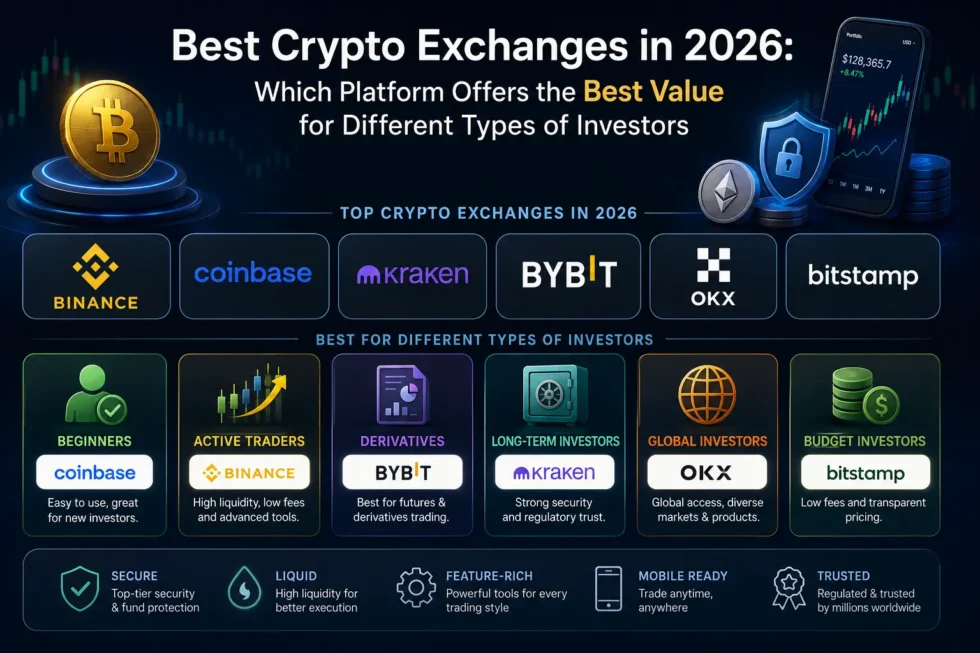
No platform in this comparison maximises all four simultaneously. Binance and KuCoin generally win on cost. Kraken and Coinbase generally win on independently verifiable security and compliance. eToro wins on the highest UK regulatory bar (full FCA authorisation, not just registration). Platforms like Bybit and OKX offer deep derivatives features but carry more recent security or regulatory complications worth weighing carefully. Understanding which variable matters most to you is the actual first step — before comparing a single fee.
Best Crypto Exchange for Beginners
Beginners buying crypto for the first time are usually optimising for simplicity, a straightforward GBP on-ramp, and a recognisable regulatory footprint — not the lowest possible basis-point fee.
What to prioritise as a beginner:
- FCA registration or authorisation, verifiable on the Financial Services Register
- A simple, well-reviewed mobile app with clear GBP deposit and withdrawal paths
- Educational resources and a low-stakes way to start (small minimum purchases)
- A recognisable brand with a public track record, since beginners are least equipped to evaluate custody or security claims independently
How the field breaks down: Coinbase is widely regarded as the most beginner-friendly on-ramp in the UK, combining FCA registration, a clean interface and strong app-store reviews, though its default “Simple Trade” screen carries a meaningfully higher effective cost (spread plus fees that can exceed 3–4% on small purchases) than its Advanced Trade interface. Gemini’s basic interface follows a similar pattern — easy to use, but its combined 1.49% transaction fee plus 1.00% convenience fee is not competitive for anything beyond occasional small purchases. Kraken sits in a similar beginner-accessible category with a slightly steeper learning curve but a stronger long-term security record.
Practical beginner tip: On every platform in this comparison, the homepage “Buy” or “Instant Buy” button is the most expensive way to purchase crypto. Even as a first-time user, switching to the exchange’s standard trading or “Advanced” interface — usually one tap away — can reduce the cost of the same purchase by several multiples.
Best Crypto Exchange for Active or Frequent Traders
Active traders placing multiple orders per week feel the compounding effect of fees far more acutely than a buy-and-hold beginner. For this group, the maker/taker percentage and order-book liquidity depth matter more than interface simplicity.
What to prioritise as an active trader:
- Low base-tier maker/taker fees, with a realistic path to volume-tier discounts
- Deep order-book liquidity to minimise slippage on larger orders
- A functional advanced trading interface (charting, order types, API access)
How the field breaks down: Binance consistently offers the lowest published base-tier fees among major platforms (commonly cited around 0.10% maker/taker, with further discounts available for BNB holders) alongside the deepest general liquidity of any exchange in this comparison, commanding an estimated 39–55% of global centralised spot market share depending on the measurement window. KuCoin and Bitget publish similarly low headline rates, though Bitget’s most aggressive figures rely on its own promotional token-discount programme and are worth verifying independently rather than taken at face value. Kraken’s base fees (commonly cited around 0.16% maker / 0.26% taker) are higher than Binance’s but drop toward 0% maker at very high monthly volume, making it increasingly competitive for genuinely high-frequency traders.
Best Crypto Exchange for Long-Term Holders
Investors planning to buy and hold for months or years are optimising for something almost entirely different from an active trader: custody security and counterparty risk, not basis points on execution.
What to prioritise as a long-term holder:
- A verifiable, multi-year track record without a user-fund-loss hack
- Published proof-of-reserves attestations
- Insurance coverage on hot-wallet holdings
- A regulatory status that doesn’t leave continued market access in question
How the field breaks down: Kraken has the strongest continuous security record among the twelve platforms in our comparison — no user-fund-loss hack since its founding in 2011, and a June 2024 intrusion attempt was reportedly contained within 47 minutes with no client losses. Coinbase, as the only publicly traded exchange in this comparison (NASDAQ: COIN), carries additional financial disclosure obligations and maintains a $250 million crime insurance policy on hot-wallet holdings. By contrast, long-term holders should weigh recent history carefully before parking significant balances on platforms like Bybit, which suffered the largest crypto exchange hack on record — approximately $1.4–1.5 billion in Ethereum — in February 2025, even though the platform has since obtained EU MiCA authorisation.
Best Crypto Exchange for UK Investors Specifically
UK investors face a regulatory distinction that many comparison articles gloss over: FCA registration is not the same as FCA authorisation.
| Status | What It Confirms | FSCS Protection? |
|---|---|---|
| FCA Registered | Anti-money-laundering and KYC compliance under the Money Laundering Regulations 2017 | No |
| FCA Authorised | Full investment-firm conduct rules, capital adequacy, client-money rules | Still no for cryptoassets, but a materially higher regulatory bar |
Most exchanges UK investors use day to day — Coinbase, Kraken, Gemini, Crypto.com, Uphold, Bitstamp — hold FCA registration, the baseline legal requirement to serve UK customers. eToro stands apart as a fully FCA-authorised investment firm, which brings a higher regulatory bar even though crypto itself remains outside Financial Services Compensation Scheme protection regardless of which exchange holds it. For GBP-focused investors, Kraken and Bitstamp are also frequently cited for the deepest GBP/EUR liquidity and the fastest Faster Payments withdrawal turnaround.
Best Crypto Exchange for Advanced or Professional Traders
Investors trading with leverage, running algorithmic strategies, or requiring institutional-grade execution have a different feature checklist entirely — margin limits, futures funding structures, API reliability and OTC desk access. This is covered in full depth in our companion guide, [Advanced Crypto Trading Features Explained for Serious Investors], which walks through margin trading, perpetual futures, staking programmes and API access platform by platform.
Decision Table: Investor Type → Recommended Starting Point
| Investor Type | Leading Candidates | Primary Trade-Off to Accept |
|---|---|---|
| First-time / occasional buyer | Coinbase, Gemini | Higher simple-interface fees in exchange for ease of use |
| Active / frequent trader | Binance, Kraken (advanced tier), KuCoin | Lower fees require using the advanced interface, not the app’s default screen |
| Long-term holder | Kraken, Coinbase | Slightly higher base fees in exchange for a stronger independent security record |
| UK-focused, compliance-first | eToro, Kraken, Bitstamp | eToro’s spread-based pricing (~1–2%) is higher than order-book trading |
| Advanced / derivatives trader | Kraken, OKX, Bybit (with caution) | Greater feature depth alongside more recent regulatory or security complications to verify |
No single row is a universal recommendation — each reflects a trade-off, not a guarantee. Full fee, liquidity, security and regulatory detail for all twelve platforms referenced above is available in The Global Crypto Exchange Cost Map 2026.
Frequently Asked Questions
Is the cheapest exchange always the best choice?
No. The lowest headline fee usually applies only to the advanced trading interface, not the default buy screen most beginners use, and it says nothing about custody security or regulatory standing. Cost is one of four variables — cost, security, compliance and features — that should be weighed together.
Should a beginner start with the same exchange an active trader would use?
Not necessarily. A beginner benefits more from a simple, well-regulated on-ramp like Coinbase or Gemini, even at a higher effective cost, than from the lowest-fee order-book platform, which assumes familiarity with limit orders and order types.
Is it safe to hold crypto long-term on any of these exchanges?
Every centralised exchange carries counterparty risk, including the platforms with strong security records. Long-term holders should weigh each platform’s hack history and insurance coverage, and many choose to move larger, long-held balances into self-custody rather than leaving them on any exchange indefinitely.
Does FCA registration mean my crypto is protected if the exchange fails?
No. FCA registration confirms anti-money-laundering compliance; it does not bring Financial Services Compensation Scheme protection for cryptoassets, regardless of which UK-registered exchange is used.
Can I use more than one exchange for different purposes?
Yes, and many experienced investors do — for example, using a low-fee platform for active trading and a platform with a stronger independent security record for long-term holdings. This adds tax record-keeping complexity but can reduce single-point-of-failure risk.
Sources and References
- FCA — Cryptoassets Consumer Research 2024, Wave 5
- FCA — Cryptoasset Register and Financial Services Register guidance
- Koinly — “10 Best UK Crypto Exchanges 2026”
- Publicly available exchange fee schedules: Binance, Coinbase Advanced, Kraken, Bybit, OKX, KuCoin, Bitget, Gemini, eToro, Crypto.com, Bitstamp, Uphold (checked early-to-mid 2026; subject to change)
- This site’s pillar page: The Global Crypto Exchange Cost Map 2026