Advanced Crypto Trading Features Explained for Serious Investors
Once an investor moves beyond simple spot buying, exchange choice starts to depend on an entirely different set of features: margin and futures trading, staking yields, API access for automated strategies, and institutional-grade execution through OTC desks. Not every platform in our comparison supports these to the same standard, and the features that matter most to a beginner — a clean app, an easy GBP on-ramp — are largely irrelevant here.
This guide explains the advanced features serious traders should evaluate before choosing a platform, and which exchanges from our comparison are best positioned for each. For the underlying fee, liquidity, security and regulatory data across all twelve platforms referenced below, see our Global Crypto Exchange Cost Map 2026.
About the Author
Cristopher Hymon is a financial markets analyst specialising in digital assets, trading infrastructure, exchange cost structures and regulatory developments. His work focuses on how execution quality, hidden fees, liquidity mechanics and licensing regimes shape real-world outcomes for retail traders and investors.
Margin Trading: Leverage Limits, Liquidation Mechanics and Jurisdictional Restrictions
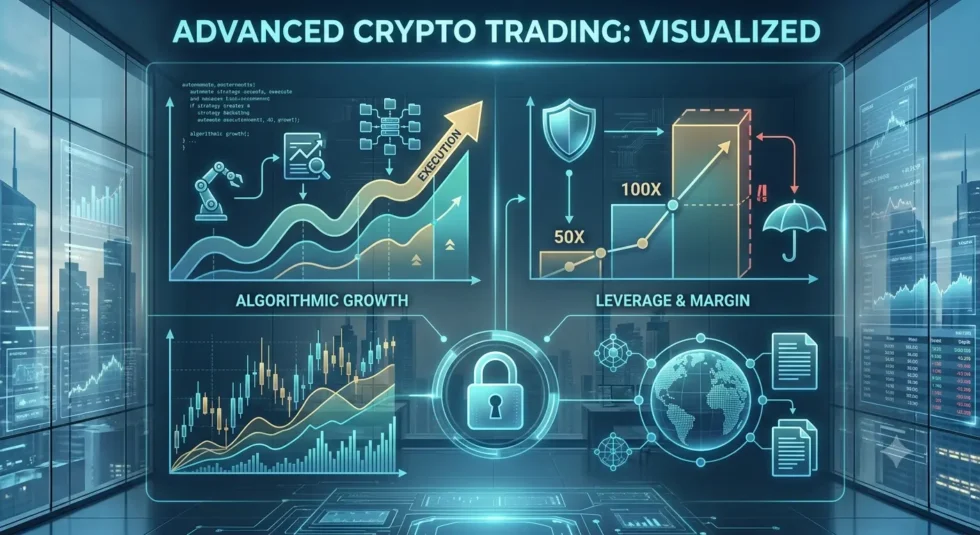
Margin trading allows a trader to borrow funds to increase position size beyond their own capital. It amplifies both gains and losses, and the mechanics differ meaningfully across platforms.
What to evaluate:
- Leverage limits — these vary widely by platform and jurisdiction. Binance has offered margin trading up to 10x for eligible users in select regions; Kraken has historically supported margin trading up to 5x, with tighter limits for US-based clients who must meet specific eligibility requirements. Regulatory restrictions mean the leverage available to a UK or EU retail client is often materially lower than what the same platform advertises for other jurisdictions.
- Liquidation mechanics — the price level and process at which a margin position is force-closed when collateral falls below the required maintenance margin. This directly determines how much room a position has before an adverse price move triggers forced closure.
- Margin call and warning systems — how much advance notice a platform provides before liquidation, and whether partial liquidation is used to reduce risk before a full close-out.
Why this matters more than it appears: leverage compounds losses geometrically, not linearly. Four consecutive 25% losses reduce a £100 position to approximately £31.60 (100 × 0.75⁴ ≈ 31.6) — a mechanical reality of leveraged trading that applies regardless of which platform is used, and one that makes downside control more important than position sizing alone.
Futures and Perpetual Contracts: Funding Fees Explained
Crypto perpetual futures are derivatives with no fixed expiry date, using periodic funding payments between long and short position holders to keep the contract price aligned with the underlying spot market.
Key features to compare across platforms:
- Funding rate frequency and typical range — funding is usually charged every eight hours on major platforms, though the specific rate fluctuates with market conditions.
- Maximum available leverage — Binance has offered futures leverage up to 125x for eligible users in select regions, among the highest publicly advertised in this comparison; most regulated EU and UK-facing platforms impose materially lower caps for retail clients.
- Insurance/liquidation-fund mechanics — how the platform absorbs losses when a liquidated position’s collateral is insufficient to cover the loss, and whether this risk is ever socialised across other users (auto-deleveraging).
As detailed in our companion guide on trading fees, funding costs are a compounding expense that scales with how long a position stays open, not just its size — a factor frequently underweighted by traders focused primarily on the entry trading fee. Kraken’s expansion into derivatives has been reinforced by its acquisition of NinjaTrader, a CFTC-regulated US retail futures platform, and Bitnomial, a CFTC-regulated derivatives exchange and clearinghouse — giving Kraken a regulated derivatives infrastructure that few competing crypto exchanges currently match.
Staking and Yield Products: On-Chain vs. Custodial Staking
Staking allows holders of proof-of-stake assets to earn yield by supporting network validation, either directly on-chain or through a custodial exchange programme.
What to check:
- Flexible vs. bonded/locked staking — flexible staking allows unstaking at any time with no lock-up, typically at a lower yield; bonded staking locks assets for a set period in exchange for a higher rate.
- Published yield ranges — Kraken’s sample 2026 rates before commission have been cited at approximately 1.1–2.65% APR for ETH depending on staking type, and around 4.08% APY for USDC and USDT, with select assets offering yields up to 21%. Binance has offered staking on 22+ assets with APYs up to 17%, though service fees can run higher than some competitors. These figures fluctuate with network conditions and should always be checked live before committing funds.
- Custodial risk during the lock-up period — bonded or locked staking means assets cannot be withdrawn even in a platform-level emergency until the lock-up expires, adding counterparty risk on top of normal exchange custody risk.
Regulatory caution: staking programmes sit in a genuine regulatory grey area in some jurisdictions. Gemini paid a $30 million SEC fine in 2023 specifically related to its Earn/staking programme — a reminder that yield-generating products carry a different, additional layer of regulatory risk compared to simple spot holding, independent of the underlying asset’s own volatility.
API and Algorithmic Trading Access
Traders running automated or algorithmic strategies depend on an exchange’s API infrastructure rather than its consumer-facing app.
What to evaluate:
- Rate limits — how many API calls per second/minute are permitted, which directly constrains high-frequency strategies.
- Latency and reliability — consistency of execution speed, particularly during high-volatility periods when order flow spikes and some platforms have historically experienced degraded performance.
- Key permission granularity — the ability to restrict an API key to read-only or trading-only access, with withdrawal permissions disabled, is a critical security control covered in more depth in our exchange security guide.
- Documentation and sandbox/testing environments — platforms with mature, well-documented APIs and testnet environments reduce the risk of costly integration errors before live deployment.
Binance and OKX are generally regarded as offering the most extensive API infrastructure among the platforms in this comparison, reflecting their focus on active and institutional trading volume; Coinbase Advanced Trade and Kraken also offer full API access geared toward a broader base of retail-to-semi-professional users.
OTC and Institutional Desks: When They Make Sense
Over-the-counter (OTC) desks allow large trades to be executed directly with a counterparty rather than through the public order book, reducing the market-moving price impact (“slippage”) that a large order would otherwise cause on an exchange’s standard trading interface.
When an OTC desk is worth using instead of the standard order book:
- Trade sizes large enough that placing the order directly on the exchange would move the market price meaningfully against the trader
- A need for price certainty on a large trade, rather than accepting whatever price the order book fills at
- Institutional or high-net-worth clients seeking a dedicated relationship manager rather than self-directed execution
Kraken offers a premium OTC desk alongside Kraken Prime, a dedicated institutional-grade platform for advanced traders and asset managers. Most major exchanges in this comparison — including Binance, Coinbase and OKX — offer some form of OTC or institutional desk access, typically gated behind a minimum trade size or verified institutional account status.
Copy Trading and Social Trading Features
Copy trading allows an investor to automatically mirror the trades of another, typically more experienced, trader — a feature that blurs the line between “advanced” and “passive” investing.
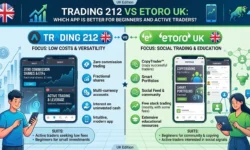
eToro is the platform most closely associated with this model in our comparison, built around social and copy-trading features from the outset. This comes with a trade-off worth naming directly: eToro’s spread-based pricing (commonly cited in the 1–2% range) is meaningfully higher than order-book trading on platforms like Binance or Kraken, meaning the convenience of copy trading is paired with a materially higher execution cost — relevant context alongside eToro’s position as the only platform in this comparison holding full FCA investment-firm authorisation.
Tokenised Stocks and Multi-Asset Access
A newer development among leading exchanges is the extension of crypto-native infrastructure to traditional assets. Kraken’s xStocks product provides 24/7 access to tokenised US equities, with leverage available on select assets for non-US users, while its US clients can trade thousands of US stocks and ETFs commission-free within the same account following its acquisition of NinjaTrader. This reflects a broader industry direction — several platforms in this comparison are moving toward multi-asset infrastructure that extends beyond spot crypto trading, which may be relevant for investors looking to consolidate crypto and traditional-asset trading under a single provider.
Feature Availability Snapshot Across Platforms
| Platform | Margin | Futures | Staking | Notable Institutional Feature |
|---|---|---|---|---|
| Binance | Up to 10x (select regions) | Up to 125x (select regions) | 22+ assets, up to 17% APY | Extensive API infrastructure |
| Kraken | Up to 5x | Yes, via Kraken Futures | 20+ assets, flexible & bonded | Kraken Prime; OTC desk; NinjaTrader/Bitnomial derivatives infrastructure |
| Coinbase | Limited retail availability | Futures via regulated EU entity | 8+ assets | Institutional custody solutions |
| OKX | Yes | Yes | Available | Extensive API infrastructure |
| eToro | — | — | 8+ assets | Copy trading / social trading |
| Gemini | — | — | ETH & SOL | ActiveTrader platform |
| Crypto.com | — | — | 30+ assets | Visa card ecosystem integration |
Full fee, security and regulatory detail supporting each platform above is available in The Global Crypto Exchange Cost Map 2026.
Frequently Asked Questions
Is high leverage ever a good idea for a retail trader?
Leverage magnifies losses as sharply as gains, and the compounding math (four consecutive 25% losses reducing capital by roughly 68%) applies regardless of platform. Most professional traders prioritise downside control and capital preservation over maximum available leverage.
Are staking yields guaranteed?
No. Published staking rates fluctuate with network conditions and are typically quoted before platform commission; bonded/locked staking also introduces liquidity risk during the lock-up period, on top of standard exchange custody risk.
Do I need an OTC desk if I’m not an institutional trader?
Generally no — OTC desks are designed for trade sizes large enough to move the public order-book price, which is not a relevant concern for most retail-sized trades.
Is copy trading suitable for a beginner, or is it an “advanced” feature?
Copy trading is accessible to beginners in terms of usability, but it still carries the underlying market risk of whichever trader is being copied, and on platforms like eToro it comes with a materially higher spread-based cost than standard order-book trading — worth weighing against the convenience.
Which platform has the strongest API infrastructure for algorithmic trading?
Binance and OKX are generally regarded as offering the most extensive API infrastructure among the platforms in this comparison, reflecting their focus on high-volume and institutional trading activity.
Sources and References
- Kraken — “Kraken vs Binance” comparison; Kraken Learn resources
- BitDegree — “Kraken vs Binance: Features, Fees & More (2026)”
- Moneywise — “Kraken vs. Binance: Which Is Better for You?”
- This site’s cluster article: Crypto Trading Fees Explained: How Exchange Costs Affect Long-Term Investment Returns
- This site’s cluster article: How Secure Are Crypto Exchanges? Security Features Every Investor Should Check
- Publicly available exchange feature documentation: Binance, Kraken, Coinbase, OKX, eToro, Gemini, Crypto.com (checked early-to-mid 2026; subject to change)
- This site’s pillar page: The Global Crypto Exchange Cost Map 2026