Why Most Day Traders Lose Money in the UK And How Platform Choice Plays a Role
Day trading has become one of the fastest-growing forms of retail investing in the United Kingdom. Social media influencers, YouTube trading channels, Discord communities, and mobile-first UK trading platforms have made active trading appear more accessible than ever before. Thousands of new traders now enter financial markets every month hoping to generate fast profits from forex, stocks, indices, commodities, and cryptocurrency CFDs.
However, the reality of day trading is far harsher than many beginners expect. Most retail day traders lose money over time. This is not simply a theory repeated by financial commentators; even regulated brokers operating under the Financial Conduct Authority (FCA) publicly disclose that a majority of retail CFD accounts lose money. The numbers vary between platforms, but loss rates commonly range between 65% and 85% of retail traders.
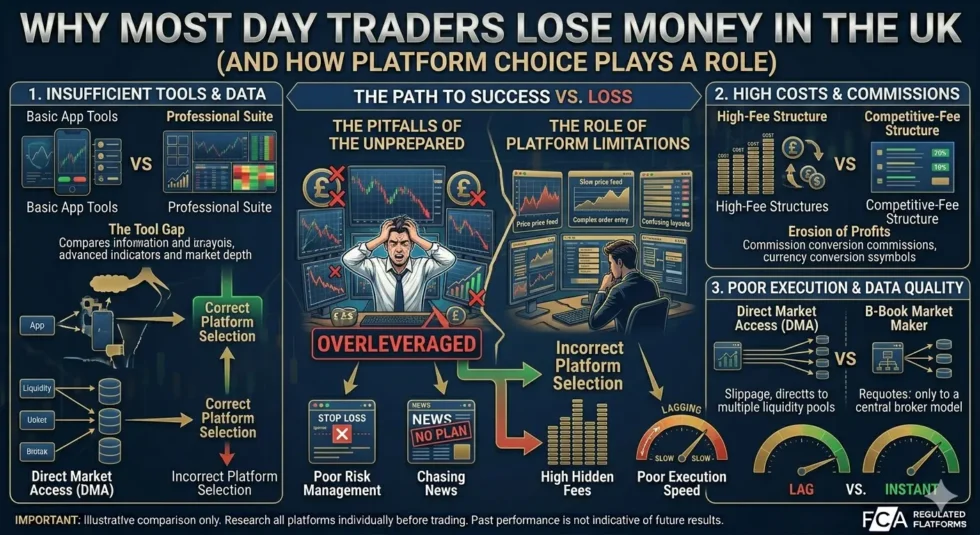
The reasons behind these losses are far more complex than most beginners realize. Many traders assume failure happens purely because people lack discipline or trading knowledge. While psychology certainly matters, platform choice also plays a surprisingly important role in long-term trading outcomes. Execution speed, spreads, charting functionality, mobile stability, risk management tools, and fee structures can all influence whether a trader survives long enough to become consistently profitable.
This guide explains why most UK day traders lose money and how choosing the right trading platform can significantly improve a trader’s chances of long-term survival.
The Illusion of Easy Money in Modern Trading
One of the biggest reasons traders lose money is unrealistic expectations created by online trading culture. Social media often presents day trading as a fast path to financial freedom. Platforms like TikTok, YouTube, Instagram, and Reddit are filled with screenshots of winning trades, luxury lifestyles, and claims of quick profits from forex or stock trading.
What rarely appears in these posts are the months or years of losses, emotional stress, and failed strategies that many traders experience before becoming profitable — if they ever do. The rise of commission-free trading apps and simplified mobile platforms has further increased this illusion. Modern UK trading platforms make market access feel easy, but easy access does not mean easy profitability.
Many beginners start trading with little understanding of market structure, risk management, or trading psychology. Instead of treating trading as a professional skill requiring education and experience, they approach it like gambling. This mindset alone causes many accounts to fail quickly.
Lack of Risk Management Is the Biggest Problem
The single most common reason traders lose money is poor risk management. Many beginners focus entirely on how much profit they can make while ignoring how much they can lose.
Professional traders understand that preserving capital is more important than chasing large gains. Retail traders often do the opposite. They risk large portions of their accounts on individual trades, increase position sizes after losses, or overuse leverage in an attempt to recover quickly.
Leverage is particularly dangerous in day trading because it magnifies both gains and losses. UK trading platforms regulated by the FCA impose leverage limits for retail clients, but even regulated leverage can produce rapid account losses if risk is poorly managed.
A trader risking 20% or 30% of their account on a single trade can wipe out their capital within days. By contrast, experienced traders typically risk only a small percentage of capital per position. This allows them to survive losing streaks while remaining emotionally stable.
No trading platform can completely protect traders from poor decision-making, but high-quality UK trading platforms do provide tools that support better risk management. Features like guaranteed stop-loss orders, margin alerts, position size calculators, and volatility warnings help traders control exposure more effectively.
Emotional Trading Destroys Consistency
Trading psychology plays a massive role in day trading performance. Markets constantly trigger emotional responses such as fear, greed, frustration, and overconfidence. Many traders enter the market with a reasonable strategy but abandon it once emotions begin influencing decisions.
After a winning streak, traders may become overconfident and increase position sizes recklessly. After a loss, they may revenge trade by entering impulsive positions without proper analysis. Emotional reactions often create a destructive cycle that leads to inconsistent trading behavior.
Mobile trading apps have made this problem even worse in some ways. Because markets are now accessible 24 hours a day from smartphones, traders often overtrade. Constant notifications, price alerts, and real-time market movement encourage impulsive decision-making.
Professional traders rely heavily on discipline and structured trading plans. They understand that trading success depends on consistency over hundreds of trades rather than emotional reactions to short-term results.
The best UK trading platforms support disciplined trading by providing features such as predefined stop losses, trade journals, detailed performance analytics, and customizable risk controls. Poor platforms, on the other hand, often encourage excessive trading through gamified interfaces and aggressive marketing tactics.
Most Traders Underestimate Trading Costs
One of the least understood reasons day traders lose money is trading costs. Beginners often focus only on visible commissions while ignoring spreads, slippage, overnight financing charges, and execution quality.
For active traders placing multiple trades daily, even small costs accumulate rapidly over time. A trader using a platform with wider spreads may lose a significant portion of profits before realizing it. Scalpers are especially vulnerable because they rely on small price movements where trading costs represent a larger percentage of potential gains.
Execution quality is equally important. A broker advertising low spreads may still provide poor overall trading conditions if orders experience slippage or delayed execution during volatile periods.
Many inexperienced traders choose platforms based purely on marketing or influencer recommendations without understanding how pricing models work. Some UK trading platforms offer spread-only pricing, while others use raw spreads plus commission structures. Professional traders often prefer commission-based pricing because it can provide more transparent and lower total trading costs.
Poor Platform Execution Can Damage Profitability
Execution quality is one of the most overlooked aspects of day trading. Traders often spend months developing strategies while ignoring the technology used to execute those trades.
Execution speed becomes extremely important in fast-moving markets, particularly during economic news releases or periods of elevated volatility. Delayed fills, requotes, or platform freezes can significantly impact profitability, especially for short-term traders.
Imagine a trader attempting to scalp the EUR/USD during a major Bank of England announcement. A delay of even a fraction of a second may turn a profitable setup into a losing trade. Slippage can widen dramatically during volatile conditions if the broker’s infrastructure or liquidity access is weak.
This is one reason why professional traders pay close attention to broker infrastructure. High-quality UK trading platforms invest heavily in low-latency execution systems, strong liquidity provider relationships, and stable server performance.
Beginners Often Use the Wrong Trading Platforms
Another major reason traders fail is choosing platforms unsuitable for active trading. Many beginner-focused apps prioritize simplicity and marketing appeal rather than professional trading functionality.
Some platforms are excellent for casual investing but weak for serious day trading. They may lack advanced charting, detailed order controls, reliable execution infrastructure, or strong risk management features.
For example, beginner-friendly platforms may provide attractive interfaces but offer wider spreads and limited analytical tools. This creates difficulties for traders attempting to transition from casual speculation into structured day trading.
More advanced UK trading platforms offer significantly better environments for serious traders. Platforms such as MetaTrader 5, cTrader, ProRealTime, and Trader Workstation provide deeper market analysis, advanced order routing, automation support, and professional-grade charting.
However, advanced platforms also involve steeper learning curves. Many beginners avoid them because they initially appear complex. Ironically, the simplified platforms that feel easier to use may sometimes encourage poor trading habits due to limited analytical depth and excessive ease of access.
Overtrading Is a Silent Account Killer
One of the most destructive habits among day traders is overtrading. Many beginners believe profitable traders constantly place trades throughout the day. In reality, professional traders are often highly selective.
Overtrading usually happens because traders become emotionally attached to market activity. They feel pressure to always be in a position, especially after a loss. Mobile apps intensify this behavior because markets remain constantly accessible.
The availability of instant execution and continuous price updates creates psychological pressure to react constantly. Many traders begin forcing trades even when no clear setup exists.
This behavior increases transaction costs, emotional fatigue, and poor decision-making. Over time, overtrading can completely destroy an account even if the trader occasionally makes good market calls.
Most Traders Never Develop a Real Strategy
Many retail traders enter the market without a clearly defined trading strategy. Instead of testing systems over large sample sizes, they constantly switch approaches after a few losing trades.
One week they follow breakout strategies. The next week they attempt scalping. Then they move to momentum trading after seeing a social media influencer post profits online. This constant strategy switching prevents traders from developing consistency.
Successful trading requires statistical thinking. Even strong trading systems experience losing streaks. Professional traders understand probabilities and focus on long-term expectancy rather than short-term outcomes.
Lack of Education and Unrealistic Expectations
Many people begin trading without understanding how financial markets actually function. They may know basic candlestick patterns or indicator setups but lack deeper knowledge of market structure, liquidity behavior, macroeconomics, or risk dynamics.
Professional trading requires continuous education. Markets evolve constantly, and strategies that worked in one environment may struggle in another. Traders who stop learning often fall behind changing market conditions.
Unfortunately, much of the online trading industry focuses more on selling excitement than realistic education. Influencers frequently market expensive courses, signal groups, or unrealistic lifestyle expectations.
This creates distorted perceptions of what trading success actually looks like. In reality, many professional traders focus on consistency, discipline, and risk control rather than dramatic profits.
Educational resources provided by high-quality UK trading platforms can help traders develop stronger foundations. Brokers like IG and CMC Markets invest heavily in webinars, market analysis, and educational content designed to support long-term trader development.
Why Professional Traders Focus on Platform Quality
Experienced traders understand that platform quality matters enormously over time. The difference between strong and weak trading infrastructure becomes more noticeable as trading frequency increases.
Professional traders evaluate platforms based on:
- Execution speed
- Spread consistency
- Slippage performance
- Platform uptime
- Market access
- Charting tools
- Risk management features
- Order routing quality
A beginner may not notice these differences immediately, but over hundreds or thousands of trades they become extremely important.
The best UK trading platforms invest heavily in infrastructure because execution quality directly impacts trader performance. Institutional-grade brokers understand that serious traders value stability and transparency more than flashy marketing campaigns.
The Psychological Impact of Platform Design
Trading platform design itself can influence trader behavior. Some apps intentionally use simplified interfaces, bright visuals, and gamified features that encourage excessive engagement.
This can create gambling-like behavior rather than disciplined investing. Constant notifications, achievement-style rewards, and frictionless execution may increase impulsive trading.
Professional trading environments tend to feel more analytical and less entertainment-focused. They emphasize charts, risk metrics, execution controls, and market data rather than social engagement.
Traders should pay attention not only to costs and tools but also to how a platform influences their behavior psychologically.
Can Most Traders Become Profitable?
Despite the high failure rate, profitable trading is possible. However, it usually takes far longer than beginners expect.
Consistently profitable traders often spend years developing skills in:
- Risk management
- Emotional discipline
- Strategy development
- Market analysis
- Position sizing
- Trade journaling
- Statistical analysis
Final Thoughts
Most day traders lose money in the UK because they underestimate the complexity of trading. Poor risk management, emotional decision-making, unrealistic expectations, overtrading, weak strategies, and lack of education all contribute heavily to failure.
However, platform choice also plays a significant role. Execution quality, spreads, charting functionality, platform stability, and risk management tools directly affect trading outcomes, especially for active intraday traders.
The best UK trading platforms are not simply the cheapest or most aggressively marketed. They are the platforms that provide reliable execution, strong regulatory protection, advanced analytical tools, and professional-grade trading infrastructure.
Frequently Asked Questions
Why do most day traders lose money?
Most traders lose money because of poor risk management, emotional trading, overleveraging, unrealistic expectations, and lack of strategy consistency.
Does platform choice really matter in day trading?
Yes. Execution speed, spreads, slippage, charting tools, and platform reliability can significantly affect trading performance over time.
Which UK trading platforms are best for serious day traders?
Platforms like IG, Pepperstone, CMC Markets, and Interactive Brokers are commonly preferred by active traders because of their execution quality and professional tools.
Are FCA-regulated brokers safer?
Yes. FCA-regulated brokers must follow strict rules involving client fund protection, transparency, and operational standards. Always verify FCA authorisation before depositing funds at register.fca.org.uk.
Can beginners become profitable day traders?
Yes, but profitability usually requires years of practice, disciplined risk management, education, and emotional control.
Why is overtrading dangerous?
Overtrading increases emotional stress, transaction costs, and impulsive decision-making, which often leads to account losses.