FCA-Regulated Trading Platforms in the UK: Full List and How to Verify Them
When evaluating UK trading platforms, fees and execution speed matter—but regulation and trust should always come first. In the United Kingdom, the gold standard for financial oversight is the Financial Conduct Authority (FCA).
This guide provides a practical, experience-driven breakdown of FCA-regulated platforms, how to verify them, and how regulation directly impacts your trading safety, costs, and execution risk in 2026.
Why FCA Regulation Is Critical for UK Trading Platforms
The FCA is one of the most respected financial regulators globally. Any platform offering trading services to UK residents must either be FCA-authorised or operate under strict regulatory permissions.
What FCA Regulation Guarantees:
- Segregation of client funds (your money is kept separate from broker funds)
- Negative balance protection (you cannot lose more than your deposit)
- Strict capital requirements (brokers must remain financially stable)
- Transparent pricing and execution policies
- Access to compensation schemes
These protections directly reduce counterparty risk, one of the biggest hidden dangers in trading.
Full List of Popular FCA-Regulated Trading Platforms (2026)
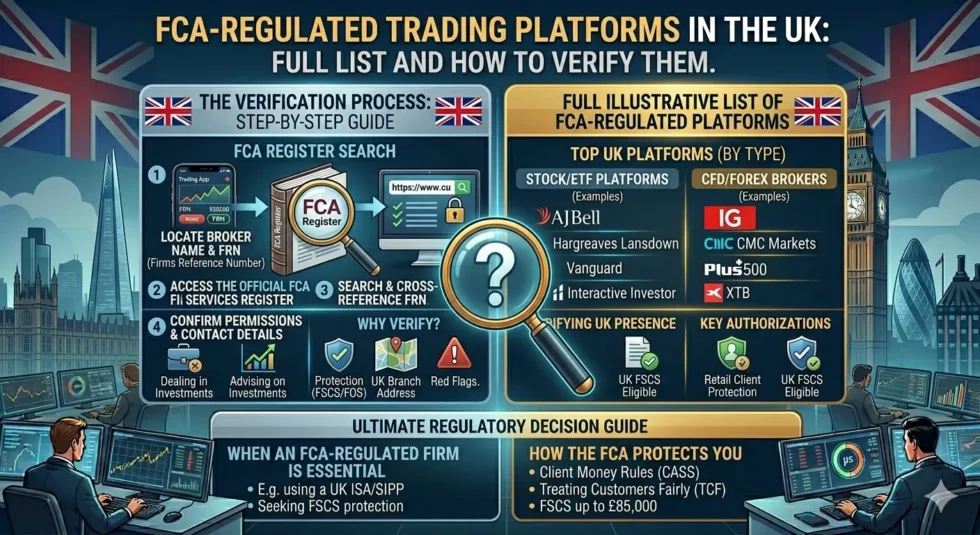
Below are some widely used UK trading platforms that are authorised and regulated by the FCA. Always verify individually (explained later).
1. IG Group
- One of the oldest UK brokers
- Strong reputation for transparency
- Offers CFDs, forex, and shares
2. CMC Markets
- Known for low spreads and advanced tools
- Highly trusted among professional traders
3. Plus500
- Beginner-friendly interface
- Commission-free trading model (spread-based)
4. eToro
- Popular for social and copy trading
- Strong retail trader adoption
5. Saxo Bank
- Premium platform with institutional-grade tools
- Higher minimum deposit requirements
6. Pepperstone
- Offers ECN-style accounts
- Known for fast execution
7. XTB
- Commission-free stock trading
- Strong educational resources
8. Interactive Brokers
- Global broker with advanced tools
- Extremely competitive pricing
9. City Index
- Backed by a large financial group
- Offers spread betting and CFDs
10. AvaTrade
- Strong global presence
- Multiple platform integrations
Important: This is not an exhaustive list. Hundreds of firms are FCA-authorised. Always verify before opening an account.
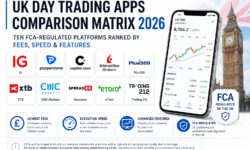
For a detailed comparison of fees, execution speed, and platform costs, see our complete guide: The UK Day Trading App Cost Map 2026.
How to Verify FCA-Regulated Brokers (Step-by-Step)
Many scams today involve clone firms pretending to be FCA-regulated. Verification is essential.
Step 1: Visit the FCA Register
Go to the official FCA register via the Financial Conduct Authority website.
Step 2: Search the Broker Name
Enter the platform’s name (e.g., IG Group or eToro).
Step 3: Check the Firm Reference Number (FRN)
- Every regulated broker has a unique FRN
- Match it with the broker’s official website
Step 4: Verify Contact Details
- Ensure phone number, email, and domain match exactly
- Fraudsters often use similar names with different domains
Step 5: Check Permissions
Confirm the firm is authorised for:
- CFD trading
- Forex trading
- Investment services
Step 6: Look for “Clone Warnings”
The FCA frequently publishes alerts about scam firms impersonating legitimate brokers.
Red Flags: How to Spot Fake “FCA-Regulated” Platforms
Even experienced traders fall for well-designed scams. Watch for:
- Promises of guaranteed profits
- Pressure to deposit quickly
- Unverified contact details
- Slightly altered domain names
- No clear regulatory number
If anything feels off, do not deposit funds. Always verify FCA authorisation before depositing funds at register.fca.org.uk.
FCA vs Other Regulators: Why It Matters
Not all regulation is equal. Some offshore regulators offer minimal protection.
FCA vs Offshore Regulators
| Feature | FCA (UK) | Offshore Regulators |
|---|---|---|
| Client fund protection | Strong | Weak |
| Transparency | High | Low |
| Legal recourse | Available | Limited |
| Compensation scheme | Yes | Rare |
Choosing FCA-regulated platforms significantly reduces fraud and insolvency risk.
FSCS Protection: Your Safety Net
FCA-regulated brokers are covered by the
Financial Services Compensation Scheme (FSCS).
What FSCS Covers:
- Up to £85,000 per person, per firm
- Applies if the broker becomes insolvent
Note: This does NOT cover trading losses—only broker failure.
How Regulation Impacts Trading Costs (Hidden Insight)
Regulation doesn’t just protect funds—it also affects cost transparency.
With FCA-Regulated Brokers:
- No hidden pricing manipulation
- Clear disclosure of spreads and commissions
- Fair execution policies
With Unregulated Brokers:
- Artificial spreads
- Slippage manipulation
- Withdrawal issues
In many cases, “cheap” unregulated brokers become more expensive due to hidden risks.
From real-world trading experience, one of the biggest mistakes traders make is prioritising low fees over regulation.
Even the tightest spreads mean nothing if:
- You can’t withdraw funds
- Orders are manipulated
- The broker disappears overnight
That’s why professional traders treat FCA regulation as a non-negotiable baseline, not an optional feature.
Best Practices When Choosing UK Trading Platforms
- Always verify FCA registration
- Start with a demo account
- Read execution policy documents
- Compare real spreads (not advertised minimums)
- Avoid unknown offshore brokers
Conclusion
In the world of UK trading platforms, regulation is the foundation of everything—trust, safety, and even cost efficiency.
FCA-regulated brokers provide:
- Strong investor protection
- Transparent pricing
- Reliable execution
Before you compare spreads or commissions, make sure the platform is fully verified and FCA-authorised.
Because in trading, the safest platform is often the most profitable in the long run.
Frequently Asked Questions
1. What does FCA-regulated mean for UK trading platforms?
An FCA-regulated trading platform is authorised and supervised by the Financial Conduct Authority. This means the broker must follow strict rules on client fund protection, transparency, fair execution, and financial stability. It significantly reduces the risk of fraud and broker insolvency for traders.
2. How can I verify if a trading platform is FCA regulated?
You can verify a broker by searching its name on the official FCA register. Check the Firm Reference Number (FRN), match the website domain, and confirm the firm’s permissions for trading services. Always ensure the contact details listed match exactly with the broker’s official website.
3. Are all UK trading platforms regulated by the FCA?
No, not all platforms are FCA-regulated. Some operate under offshore licenses or target UK traders without proper authorisation. It is essential to verify regulation before opening an account to avoid scams or unprotected investments.
4. What protection do FCA-regulated brokers provide?
FCA-regulated brokers provide:
- Segregation of client funds
- Negative balance protection
- Transparent pricing and execution
- Access to the Financial Services Compensation Scheme (FSCS), covering up to £85,000 if the broker fails.
5. What is the FSCS and how does it protect traders?
The Financial Services Compensation Scheme (FSCS) protects clients if a regulated broker becomes insolvent. Eligible traders can claim compensation up to £85,000 per firm. However, it does not cover trading losses from market movements.
6. Can FCA-regulated brokers still go bankrupt?
Yes, but it is rare due to strict financial requirements. If it happens, client funds are protected through segregation rules and FSCS compensation, reducing the financial impact on traders.
7. What are clone firms and how do they work?
Clone firms are scams that impersonate legitimate FCA-regulated brokers. They use similar names, logos, and fake registration numbers to trick traders into depositing money. Always verify details directly on the FCA register to avoid these scams.
8. Why is FCA regulation important for day traders?
For day traders, FCA regulation ensures:
- Fair execution of trades
- No price manipulation
- Reliable withdrawals
- Transparent spreads and commissions
This directly impacts profitability and reduces execution risk.
9. Are FCA-regulated brokers safer than offshore brokers?
Yes, FCA-regulated brokers are significantly safer. Offshore brokers often lack investor protection, transparency, and legal accountability, increasing the risk of fraud or fund loss.
10. Do FCA-regulated platforms guarantee profits?
No. Regulation ensures safety and fairness, not profitability. Trading always involves risk, and profits depend on strategy, market conditions, and execution quality.
People Also Ask
• How do I check if a UK trading platform is legitimate?
Search the broker on the Financial Conduct Authority register, verify the FRN, and match the official website and contact details to avoid clone scams.
• What is the safest trading platform in the UK?
The safest platforms are those fully regulated by the FCA, offering strong investor protection, transparent pricing, and access to compensation schemes like FSCS.
• Are FCA-regulated brokers trustworthy?
Yes, FCA-regulated brokers are considered highly trustworthy due to strict compliance rules, regular audits, and strong investor protection mechanisms.
• What happens if an FCA-regulated broker fails?
If a broker fails, client funds are protected through segregation rules, and eligible traders can claim compensation via the Financial Services Compensation Scheme.
• Can a scam broker claim to be FCA regulated?
Yes, many scams falsely claim FCA regulation. Always verify directly on the FCA register instead of trusting website claims.
• Why do some traders avoid offshore brokers?
Offshore brokers often lack regulation, making them riskier due to weak investor protection, unclear pricing, and potential withdrawal issues.
• Is FCA regulation enough to ensure safe trading?
It ensures safety and fairness but does not eliminate trading risk. Market losses can still occur, so risk management is essential.
• Do FCA-regulated brokers charge higher fees?
Not necessarily. While some may have slightly higher fees, they offer better transparency and protection, which often results in lower overall risk-adjusted costs.
• What should I do if I suspect a broker is fake?
Stop all transactions immediately and report the broker to the Financial Conduct Authority. Do not deposit additional funds.
• Can beginners rely on FCA-regulated platforms?
Yes, FCA-regulated platforms are ideal for beginners because they provide a safer trading environment and clear fee structures.