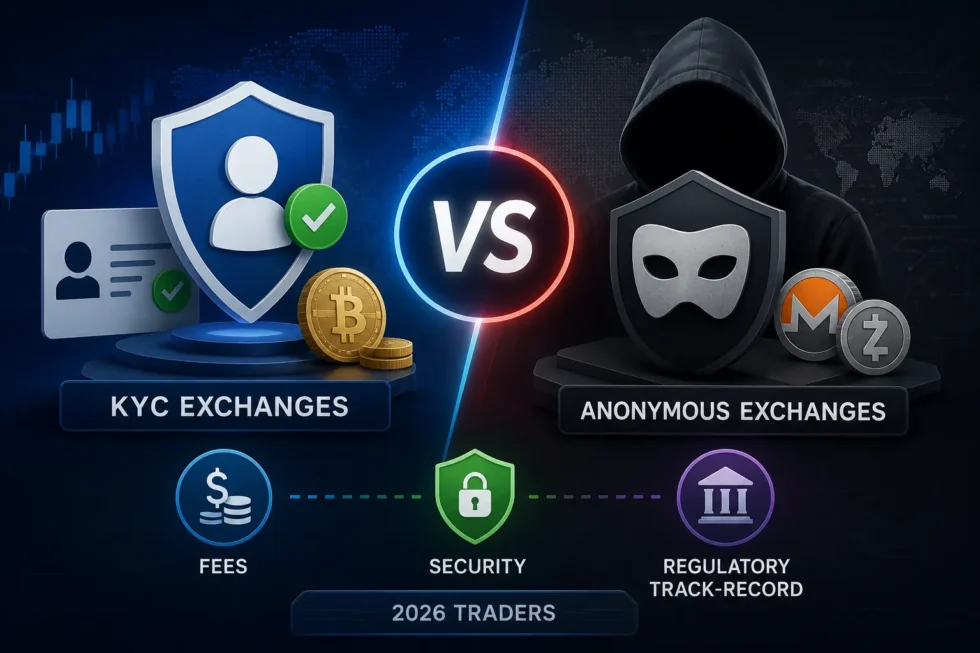
KYC vs Anonymous Crypto Exchanges: A Fee, Security, and Regulatory Track Record Comparison for 2026 Traders
Why this comparison belongs next to a cost map
Our pillar guide, The Global Crypto Exchange Cost Map 2026: 12 Trusted Platforms Compared by Trading Fees, Liquidity, Security, Withdrawal Speed & Regulatory Compliance, treats KYC status as one input among several. This article isolates that single variable and asks a narrower question: if you strip away brand loyalty and marketing copy, what does choosing a no-KYC platform over a fully verified one actually cost you — in basis points, in legal exposure, and in the odds your funds survive a breach?
It sits alongside our companion piece, Crypto Exchange Regulations Around the World: What Investors Need to Know in 2026, which maps the regulatory patchwork this article draws on. Read that piece first if you want the full jurisdiction-by-jurisdiction breakdown; this one applies those rules to a head-to-head KYC vs. anonymous decision.
What “no-KYC” actually means in 2026 (it’s rarely absolute)
Almost no centralized exchange marketed as “no-KYC” is KYC-free at every tier. What actually exists is a withdrawal-limit gate: trade freely, but hit a ceiling on how much you can move without submitting ID. As of mid-2026, the unverified daily withdrawal limits publicly listed by these platforms are:
| Exchange | Unverified daily withdrawal cap | Full KYC required for |
|---|---|---|
| MEXC | 10 BTC/day (some regional listings show 1,000 USDT/day tiers) | Fiat on-ramps, large withdrawals |
| BingX | Varies by region | Fiat, higher tiers |
| BloFin | 20,000 USDT/day | Fiat, higher tiers |
| BYDFi | 1.5 BTC/day | Fiat, higher tiers |
| CoinEx | 10,000 USD/24h, 50,000 USD/30 days (unverified) → up to $1,000,000 with ID | Fiat, high-volume trading |
Sources disagree on exact figures because limits change by region and quarter — treat any specific number as approximate and verify on the exchange’s live fee/limits page before relying on it. <cite index=”1-1″>MEXC offers three account tiers — unverified, primary KYC, and verified plus — with a roughly 1,000 USDT daily withdrawal limit for unverified users in most regions</cite>.
True zero-KYC only exists on non-custodial infrastructure — decentralized exchanges (Uniswap, PancakeSwap, dYdX) and peer-to-peer/atomic-swap networks (Bisq, Hodl Hodl, RoboSats), where there is no company account to verify in the first place because you’re trading from your own wallet against a protocol or a counterparty, not against a custodian. Genuinely important distinction: a “no-KYC CEX” still custodies your funds and still has a legal entity somewhere that can freeze your account or go dark. A DEX or non-custodial P2P network structurally cannot do either, because it never held your assets.
Also worth flagging: the roster of “no-KYC” exchanges shifts constantly. <cite index=”7-1″>KuCoin, OKX, Bybit, and Kraken now require mandatory KYC and should no longer be classified as no-KYC options</cite> as of 2026, despite still appearing on outdated “best no-KYC” lists. If you’re reading a listicle that includes Bybit or KuCoin as anonymous-friendly, it’s stale.
Real fee schedules: what KYC actually costs you
The privacy-vs-fee trade-off is smaller than most marketing implies, and in some cases it’s inverted — a few no-KYC platforms are not the cheapest option once you look at entry-tier rates.
Base-tier (VIP 0) spot maker/taker fees, verified against 2026 published schedules:
| Exchange | KYC status | Maker | Taker | Notes |
|---|---|---|---|---|
| MEXC | No-KYC tier available | 0% | 0.05% | <cite index=”25-1″>Lowest published spot maker/taker in the comparison set</cite> |
| OKX | KYC required | 0.08% | 0.10% | |
| Binance | KYC required | 0.10% | 0.10% | <cite index=”24-1″>25% discount available when fees are paid in BNB</cite> |
| Binance.US | KYC required | 0% | 0.02% | <cite index=”21-1″>Cheapest entry-tier rate among US-accessible exchanges</cite> |
| Bybit | KYC required | 0.10% | 0.10% | No longer genuinely no-KYC |
| Kraken (Kraken Pro) | KYC required | 0.25% | 0.40% | <cite index=”23-1″>Drops with higher 30-day volume; no inactivity fees</cite> |
| Coinbase Advanced Trade | KYC required | 0.60% | 1.20% | <cite index=”21-1″>Drops to 0.25%/0.40% at the $10,000 30-day volume tier</cite> |
| Gemini ActiveTrader | KYC required | 0.20% | 0.40% | Base tier; <cite index=”25-1″>scales toward roughly 0.00%/0.02% at the highest published tiers</cite> |
The bigger cost trap isn’t the maker/taker schedule — it’s the “simple” buy/sell screen every major KYC exchange defaults new users to. <cite index=”19-1″>Coinbase’s Simple interface runs roughly a 1.5% spread plus fees up to 3.99% depending on payment method, and Kraken’s Instant Buy layers roughly a 1.5% spread plus a 0.9% processing fee</cite> — five to ten times the cost of placing a limit order on the same exchange’s advanced interface. This matters for the KYC-vs-anonymous comparison because it means the real fee gap between a “cheap no-KYC exchange” and a “expensive KYC exchange” often has nothing to do with KYC at all — it’s about which order type and which interface you’re using. A KYC-verified Kraken Pro user placing limit orders at the $10K+ tier can pay less than an unverified user on a no-KYC platform using a convenience swap widget.
Withdrawal fees compound the same way and are asset-specific rather than KYC-specific — <cite index=”19-1″>Coinbase uses dynamic withdrawal fees that adjust with network conditions, which can run cheaper or more expensive than the flat fees many other exchanges charge</cite>, regardless of your verification tier.
Practical takeaway: if fee minimization is your actual goal, KYC status is a weak proxy for cost. Order type, interface choice, and 30-day volume tier explain far more of the fee variance than whether you uploaded a passport.
Regulatory status: the gap that’s closing fast in 2026
This is where the KYC/anonymous choice carries real, asymmetric consequences — and where 2026 is a genuine inflection point.
The MiCA deadline (EU)
<cite index=”29-1″>The final MiCA deadline across the EU is July 1, 2026 — after that date, any Crypto-Asset Service Provider without MiCA authorization must cease operations in the EU entirely, with no extensions or further grace periods</cite>. <cite index=”30-1″>Over 40 CASP licenses had been issued as of late 2025, and roughly 65% of EU-based crypto businesses reported compliance by Q1 2025</cite>, but a meaningful tail of platforms — disproportionately the ones marketed as no-KYC — has not applied. <cite index=”30-1″>France issued 14 enforcement notices in Q4 2025 alone, and Germany’s BaFin blocked access to six offshore exchange domains targeting German users without CASP authorization</cite>.
The Travel Rule threshold you’re actually subject to
FATF’s Recommendation 16 requires exchanges to collect and transmit sender/receiver identity data on transfers above a threshold — but that threshold varies sharply by jurisdiction, and the EU’s is effectively zero:
| Jurisdiction | Regulator | Travel Rule threshold | Applies to self-hosted wallets |
|---|---|---|---|
| European Union | EBA/ESMA (TFR) | <cite index=”38-1″>€0 — applies to all transfers</cite> | <cite index=”38-1″>Yes, with verification</cite> |
| United States | FinCEN | <cite index=”38-1″>$3,000</cite> | Partially |
| United Kingdom | FCA | <cite index=”38-1″>£1,000</cite> | <cite index=”38-1″>Yes</cite> |
| Singapore | MAS | <cite index=”38-1″>S$1,500</cite> | <cite index=”38-1″>Yes</cite> |
| Switzerland | FINMA | <cite index=”38-1″>CHF 1,000</cite> | <cite index=”38-1″>Yes</cite> |
| Canada | FINTRAC | <cite index=”38-1″>CAD 1,000</cite> | <cite index=”38-1″>No</cite> |
| Japan | FSA | <cite index=”38-1″>¥100,000</cite> | <cite index=”38-1″>No</cite> |
<cite index=”30-1″>For transfers to or from self-hosted wallets above €1,000, EU exchanges must now verify whether the customer actually controls that wallet before processing the transaction</cite> — meaning the “withdraw to your own cold wallet, no questions asked” experience that made no-KYC platforms attractive is itself disappearing for any platform trying to stay licensed in a major market. <cite index=”36-1″>As of FATF’s 2025 Targeted Update, 85 of 117 surveyed jurisdictions had passed Travel Rule legislation</cite>, so this isn’t an EU-only phenomenon; it’s the direction every major regulator is converging on.
What’s already happened to unlicensed exchanges — not hypothetical
The clearest evidence that “no-KYC” carries real regulatory risk isn’t a policy paper, it’s the enforcement record:
- <cite index=”41-1″>KuCoin pleaded guilty to operating an unlicensed money-transmitting business and paid $300 million in combined fines and forfeitures</cite> in January 2025. <cite index=”42-1″>The DOJ specifically cited KuCoin’s failure to implement effective AML and KYC programs, its failure to report suspicious transactions, and its failure to register with FinCEN</cite> as the underlying charges.
- <cite index=”43-1″>BitMEX pleaded guilty to willfully failing to establish an adequate AML program</cite>, and <cite index=”45-1″>until September 2020 had allowed customers to register and trade essentially anonymously, without any identifying information</cite>. <cite index=”47-1″>BitMEX was fined $100 million and given two years of unsupervised probation</cite>; its two founders separately <cite index=”39-1″>each agreed to pay a $10 million criminal fine</cite>.
- <cite index=”1-1″>Canadian authorities seized roughly $40 million in crypto and shut down TradeOgre in Canada’s first-ever full exchange takedown, after the RCMP’s yearlong investigation — prompted by a Europol tip — found the platform operated without registration or KYC checks, which authorities said made it attractive for money laundering</cite>.
- <cite index=”1-1″>ProBit Global announced it was closing services in early 2026 due to regulatory pressure, warning users to withdraw assets by February</cite>.
The pattern across all four cases is the same: regulators aren’t targeting anonymity as an abstract principle, they’re targeting the absence of a compliance program, and no-KYC-by-design is functionally indistinguishable from “no AML program” in a courtroom. If you’re trading meaningful volume, the operator’s licensing status is not a side detail — it’s the variable that determines whether your funds are sitting on a platform that could be seized mid-cycle.
DEXs occupy a genuinely different legal category
<cite index=”3-1″>DEX platforms like Uniswap, SushiSwap, and dYdX remain legal for US users because they operate as protocols rather than traditional exchanges</cite> — there’s no custodial entity to charge with unlicensed money transmission because there’s no custodian. This is the one place where “no-KYC” and “regulatorily durable” currently overlap. It’s also why our pillar page treats DEX liquidity and CEX liquidity as separate comparison categories rather than substitutes.
Security track records: breach data, not brand reputation
The largest CEX hack in history happened to a KYC-compliant exchange
It’s worth stating plainly, because it cuts against the intuitive “no-KYC = riskier” assumption: <cite index=”12-1″>the FBI attributed the theft of approximately $1.5 billion in virtual assets from Bybit on February 21, 2025 to North Korea</cite>, and Bybit is a fully KYC-compliant exchange that was, at the time, <cite index=”14-1″>pursuing a VASP license in Dubai and had just been removed from France’s AMF blacklist to pursue a MiCA license</cite>. <cite index=”17-1″>The attack was a supply-chain compromise of Safe{Wallet}’s multisig infrastructure — a developer machine was compromised, malicious JavaScript was injected into the interface, and Bybit’s signers approved what looked like a routine transfer while the underlying transaction logic had been altered</cite>. <cite index=”18-1″>This surpassed the $540 million Ronin Network hack in 2022, the $600 million Poly Network exploit in 2021, and the Mt. Gox collapse</cite>.
The lesson: KYC compliance is a regulatory and legal-exposure variable, not a custody-security variable. It tells you almost nothing about whether an exchange’s multisig, cold-storage, and signing infrastructure will hold up against a state-sponsored attacker. Bybit’s recovery — <cite index=”15-1″>it closed the ETH deficit within 72 hours through partnerships with Galaxy Digital, FalconX, Wintermute, and others, with reserves confirmed to exceed liabilities by independent auditor Hacken</cite> — is a genuinely different signal: balance-sheet depth and crisis response, which correlates more with an exchange’s size and capital reserves than with its KYC policy.
No-KYC exchanges have their own, separate breach history
The privacy argument for no-KYC platforms usually rests on reduced “attack surface” — no passport scan sitting in a database to leak. That’s a real point: <cite index=”6-1″>KuCoin’s 2020 hack exposed personal data across hundreds of thousands of accounts, and the Liquid exchange’s 2021 breach directly compromised identity documents</cite> — both breaches would have exposed less if those platforms had held less KYC data on file. Centralizing ID documents is a genuine, quantifiable risk that KYC exchanges carry and no-KYC platforms structurally avoid.
But that argument only holds for the identity-document attack surface — it says nothing about custody security. A no-KYC exchange still custodies your coins in a hot or cold wallet exactly like a KYC exchange, and that wallet is just as exposed to the kind of supply-chain and social-engineering attacks that hit Bybit, regardless of whether the exchange asked for a passport. The realistic security calculus is:
- Reduces: exposure to identity-theft-via-data-breach (KuCoin 2020, Liquid 2021 style incidents)
- Does not reduce: exposure to custodial-wallet compromise (Bybit 2025 style incidents), exit scams, or platform insolvency
- Adds: exposure to abrupt shutdown or fund seizure when the platform itself is the thing regulators go after (TradeOgre, ProBit)
Non-custodial venues sidestep both categories, with a different trade-off
Bisq and RoboSats <cite index=”6-1″>operate without any company behind them — no servers to seize, no accounts to freeze — using multisig escrow between peers directly, or, in RoboSats’ case, running natively over Tor with Lightning Network settlement</cite>. Uniswap <cite index=”6-1″>regularly clears over $2.4 billion in daily volume across supported chains as the most liquid no-KYC venue in existence</cite>. The trade-off here isn’t security in the breach sense — it’s operational: no customer support if you make a mistake, slower settlement on some P2P trades, and (for AMM-based DEXs) gas costs and slippage that don’t exist on a centralized order book.
Side-by-side: what you’re actually trading off
| Factor | KYC exchange (Coinbase, Kraken, Binance) | No-KYC-tier CEX (MEXC, BloFin, CoinEx) | Non-custodial (Uniswap, Bisq, RoboSats) |
|---|---|---|---|
| Base spot fees | Higher at entry tier (Coinbase 0.60%/1.20%), competitive at volume | Often lower (MEXC 0%/0.05%) | Gas + protocol fee, no maker/taker tiers |
| Regulatory durability | High — licensed, MiCA/FinCEN-compliant | Uncertain — several platforms have been fined, shut down, or delisted from “no-KYC” status mid-year | High for true DEXs (protocol, not entity) |
| Identity-breach exposure | Real — your ID sits in their database (KuCoin 2020, Liquid 2021) | Lower for unverified tiers | None — no ID collected |
| Custodial-hack exposure | Real — Bybit 2025 proves KYC doesn’t prevent this | Equally real — same custody model | None — you hold the keys |
| Fund-freeze/seizure risk | Low (licensed entity, legal recourse exists) | Elevated (TradeOgre, ProBit precedent) | Near zero (no entity to seize) |
| Fiat on/off-ramp | Full access | Limited or KYC-gated above small thresholds | None (need external on-ramp) |
| Tax reporting exposure | Exchange issues 1099s/reports to authorities | You self-report; <cite index=”7-1″>using a no-KYC exchange does not eliminate tax obligations — trades remain taxable events under 1099-DA in the US, and in the UK and EU regardless of whether the exchange collected identity data</cite> | Fully self-reported |
Where this leaves the decision
If you’re evaluating exchanges through the lens of our pillar cost map, treat KYC status as a proxy for two things it genuinely predicts — regulatory durability and fiat access — and not as a proxy for two things it doesn’t reliably predict — trading fees and custodial security. The fee gap is mostly explained by order type and volume tier, not verification status. The security gap is mostly explained by an exchange’s operational infrastructure and capital reserves, not verification status. What KYC status does reliably predict, based on the 2025–2026 enforcement record, is whether the platform survives the next regulatory cycle with your funds still on it.
For the jurisdiction-by-jurisdiction rules that determine which of these platforms remains legally accessible where you live — including the FATF Travel Rule variations and the MiCA transition deadline detailed above — see the full breakdown in Crypto Exchange Regulations Around the World: What Investors Need to Know in 2026.