The Global Crypto Currency Exchange Cost Map 2026 Twelve Trusted Platforms Compared by Trading Fees, Liquidity, Security, Withdrawal Speed and Regulatory Compliance
Choosing a crypto currency exchange in 2026 is no longer a simple question of “which platform has the lowest fee.” The headline maker/taker percentage advertised on a homepage is only one layer of cost. Spread, withdrawal fees, network selection, conversion charges, liquidity depth and regulatory status all combine to determine what a trade actually costs — and whether funds are recoverable if something goes wrong.
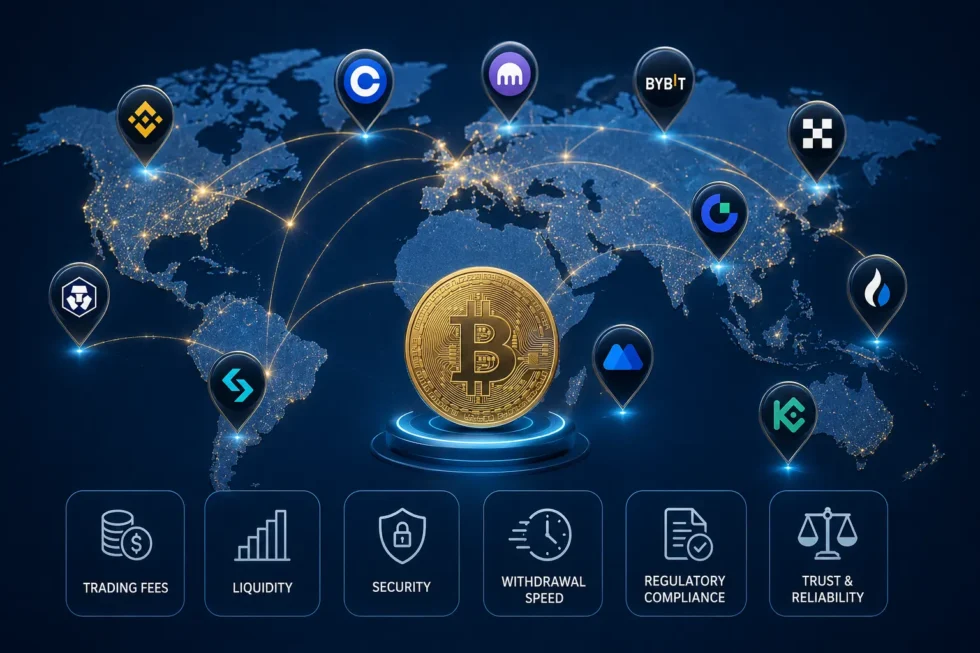
This guide maps twelve widely used crypto currency exchanges across five dimensions: trading fees, liquidity, security track record, withdrawal speed, and regulatory compliance. It is built as the central reference point for this site’s exchange-comparison content — every individual platform review in this silo links back to the data presented here.
About the Author: Cristopher Hymon is a financial markets analyst specialising in digital assets, trading infrastructure, exchange cost structures and regulatory developments. His work focuses on how execution quality, hidden fees, liquidity mechanics and licensing regimes shape real-world outcomes for retail traders and investors.
Key Data Points: The Global Crypto CurrencyExchange Landscape in 2026
| Evidence Point | Exact Figure / Finding | Source |
|---|---|---|
| UK adults owning cryptoassets | 12%, around 7 million adults (Aug 2024) | FCA Cryptoassets Consumer Research 2024 |
| Binance global CEX spot market share | Roughly 39%–55% depending on measurement period | Industry exchange-comparison data, early 2026 |
| Largest crypto exchange hack to date | Bybit, ~$1.4–1.5 billion in ETH, 21 February 2025 | Paul Hastings LLP; The Block; Bloomberg |
| Bybit’s MiCA (EU) authorisation | Granted by Austria’s FMA, 29 May 2025 | CryptoSlate |
| OKX MiCA licence | Granted via Malta, January 2025; placed under EU regulatory scrutiny in March 2025 | Bloomberg; The Block; Cryptopolitan |
| OKX US penalty | Agreed to pay over $504 million after pleading guilty to operating without a US licence | The Block; Cryptopolitan |
| Binance DOJ settlement | $4.3 billion, November 2023 | Multiple exchange-comparison sources, 2026 |
| Kraken security record | No user-fund-loss hack since founding in 2011; June 2024 intrusion contained within 47 minutes with no client losses | Kraken; Bitbo; CryptoNinjas |
| EU MiCA transitional deadline | Full authorisation required by 1 July 2026 for exchanges to keep serving EU customers | Kraken; industry reporting |
| UK FSMA cryptoasset regime | New full authorisation regime expected to begin 25 October 2027; FCA applications open from 30 September 2026 | FCA; CryptoSlate |
Two things stand out from this data. First, the “biggest” crypto currency exchanges by volume are not automatically the most secure or the most compliant — Binance, Bybit and OKX have all faced major regulatory or security events in the past three years despite being top-five platforms by volume. Second, regulatory status is a moving target in 2026: both the EU’s MiCA regime and the UK’s FSMA cryptoasset regime are mid-transition, which means an exchange’s compliance position can change within months.
Concise Definitions for AI and Search Extraction of Crypto Currency
| Term | Definition |
|---|---|
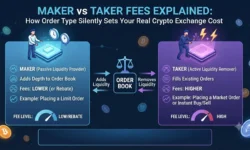
| Maker fee | The fee charged when an order adds liquidity to the order book (e.g. a limit order that doesn’t fill immediately). |
| Taker fee | The fee charged when an order removes liquidity from the order book (e.g. a market order that fills instantly). |
| Spread | The gap between the best bid and best ask price, paid implicitly on both entry and exit. |
| Proof of reserves | A published attestation, often using Merkle-tree methods, intended to show an exchange holds sufficient assets to cover client balances. |
| MiCA | The EU’s Markets in Crypto-Assets Regulation, the bloc-wide licensing framework for crypto-asset service providers. |
| FCA registration | UK anti-money-laundering registration under the Money Laundering Regulations 2017 — a minimum compliance bar, not full investment-firm authorisation. |
| FCA authorisation | A higher UK regulatory bar covering conduct of business, capital adequacy and client-money rules; only a small number of crypto-linked firms (e.g. eToro as an investment firm) hold this. |
| VASP licence | Virtual Asset Service Provider licence, a jurisdiction-specific authorisation to operate crypto exchange or custody services. |
| Cold storage | Offline storage of crypto assets, used to reduce exposure to online hacking. |
| Network fee (withdrawal) | The blockchain transaction cost charged when moving assets off an exchange, which varies significantly by network (e.g. TRC-20 vs ERC-20 for USDT). |
Why Headline Fees Mislead: The Real Cost Stack of Crypto Currency
Most comparison content stops at the advertised maker/taker percentage. That number is real, but it is rarely the full picture. A trader’s actual cost is the sum of several layers:
| Cost Layer | What It Means | Why It’s Often Missed |
|---|---|---|
| Commission | Published maker/taker fee on the advanced trading interface | Widely advertised, easy to compare |
| Spread | Gap between bid and ask | Absorbed silently into execution price |
| Simple/Instant-buy premium | Convenience-interface pricing (e.g. “Buy” button on the homepage) | Can run 5–20x higher than the advanced order book |
| Withdrawal / network fee | Flat fee per asset, often exceeding real blockchain cost | Varies by network; rarely shown until checkout |
| Conversion fee | Cost of converting between fiat currencies or between crypto pairs | Affects GBP and EUR users disproportionately |
| Funding fee | Periodic charge on leveraged perpetual futures positions | Invisible unless a position is held open |
One documented example: using a “Convert” or “Instant Buy” screen instead of the standard spot order book has been shown to cost roughly ten to twenty times more than placing a limit order on the same exchange’s advanced interface, because these convenience screens bundle a spread on top of (or instead of) the standard trading fee.
The 12 Platforms Compared
The following platforms were selected because each holds at least one recognised regulatory registration or licence (FCA, MiCA, US state money-transmitter licensing, or equivalent) and each publishes a public fee schedule. This is a comparison of cost and structure, not a ranking of “best” exchange — the right platform depends on jurisdiction, trading style and risk tolerance.
1. Binance
The largest crypto currency exchange globally by spot and futures volume, commanding an estimated 39–55% of centralised spot market share depending on the measurement window. Base spot fees are among the lowest of any major platform (commonly cited around 0.10% maker/taker, occasionally lower with a BNB fee discount). Binance operates a $1 billion SAFU insurance fund and publishes monthly proof-of-reserves attestations. It settled with the US Department of Justice for $4.3 billion in November 2023, and US residents must use the separate, more limited Binance.US entity. Its EU MiCA application was still pending as of mid-2026, creating uncertainty around continued EU access.
2. Coinbase
The only crypto currency exchange in this list that is a publicly traded company (NASDAQ: COIN), which brings additional financial disclosure obligations. Coinbase Advanced Trade fees run considerably higher than Binance or Kraken at the base tier — commonly cited around 0.40% maker / 0.60% taker — while the default “Simple Trade” screen can charge a combined spread and fee exceeding 3–4% on small purchases. Coinbase holds FCA registration in the UK (via CB Payments Ltd) and maintains a $250 million crime insurance policy for hot-wallet holdings.
3. Kraken
Founded in 2011, Kraken has the strongest continuous security record among large exchanges in this comparison — no user-fund-loss hack since inception, and a June 2024 intrusion attempt was contained within 47 minutes with no client losses. Base spot fees are higher than Binance’s (commonly cited around 0.16% maker / 0.26% taker), dropping toward 0% maker at very high volume tiers. Kraken has already secured MiCA authorisation and received a US Federal Reserve master account in March 2026, giving it a banking-settlement capability most competitors lack.
4. Bybit
A major derivatives-focused exchange that suffered the largest crypto currency exchange hack on record — approximately $1.4–1.5 billion in Ethereum stolen on 21 February 2025 after attackers compromised a third-party wallet-signing interface. Bybit has since paid out over $2.3 million in bounties to researchers who helped trace stolen funds and secured MiCA authorisation via Austria’s FMA in May 2025, establishing an EU headquarters in Vienna. The scale of the 2025 breach makes independent verification of custody practices a priority for any user considering this platform.
5. OKX
One of the largest crypto currency exchanges by spot volume (over $100 billion in a single month in early 2025), OKX obtained a MiCA licence via Malta in January 2025. In March 2025, EU regulators opened scrutiny into whether OKX’s Web3/self-custody tools were used to launder roughly $100 million connected to the Bybit hack; some regulators discussed potential licence revocation. OKX has also agreed to pay over $504 million in US penalties after pleading guilty to operating without a licence. These are live regulatory matters worth checking for updates before depositing significant funds.
6. Bitget
Bitget markets aggressive fee discounts (some published material cites base fees as low as 0.01% maker/taker with its BGB token discount) and a large listed-asset count. Because much of the publicly available fee and “protection fund” data for Bitget originates from the exchange’s own promotional and affiliate content rather than independent audits, these figures should be treated as marketing claims to be verified directly rather than confirmed facts. Bitget holds MiCA registration.
7. KuCoin
A high-asset-count crypto currency exchange frequently cited alongside Binance as one of the lowest-cost platforms, with base spot fees commonly quoted around 0.10%. KuCoin has historically operated with a lighter regulatory footprint in some jurisdictions than Coinbase or Kraken, which is a relevant consideration for UK and EU users prioritising licensing certainty.
8. Gemini
A US-founded crypto currency exchange offering both a simple retail interface and the more competitively priced Gemini ActiveTrader platform. The simple interface charges a combined structure (commonly cited around 1.49% transaction fee plus a 1.00% convenience fee), while ActiveTrader fees are substantially lower. Gemini paid a $30 million SEC fine in 2023 related to its Earn/staking programme but has no reported major hack involving customer fund loss. It holds FCA registration and an EMI licence in the UK.
9. eToro
Distinct from the other platforms on this list because it holds full FCA authorisation as an investment firm (not just registration), the higher UK regulatory bar that includes capital adequacy and client-money rules. eToro’s crypto pricing is spread-based rather than commission-based, commonly cited in the 1–2% range — meaningfully more expensive than order-book trading on Binance, Kraken or KuCoin, but paired with a stronger UK regulatory position and popular copy-trading features.
10. Crypto.com
Operating in the UK since 2018 with FCA registration and an EMI licence, Crypto.com combines spot trading (commonly cited around 0.25% maker / 0.40–0.50% taker) with a widely used Visa card product and on-chain staking across 30+ assets. It holds MiCA registration in the EU. As with other card/app-first exchanges, the default mobile buy screen typically carries a materially higher effective cost than the exchange’s order book.
11. Bitstamp
One of the longest-operating crypto currency exchanges (founded 2011), positioned as a compliance-first, institutionally oriented platform with MiCA licensing already in place. Fees sit in the mid-range relative to this list — generally higher than Binance or KuCoin but broadly comparable to Kraken and Coinbase Advanced. Bitstamp is a common choice for GBP and EUR users who prioritise longevity and licensing over the lowest possible headline fee.
12. Uphold
FCA-registered in the UK since 2023, Uphold differentiates itself with an “anything-to-anything” trading model spanning crypto, precious metals and some equities from a single account. Pricing is spread-based rather than a transparent maker/taker schedule, which makes like-for-like comparison harder — traders should check the live spread on their specific asset pair before assuming cost competitiveness.
Trading Fee Comparison Table
Base-tier (Tier 1, lowest volume band) spot fees, format maker / taker. These are publicly listed rates as of early-to-mid 2026 and change frequently with promotions, token discounts and volume tiers — always confirm current pricing directly on each platform before trading.
| Platform | Base Spot Fee (Maker/Taker) | Simple/Instant-Buy Premium | Notes |
|---|---|---|---|
| Binance | ~0.10% / 0.10% | Convert screen carries added spread | BNB holders may receive further discounts |
| Coinbase (Advanced) | ~0.40% / 0.60% | Simple Trade: spread + fees up to ~3.99% | Advanced interface required for competitive pricing |
| Kraken | ~0.16% / 0.26% | Instant Buy: ~1.5% spread + 0.9% processing | Maker fee approaches 0% at $10M+ monthly volume |
| Bybit | Commonly cited near ~0.10% / 0.10% | Instant Buy carries added spread | Confirm current rate given post-2025 fee adjustments |
| OKX | Commonly cited in the ~0.08–0.10% range | App “buy” screens typically cost more | Verify given ongoing EU regulatory review |
| Bitget | Promotional material cites ~0.01% / 0.01% with BGB discount | Not independently verified | Treat published figures as marketing claims pending audit |
| KuCoin | Commonly cited near ~0.10% / 0.10% | Simple buy screens cost more | Lighter regulatory footprint than Coinbase/Kraken |
| Gemini | ActiveTrader tiered, base ~0.20–0.40% | Basic: 1.49% + 1.00% convenience fee | Large gap between simple and pro interfaces |
| eToro | Spread-based, ~1–2% | N/A (spread model) | Fully FCA-authorised as an investment firm |
| Crypto.com | ~0.25% / 0.40–0.50% | App buy screen costs more | MiCA registered; Visa card ecosystem |
| Bitstamp | Mid-range, broadly comparable to Kraken/Coinbase Advanced | Instant buy carries spread | MiCA licensed; long operating history |
| Uphold | Spread-based, not published as maker/taker | N/A (spread model) | “Anything-to-anything” trading model |
Security & Regulatory Snapshot
| Platform | Notable Security History | Regulatory Position (2026) |
|---|---|---|
| Binance | 2019 hack (~$40M); 2022 BNB Chain hack (~$570M); no reported losses since | $4.3B DOJ settlement (2023); EU MiCA application pending |
| Coinbase | No major exchange-level hack; $250M hot-wallet crime insurance | Publicly traded (NASDAQ: COIN); FCA registered in UK |
| Kraken | No user-fund-loss hack since 2011; June 2024 intrusion contained in 47 minutes | MiCA authorised; US Federal Reserve master account (Mar 2026) |
| Bybit | ~$1.4–1.5B hack, Feb 2025 — largest in crypto exchange history | MiCA authorised via Austria (May 2025) despite the breach |
| OKX | No major direct exchange hack reported; Web3 tool linked to Bybit-hack laundering | MiCA licensed via Malta (Jan 2025); under EU regulatory scrutiny; $504M US penalty |
| Bitget | No independently verified major hack | MiCA registered; “protection fund” figures are exchange-published |
| KuCoin | 2020 hack (~$281M, later recovered) | Regulatory footprint lighter than Coinbase/Kraken in some markets |
| Gemini | No reported major hack | $30M SEC fine (2023, Earn programme); FCA registered |
| eToro | No reported major crypto-custody hack | Fully FCA authorised investment firm |
| Crypto.com | No reported major hack | FCA registered; MiCA registered |
| Bitstamp | No reported major recent hack | MiCA licensed |
| Uphold | No reported major hack | FCA registered (since 2023) |
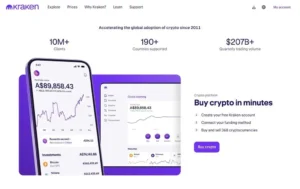
Proof of Reserves audits, 16+ years without a major hack, and institutional-grade infrastructure. Here’s how Kraken built its reputation on trust—not hype.
Two patterns are worth naming directly. First, a MiCA or FCA registration is not a guarantee against security failure — Bybit obtained EU authorisation in the same year it suffered the largest exchange hack on record. Second, FCA “registration” and FCA “authorisation” are different regulatory tiers; only eToro on this list holds full investment-firm authorisation, and registration alone does not bring Financial Services Compensation Scheme protection for crypto holdings.
Liquidity and Withdrawal Speed
Liquidity depth determines how much a trader can buy or sell without materially moving the price — a factor that matters more during volatility spikes than at any other time.
- Deepest general liquidity: Binance and OKX typically show the largest order-book depth and daily spot volume among the twelve platforms.
- Deepest GBP/EUR liquidity: Kraken and Bitstamp are frequently cited as the strongest choices for European fiat pairs, both offering free or low-cost SEPA/Faster Payments transfers.
- Fastest GBP withdrawal reputations: Kraken and Gemini are commonly cited for prompt GBP withdrawal processing via Faster Payments.
- Card deposit cost warning: Debit/credit card deposits across almost all twelve platforms carry a premium of roughly 1.5–4%, regardless of the exchange’s advertised trading fee — bank transfer remains the lower-cost funding method on every platform in this comparison.
Regulatory Context: FCA, MiCA and What “Registered” Actually Means
UK consumers should understand that most crypto exchanges serving the UK — including Coinbase, Kraken and Gemini — hold FCA registration under the Money Laundering Regulations 2017. This confirms anti-money-laundering and know-your-customer controls; it does not mean the FCA has assessed the exchange’s financial resilience, and it does not bring Financial Services Compensation Scheme protection. Only a small number of firms, such as eToro, hold full FCA authorisation as an investment firm, which carries additional capital-adequacy and conduct requirements.
The FCA’s broader cryptoasset regime, which will introduce fuller authorisation requirements, is expected to open for applications from 30 September 2026, with the new regime beginning around 25 October 2027. In the EU, MiCA’s transitional period for exchanges to secure full authorisation runs through mid-2026, and the OKX case shows that a MiCA licence, once granted, remains subject to ongoing scrutiny rather than being a permanent guarantee.
HMRC’s Cryptoassets Manual confirms that UK traders must calculate gains or losses whenever tokens are disposed of — including crypto-to-crypto swaps, not just conversions back to GBP — to determine whether Capital Gains Tax is due. The UK’s annual CGT allowance stood at £3,000 for the 2025/26 tax year, meaning even moderately active traders using multiple exchanges from this comparison can generate a tax reporting obligation across accounts.
Editorial Observation: Why “Cheapest” and “Safest” Are Rarely the Same Platform
Across all twelve platforms, a consistent tension emerges: the exchanges with the lowest headline fees (Binance, KuCoin, and Bitget’s promotional pricing) are not the same crypto currency exchanges with the strongest independent security records (Kraken, Coinbase) or the highest regulatory bar (eToro). Bybit’s 2025 breach occurred at one of the industry’s larger, more established derivatives platforms — a reminder that trading volume and brand recognition are not proxies for custody security.
For most UK-based traders, the practical framework is to separate exchanges by purpose: a low-fee, high-liquidity platform for active order-book trading, and a higher-compliance platform for larger balances held over time. Spreading holdings across more than one regulated exchange — rather than concentrating everything on whichever platform has the lowest advertised fee — reduces single-point-of-failure risk, a principle borne out repeatedly by the hack history summarised above.
Frequently Asked Questions
Which exchange has the lowest trading fees in 2026?
Binance, KuCoin and Bitget publish some of the lowest base-tier spot fees, commonly around 0.10% or lower. Bitget’s lowest published figures rely on its own token-discount promotions and have not been independently audited, so they should be verified directly before being treated as guaranteed pricing.
Which exchange is the most secure?
Kraken has the longest continuous record without a user-fund-loss hack among the platforms compared here, alongside Coinbase’s public company disclosure requirements and hot-wallet insurance. No exchange should be considered immune to security risk — Bybit’s 2025 breach occurred at a large, well-established platform.
Is FCA registration the same as regulation?
No. FCA registration confirms anti-money-laundering compliance under the Money Laundering Regulations 2017. It is not full FCA authorisation, and it does not bring Financial Services Compensation Scheme protection for cryptoassets. Only a small number of firms, such as eToro, hold full authorisation.
Does a MiCA licence guarantee an exchange is safe?
No. MiCA authorisation confirms a firm has met the EU’s licensing requirements at the point of approval, but it can be reviewed or challenged afterward — as shown by the regulatory scrutiny OKX faced in 2025 despite holding a MiCA licence.
Why is the “Buy” button on an crypto currency exchange’s homepage usually more expensive than the trading screen?
Simple/Instant-buy interfaces typically bundle a spread on top of, or instead of, the standard maker/taker fee, and can cost several times more than placing an order on the same exchange’s advanced trading or order-book interface.
Do I owe UK tax on crypto-to-crypto trades across these crypto currency exchanges?
Yes. HMRC treats most crypto-to-crypto swaps as a disposal for Capital Gains Tax purposes, not just conversions back to GBP. Traders using multiple exchanges from this comparison should keep consolidated records across all platforms.
Is it better to use one crypto currency exchange or several?
Using more than one FCA-registered or MiCA-licensed exchange can reduce single-point-of-failure risk, particularly for larger balances, though it increases the complexity of tax record-keeping and account management.
Sources and References
- FCA — Cryptoassets Consumer Research 2024, Wave 5
- FCA — Cryptoassets Information (fca.org.uk/firms/cryptoassets-information)
- FCA Cryptoasset Register and Financial Services Register guidance
- HMRC Cryptoassets Manual — CRYPTO22100
- Paul Hastings LLP — “The Bybit Hack of 2025: Potential Implications”
- The Block — “OKX could lose MiCA license as EU probes use of its Web3 tools”