Free VPN vs Paid VPN Which One Protects Your Privacy Better
Free VPN vs paid VPN is one of the most common decisions people face before downloading their first privacy tool. Both promise encrypted connections and hidden IP addresses, yet the privacy protection behind each option can differ dramatically. This guide compares free VPN vs paid VPN across logging practices, encryption standards, revenue models, and real-world risk, so you can choose the option that actually matches your privacy needs.
This article builds on our Free VPN Complete Guide (2026), which ranks the best free VPNs across speed, streaming, and security. For a closer look at data-selling risks specifically, read our related piece on whether free VPNs sell your data.
Free VPN vs Paid VPN: Business Model Differences
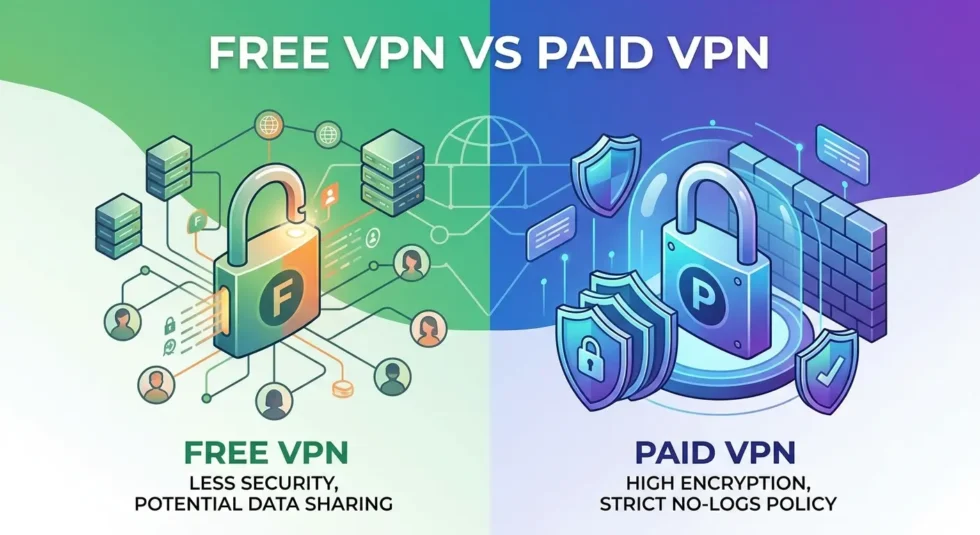
Every VPN needs revenue to operate servers and maintain apps. Paid VPNs generate income directly from subscribers, which removes much of the pressure to monetize user data. Free VPNs, by contrast, often rely on advertising, freemium upgrades, or in some cases the sale of browsing data to third parties.
This distinction matters more than most users realize. A subscription-funded VPN has a financial incentive to protect your privacy, since data breaches or leaked logs damage the brand that pays its bills through trust. A free VPN funded by advertising or data sales faces the opposite incentive: your information itself becomes part of the revenue stream.
Logging Policies: Free VPN vs Paid VPN Transparency
Logging practices separate trustworthy VPNs from risky ones, regardless of price. Reputable paid VPNs commission independent audits to verify their no-logs claims, publishing the results for public review. Many free VPN providers skip this step entirely, leaving users to trust marketing language without proof.
Some free VPN apps log connection timestamps, IP addresses, or even browsing activity despite advertising a strict no-logs policy. Paid providers aren’t automatically immune to this problem, but the audit culture around subscription services makes false claims easier to catch and expose.
Encryption and Security Standards Compared
Encryption strength varies widely between free and paid tiers, even within the same company. Paid VPNs typically use AES-256 encryption alongside modern protocols like WireGuard or OpenVPN, paired with features such as a kill switch and DNS leak protection.
Free VPN plans sometimes use weaker encryption or omit critical safety features to cut costs. A missing kill switch, for example, can expose your real IP address the moment your connection drops. Before trusting any provider, confirm which protocols and safeguards apply to the specific plan you’re using, not just the brand name.
Server Networks and Speed Trade-Offs
Paid VPNs generally maintain larger server networks spread across more countries, which improves speed and reduces congestion. Free VPN services often limit users to a handful of overcrowded servers, since expanding infrastructure costs money that free tiers can’t easily recover.
Slower speeds aren’t just an inconvenience. Overcrowded servers can also increase the temptation for providers to monetize traffic through ads or data collection, since server costs still need to be covered somehow.
Free VPN vs Paid VPN: Data Privacy Risk Comparison
The table below summarizes how free and paid VPNs typically compare across core privacy factors.
| Factor | Free VPN | Paid VPN |
|---|---|---|
| Revenue source | Ads, upgrades, possible data sales | Subscription fees |
| Independent audits | Rare | Increasingly common |
| Encryption strength | Often inconsistent | Typically AES-256 |
| Kill switch availability | Sometimes missing | Usually included |
| Server network | Limited | Larger and more distributed |
| Data-sale risk | Higher | Lower, though not zero |
Price alone doesn’t guarantee privacy, since some paid providers have faced their own controversies. Still, the incentive structure behind subscriptions tends to favor stronger user protection overall.
When a Free VPN Might Be Enough
Not every situation demands paid-tier protection. Occasional use for light browsing, bypassing a geo-restriction once, or testing a service before committing can justify a free VPN, provided you choose a reputable one. Casual users with minimal sensitive data at stake may find the trade-offs acceptable.
Sensitive activities change the calculation considerably. Banking, handling confidential work documents, or browsing in countries with strict surveillance laws call for the stronger guarantees that paid VPNs generally provide.
When a Paid VPN Is Worth the Investment
Frequent travelers, remote workers, and anyone handling sensitive personal data benefit most from a paid VPN’s stronger encryption and audited no-logs policies. The monthly cost of a reputable paid service is often modest compared to the potential cost of a data breach or privacy violation.
Streaming enthusiasts also tend to prefer paid VPNs, since larger server networks unlock more regional content libraries with fewer buffering issues. If your privacy needs extend beyond occasional casual browsing, the investment typically pays for itself.
Final Verdict: Free VPN vs Paid VPN for Privacy
Paid VPNs generally offer stronger, more verifiable privacy protection than free VPN alternatives, thanks to audited no-logs policies, robust encryption, and a revenue model that doesn’t depend on user data. Free VPNs still hold value for casual, low-risk browsing, provided you research the specific provider carefully.
For a full breakdown of the safest free VPN options available this year, revisit our Free VPN Complete Guide (2026). If data-selling risks concern you most, our article on whether free VPNs sell your data explains exactly what to watch for.