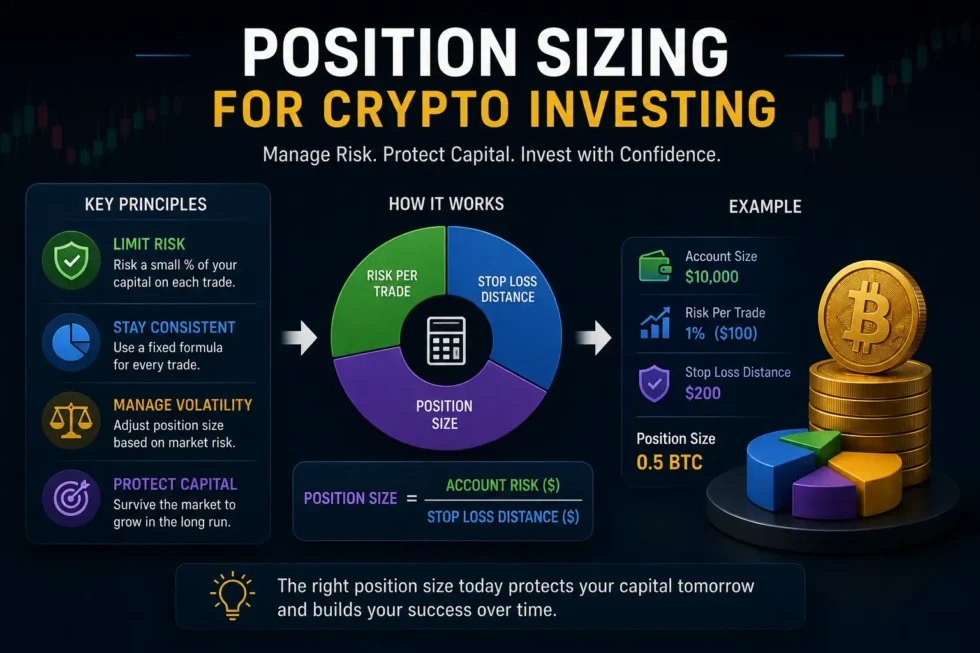
Position Sizing for Crypto Investing A Smart Risk Strategy in 2026
Position sizing for crypto investing determines how much capital you allocate to a single trade or asset. Get this wrong, and even a great entry point won’t save you from outsized losses. Get it right, and you can survive volatility that wipes out less disciplined investors.
This article explains how position sizing protects your portfolio and complements the tactics covered in our Crypto Risk Management Strategies Every Investor Should Follow guide. It also ties directly into the diversification principles from The Smart Crypto Investing Blueprint 2026, our core guide to building a lower-risk digital asset portfolio.
What Is Position Sizing in Crypto Investing?
Position sizing refers to the process of deciding how much of your total portfolio to put into a single crypto asset or trade. Instead of investing a random amount, you calculate a specific percentage based on your risk tolerance, account size, and the asset’s volatility.
This calculation happens before you enter a trade, not after. Planning your allocation in advance keeps emotion out of the decision.
Why Allocation Percentage Matters More Than Entry Price
Many new investors obsess over finding the perfect entry price. Experienced traders know that allocation size often matters more. A poor entry with proper sizing causes minor damage, while a great entry with oversized allocation can devastate a portfolio during a sudden crash.
How to Calculate Crypto Position Size
Several methods exist for calculating the right allocation. Each one balances risk differently depending on your goals and experience level.
The Fixed Percentage Method
This approach caps every position at a set percentage of your total portfolio, commonly between 1% and 5%. A trader with a $50,000 portfolio using a 2% cap would risk no more than $1,000 per position. This method keeps losses manageable even during a losing streak.
The Volatility-Adjusted Method
Not all crypto assets carry equal risk. Bitcoin typically moves less dramatically than smaller altcoins, so volatility-adjusted sizing allocates smaller amounts to highly volatile tokens and larger amounts to more stable assets. This method requires tracking historical price swings for each asset in your portfolio.
The Risk-Per-Trade Method
Some investors size positions based on the distance to their stop loss level rather than a flat percentage. A wider stop loss results in a smaller position, while a tighter stop loss allows a larger one. This approach ties your position size directly to your defined risk per trade.
Common Position Sizing Mistakes Crypto Investors Make
Overconfidence after a winning streak often leads investors to abandon their sizing rules entirely. Increasing allocation size just because recent trades performed well ignores the fact that markets remain unpredictable.
Chasing pumps creates another common trap. Investors sometimes deploy oversized positions into assets that already rallied hard, hoping to catch further upside before a correction hits.
Ignoring correlation between assets causes hidden risk too. Holding large positions in several altcoins that move together during a downturn defeats the purpose of diversification, even if each individual position looks appropriately sized on paper.
Position Sizing and Portfolio Diversification
Position sizing works hand in hand with diversification. Spreading capital across multiple assets means nothing if one oversized position can still crater your entire portfolio. Proper sizing ensures that no single trade, no matter how confident you feel about it, can cause irreversible damage.
This principle connects directly to the broader diversification strategy outlined in The Smart Crypto Investing Blueprint 2026. Building a resilient portfolio requires both spreading your capital across assets and controlling how much you commit to each one.
Combining Position Sizing With Stop Loss and Mental Stops
Sizing decisions and exit strategies work best together. A well-calculated position size limits your downside before you even enter a trade, while your exit method — whether an automated stop loss or a disciplined mental stop — protects you once you’re in the position. Investors who combine both tools tend to weather volatile markets more consistently than those who rely on only one.
Final Thoughts: Making Position Sizing Part of Your Crypto Strategy
Position sizing isn’t the most exciting part of crypto investing, but it may be the most important. Calculating your allocation before every trade removes guesswork and keeps a single bad decision from derailing your long-term goals.
For the complete risk management framework this strategy fits into, revisit Crypto Risk Management Strategies Every Investor Should Follow, and explore the full portfolio-building approach in The Smart Crypto Investing Blueprint 2026: Building a Diversified Digital Asset Portfolio with Lower Risk and Higher Long-Term Growth.