The Smart Crypto Investing Blueprint 2026 How to Build a Diversified Digital Asset Portfolio for Lower Risk and Higher Long Term Growth
Crypto has moved from a speculative sideshow into a recognized asset class, and that shift changes what a Smart Crypto Investing Blueprint actually needs to include. Institutional desks now hold spot Bitcoin and Ethereum through regulated vehicles, corporate treasuries add digital assets to their balance sheets, and regulatory frameworks in major economies have grown clearer. None of that removes risk from crypto. It does mean that the old approach — pick a coin, buy it, and hope — no longer matches how the market behaves.
This guide lays out a structured, evidence-based approach to crypto portfolio construction. It covers asset selection, allocation models, risk controls, tax basics, and the mental habits that separate durable investors from short-term traders. Readers will find a key-data table, plain-language definitions, side-by-side comparison tables, an editorial section with independent observations, and a sourced FAQ. The goal is a reference page that a beginner can follow step by step and an experienced holder can still use to sanity-check their strategy.
What “Diversification” Actually Means in a Digital Asset Portfolio
Diversification in traditional finance spreads capital across assets with low correlation, so a decline in one holding doesn’t sink the whole portfolio. Crypto complicates that idea because most tokens move together during major market swings; when Bitcoin drops sharply, altcoins usually drop harder. True diversification in crypto therefore requires layering across a few different dimensions rather than simply buying ten different coins.
Layer One: Asset Category
A resilient portfolio mixes store-of-value assets, smart-contract platforms, infrastructure tokens, and a stablecoin reserve. Each category responds to different market drivers, which reduces the odds that one macro event wipes out the entire allocation at once.
Layer Two: Market Capitalization Tier
Large-cap coins behave differently than small-cap tokens during volatility spikes. Blending tiers gives a portfolio exposure to established liquidity alongside smaller assets that carry higher upside and higher failure risk.
Layer Three: Custody and Platform Risk
Holding assets across a mix of self-custody wallets, regulated exchanges, and possibly a small allocation through spot ETFs spreads counterparty risk. A single exchange failure should never be able to erase an entire portfolio.
Key Data: Crypto Market Snapshot for 2026
The table below summarizes market conditions referenced by multiple industry trackers as of early-to-mid August 2026. Figures move daily, so treat this as a directional snapshot rather than a live price feed.
| Metric | Approximate Figure (Aug 2026) | Why It Matters for Portfolio Building |
|---|---|---|
| Bitcoin price | ~$65,000 | Anchors position sizing and rebalancing bands |
| Bitcoin market dominance | ~59% | Signals how much the broader market still tracks BTC |
| Bitcoin market capitalization | ~$1.29 trillion | Confirms BTC’s status as the primary liquidity venue |
| Combined top-10 crypto market cap | Over $2 trillion | Shows the scale of assets available for diversification |
| Institutional access vehicles | Spot ETFs, corporate treasuries, regulated custodians | Lowers the barrier for risk-managed exposure |
| Dominant investor focus for 2026 | Utility, liquidity, developer activity over pure hype | Reflects a maturing selection process |
Bitcoin’s continued dominance illustrates why most balanced blueprints still treat it as the portfolio’s core holding rather than one option among equals. <cite index=”2-1″>Bitcoin remains the largest cryptocurrency with a market capitalization of around $1.29 trillion and approximately 59% market dominance, supported by its liquidity, institutional adoption, and fixed supply</cite>. Ethereum, meanwhile, retains its role as the leading platform for decentralized applications; <cite index=”2-1″>its broad developer base, institutional participation, and role across NFTs, tokenization, and decentralized applications support its long-term investment case</cite>.
Core Definitions Every Crypto Investor Should Know
Understanding a few core terms prevents costly mistakes later. This block defines the vocabulary used throughout the rest of the guide.
- Market capitalization: the total value of a coin’s circulating supply, calculated as price multiplied by circulating units. It indicates size and relative liquidity, not safety.
- Volatility: the degree and speed of price swings over a given period. Crypto volatility is typically several multiples higher than equities.
- Rebalancing: periodically adjusting holdings back to target allocation percentages, usually by trimming winners and adding to underweighted positions.
- Self-custody: holding the private keys to a wallet directly, rather than leaving assets on an exchange or with a third-party custodian.
- Stablecoin: a token designed to hold a steady value, usually pegged to a fiat currency such as the US dollar, used for liquidity and risk reduction rather than growth.
- Dollar-cost averaging (DCA): investing a fixed amount at regular intervals regardless of price, which smooths out the average entry cost over time.
- Correlation: a statistical measure of how closely two assets move together; high correlation limits the benefit of holding both.
- Drawdown: the percentage decline from a portfolio’s peak value to its lowest subsequent point before recovery.
Building the Blueprint: A Tiered Allocation Model
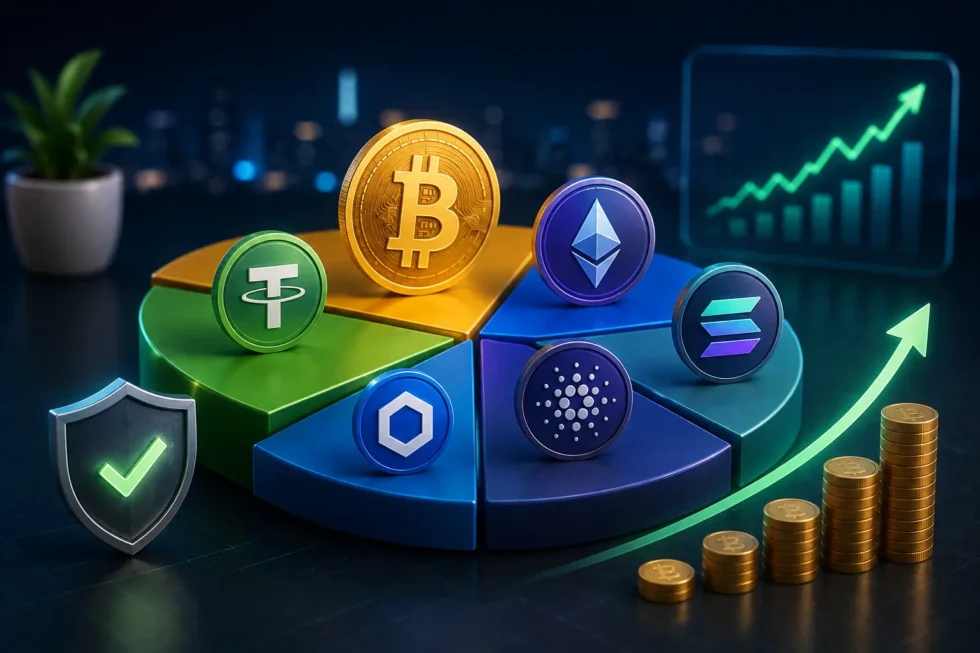
A workable digital asset portfolio typically separates holdings into three tiers, each with a different risk-and-reward profile and a different sizing rule. This structure keeps the total portfolio from swinging wildly on the fortunes of any single token.
Tier One: Core Holdings (50–65% of Crypto Allocation)
Bitcoin and Ethereum usually anchor this tier because of their liquidity, custody options, and years of market history. These two assets carry lower relative volatility than smaller tokens, even though both can still swing by double digits in a single week.
Tier Two: Growth and Infrastructure Assets (20–35%)
This tier includes established layer-1 and layer-2 networks, payment-focused tokens, and infrastructure projects with real usage metrics. Diversifying across several networks in this tier avoids concentrating growth exposure in one ecosystem that could lose developer momentum.
Tier Three: Opportunistic and Stability Positions (10–20%)
Smaller allocations here can include emerging sector tokens (AI-linked, real-world-asset, or DeFi projects) alongside a stablecoin reserve held for rebalancing and buying dips. Treat this tier as the part of the portfolio built for experimentation and liquidity management, not for large bets.
Comparison: Bitcoin vs. Ethereum vs. a Diversified Basket
| Factor | Bitcoin (BTC) | Ethereum (ETH) | Diversified Basket (8–12 assets) |
|---|---|---|---|
| Primary role | Store of value, “digital gold” | Smart-contract and DeFi infrastructure | Broad market exposure |
| Volatility profile | High, but lowest among major cryptos | Higher than BTC, moderate among large caps | Varies; typically higher aggregate swings |
| Liquidity | Highest in the market | Second-highest | Uneven across smaller holdings |
| Institutional access | Spot ETFs, treasuries, custodians | Spot ETFs, staking products | Limited outside top assets |
| Growth ceiling | Lower relative upside, higher stability | Moderate-to-high upside | Highest theoretical upside, highest failure risk |
| Best portfolio role | Core anchor | Core-to-growth bridge | Satellite/growth layer |
Comparison: Risk-Management Approaches for Crypto Portfolios
| Approach | How It Works | Best For | Trade-Off |
|---|---|---|---|
| Fixed-percentage rebalancing | Adjust holdings back to target weights on a set schedule | Investors who want discipline without daily monitoring | Can trigger taxable events depending on jurisdiction |
| Dollar-cost averaging | Buy fixed amounts at regular intervals | Long-term accumulators reducing timing risk | Slower to capture sharp dips |
| Stop-loss thresholds | Automatically exit a position past a set drawdown level | Active traders managing downside on volatile tokens | Can trigger during short-term volatility, locking in losses |
| Stablecoin buffer strategy | Hold a cash-like reserve to rebalance during downturns | Investors prioritizing capital preservation | Reduces exposure to upside during rallies |
| Barbell strategy | Combine a large safe core with small high-risk bets | Investors comfortable with asymmetric outcomes | Requires strong conviction on both ends of the barbell |
Risk Controls That Belong in Every Blueprint
Position sizing matters more than coin selection for most portfolios. Capping any single non-core asset at a modest percentage of total crypto holdings prevents a single failed project from causing catastrophic losses. Investors should also separate “invested” capital from money needed within the next one to three years, since forced selling during a downturn locks in losses that a longer time horizon would likely have recovered.
Security deserves equal weight alongside market risk. Two-factor authentication, hardware wallets for long-term holdings, and careful vetting of exchanges reduce the chance of losing funds to hacks or platform failures rather than market moves. A portfolio can be well-diversified on paper and still suffer total loss through a single security lapse, so operational hygiene functions as its own risk-management layer. The Global Crypto Currency Exchange Cost Map 2026 Twelve Trusted Platforms Compared by Trading Fees, Liquidity, Security, Withdrawal Speed and Regulatory Compliance.
Tax and Regulatory Basics to Factor Into the Blueprint
Tax treatment of digital assets varies by country, but several principles apply broadly. Selling, swapping, or spending crypto typically triggers a taxable event in jurisdictions that treat it as property. Staking rewards and airdrops are often taxed as income at the time of receipt. Keeping detailed records of purchase price, date, and disposal price for every transaction makes year-end reporting far easier and helps investors calculate true after-tax returns rather than gross gains. Regulatory clarity has improved through 2026, with clearer ETF frameworks and custody rules in several major markets, though rules can still shift with new legislation, so investors should confirm current requirements with a licensed tax professional in their jurisdiction.
Editorial Observations: What the 2026 Market Actually Tells Long-Term Investors
A few patterns stand out from watching this market cycle unfold, and they’re worth stating plainly rather than burying in caveats.
First, the narrative around crypto has genuinely shifted from speculation toward fundamentals. <cite index=”1-1″>Institutional crypto investment has passed a tipping point in terms of being accepted as one of the fundamental factors shaping future crypto market forecasts, with new regulated investment vehicles giving traditional investors an entry method that carries less risk than buying digital currencies directly</cite>. That doesn’t mean crypto has become “safe” in an absolute sense. It means the mechanisms for entering and exiting positions have matured, which reduces some of the operational risk that plagued early crypto investors.
Second, dominance concentration in Bitcoin and Ethereum hasn’t disappeared despite years of predictions that altcoins would eventually dilute it. <cite index=”3-1″>With Bitcoin hovering near the mid-$60,000s and Ethereum working through a gradual recovery, investor interest has shifted toward high-market-cap tokens that show strong financial health and real-world utility rather than speculative smaller names</cite>. A blueprint built entirely around finding the “next” breakout altcoin ignores where liquidity and institutional capital are actually flowing.
Third, energy and infrastructure criticism of proof-of-work mining remains a live consideration for socially conscious investors. <cite index=”4-1″>The U.S. Energy Information Administration has estimated that crypto mining represents up to 2.3% of U.S. electricity consumption</cite>, a figure worth weighing for investors who care about the environmental footprint of their holdings, even if it doesn’t change the underlying investment math.
The practical takeaway: chasing hype cycles has historically underperformed a disciplined, tiered strategy that treats crypto as a long-duration, high-volatility satellite allocation within a broader financial plan — not as the entire plan.
Common Mistakes That Undermine a Crypto Portfolio
Overconcentration in a single token remains the most frequent error, often driven by a strong short-term price run that convinces investors to abandon their allocation targets. Ignoring rebalancing compounds this problem, since winning positions naturally grow to dominate a portfolio if nobody trims them back to target weight. Emotional trading during drawdowns causes many investors to sell near local bottoms and buy back in near local tops, which erodes returns compared to a static buy-and-hold or DCA approach. Finally, neglecting security — reusing passwords, skipping hardware wallets, or leaving large balances on exchanges — turns a market risk into an avoidable operational loss.
Step-by-Step: Assembling a Personal Blueprint
- Define time horizon and risk tolerance. Money needed within three years generally shouldn’t sit in volatile crypto assets.
- Set a total portfolio allocation percentage. Many balanced planners suggest keeping crypto to a single-digit-to-low-teens percentage of total investable assets, adjusted for personal risk appetite.
- Allocate across the three tiers described earlier, starting heavier in core holdings and lightening exposure toward the opportunistic tier.
- Choose custody methods that match the size of each holding, using hardware wallets for long-term core positions.
- Set a rebalancing schedule, such as quarterly or semi-annual reviews, and stick to it regardless of short-term sentiment.
- Track cost basis and tax obligations from the first transaction, not after several years of accumulated trades.
- Revisit the blueprint annually as market structure, regulation, and personal circumstances evolve.
Sample Portfolio Structures by Risk Profile
Concrete examples make the tiered model easier to apply. The three sample structures below illustrate how conservative, balanced, and aggressive investors might translate the same framework into different weightings. None of these are personalized recommendations; they’re starting points for a conversation with a financial professional or for further personal research.
Conservative Profile
A conservative structure leans heavily on Tier One, typically placing 70–80% of crypto holdings in Bitcoin and Ethereum combined. The remaining allocation splits between a stablecoin reserve for liquidity and a small position in one or two established infrastructure tokens. This structure prioritizes capital preservation and accepts a lower growth ceiling in exchange for smaller drawdowns during market stress.
Balanced Profile
A balanced structure follows the tier percentages outlined earlier fairly closely: roughly 55% core holdings, 30% growth and infrastructure assets spread across four to six networks, and 15% split between opportunistic positions and a stablecoin buffer. This profile suits investors with a multi-year horizon who can tolerate meaningful volatility without needing to touch the funds.
Aggressive Profile
An aggressive structure reduces the core tier to around 40%, expands growth and infrastructure exposure to 35–40%, and dedicates the remainder to smaller-cap and emerging-sector tokens. This approach targets higher long-term returns but comes with proportionally larger drawdowns, and it generally suits investors with a long time horizon, stable income elsewhere, and genuine comfort with the possibility of losing a meaningful share of the opportunistic tier entirely.
How Macro Conditions Shape the Blueprint Over Time
Crypto doesn’t move in isolation from broader financial markets, and a durable blueprint accounts for that connection rather than ignoring it. Interest-rate policy, dollar strength, and equity-market liquidity all influence how much capital flows into risk assets, crypto included. When borrowing costs fall and liquidity expands, digital assets have historically attracted more speculative and institutional capital alike. When conditions tighten, crypto often experiences sharper corrections than traditional equities because of its higher volatility baseline and its historically thinner liquidity during stress periods.
This connection means investors shouldn’t build a blueprint assuming crypto will behave independently of stocks, bonds, and macro data releases. A genuinely diversified personal portfolio treats crypto as one component within a broader asset allocation that also includes traditional securities, cash reserves, and — depending on the individual — real assets. Sizing the crypto sleeve relative to that broader picture, rather than in isolation, keeps a single volatile asset class from dictating overall financial outcomes.
Frequently Asked Questions
What percentage of a portfolio should go into crypto in 2026?
There’s no universal number, since it depends on age, income stability, and risk tolerance. Many financial planners suggest keeping crypto exposure to a modest single-digit-to-low-teens percentage of total investable net worth, treating it as a high-volatility satellite rather than a core holding.
Is Bitcoin still the safest crypto asset to hold?
Bitcoin carries lower relative volatility and higher liquidity than most other digital assets, and it benefits from the deepest institutional infrastructure. “Safest” remains relative within an asset class that can still swing by double-digit percentages in short periods.
How many different cryptocurrencies should a diversified portfolio hold?
Somewhere between eight and fifteen assets across different categories typically balances diversification against the added complexity of tracking too many small positions. Holding dozens of tokens rarely improves diversification, since most altcoins remain highly correlated during major market moves.
Should stablecoins count as part of a crypto allocation?
Yes. Stablecoins serve as the liquidity and rebalancing layer of a portfolio, letting investors buy dips or cover short-term needs without selling volatile positions at an inopportune time.
How often should a crypto portfolio be rebalanced?
Quarterly or semi-annual rebalancing works for most long-term investors, since it enforces discipline without generating excessive trading costs or tax events.
Does diversification eliminate crypto risk?
No. Diversification reduces concentration risk but doesn’t remove market-wide volatility, regulatory risk, or security risk. Even a well-diversified crypto portfolio can experience sharp, correlated drawdowns during broad market stress.
Conclusion: Turning the Blueprint Into a Habit
A Smart Crypto Investing Blueprint isn’t a one-time purchase decision; it’s an ongoing discipline built on tiered allocation, consistent rebalancing, sound custody practices, and honest tax record-keeping. The market has matured considerably by 2026, with clearer regulation and deeper institutional participation, but that maturity hasn’t erased volatility or risk. Investors who treat crypto as a structured, sized allocation within a broader financial plan — rather than a speculative bet on the next breakout coin — put themselves in the strongest position to capture long-term growth while keeping downside risk manageable.
Sources and References
- Analytics Insight — Top Cryptocurrencies to Buy in August 2026
- Bitcoin Foundation — Top 5 Crypto Assets to Invest In: Best Cryptocurrencies for Maximum ROI
- CoinDCX — Top 10 Cryptos to Invest in August 2026 (By Market Cap)
- Forbes Advisor — Top 10 Cryptocurrencies of August 10, 2026
- Statista — Crypto Market Cap Ranking 2026
This article is for educational purposes only and does not constitute financial, investment, tax, or legal advice. Digital assets are volatile and speculative. Consult a licensed financial advisor before making investment decisions.