Stop Loss vs Mental Stop Best Crypto Risk Strategy for Investors
Every crypto investor eventually faces a hard question: stop loss vs mental stop — which one actually protects your capital? Crypto markets move fast, and a single bad night can wipe out weeks of gains. Choosing the right exit method is one of the most important risk decisions you’ll make as a digital asset investor.
This article breaks down both approaches in detail. It also builds on the strategies covered in our Crypto Risk Management Strategies Every Investor Should Follow guide, and connects back to the broader framework in The Smart Crypto Investing Blueprint 2026, our complete guide to building a diversified digital asset portfolio.
What Is a Stop Loss Order in Crypto Trading?
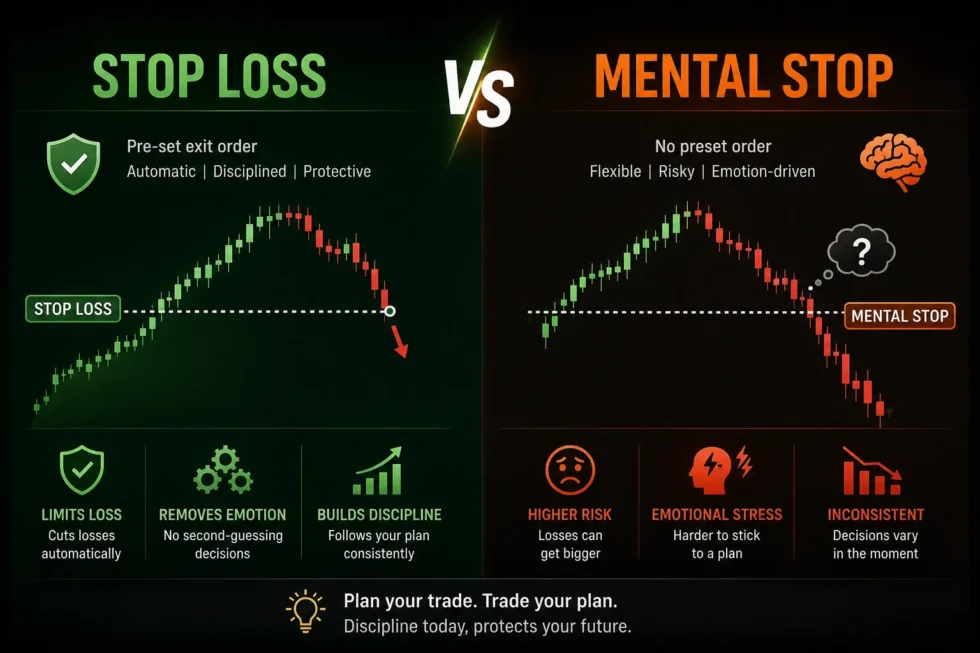
A stop loss order is a pre-set instruction that automatically sells your crypto asset once it hits a specific price. You define the exit point in advance, and the exchange executes the trade without any further input from you.
This method removes emotion from the equation. Once the order is placed, the system handles everything.
How Automated Exit Points Work
Most exchanges let you set a stop loss as a percentage below your entry price. For example, a 10% stop loss on a Bitcoin purchase triggers an automatic sale if the price drops 10% from where you bought in. Traders often pair this with a take-profit order to lock in gains on the upside too.
What Is a Mental Stop in Digital Asset Trading?
A mental stop works differently. Instead of placing an order on the exchange, you simply decide in your head where you’ll exit if the price falls too far. No system enforces this decision — you do.
Many experienced crypto traders prefer this approach for certain assets, especially during periods of high volatility.
The Psychology Behind Manual Exit Decisions
Mental stops demand discipline. Fear and hope both creep in when a price crashes, and many investors hesitate to sell even after their mental line gets crossed. This hesitation is exactly why some traders avoid mental stops for volatile altcoins and reserve them for more established assets.
Stop Loss vs Mental Stop: Key Differences Every Crypto Investor Should Know
Understanding the core differences helps you match the right tool to the right situation.
Execution Speed and Automation
A stop loss executes instantly once the trigger price is hit. A mental stop depends entirely on you being present, alert, and willing to act. During a flash crash, that gap in speed can cost you significantly.
Emotional Discipline and Human Error
Automated stops protect you from your own emotions. Manual stops test your discipline directly, since nothing forces the trade except your own willpower. Investors with strong risk discipline sometimes prefer mental stops because they avoid being “stopped out” by short-term wicks that automated orders can’t distinguish from real trend reversals.
Pros and Cons of Stop Loss Orders
- Pro: Executes automatically, even while you sleep
- Pro: Removes emotional decision-making from the exit process
- Con: Can trigger prematurely during short-term volatility spikes
- Con: Some exchanges experience slippage during high-volume crashes
Pros and Cons of Mental Stops
- Pro: Offers flexibility to reassess before selling
- Pro: Avoids being triggered by temporary price wicks
- Con: Requires constant market attention
- Con: Vulnerable to emotional decision-making under pressure
Which Exit Strategy Fits Your Crypto Portfolio?
Your choice depends on your trading style, asset type, and available time. Active day traders managing volatile altcoins usually benefit more from automated stop losses. Long-term holders of major assets like Bitcoin or Ethereum sometimes prefer mental stops, since they want room to ride out short-term dips without triggering unnecessary sales.
Portfolio size matters too. Larger positions often call for automated protection simply because the financial impact of a missed exit grows with position size.
Combining Stop Loss and Mental Stop for Smarter Risk Control
Many seasoned investors don’t choose one method exclusively. Instead, they layer both strategies together. A wide stop loss order protects against catastrophic downside, while a tighter mental stop allows for more nuanced, judgment-based exits within that range.
This hybrid approach reflects the broader risk management philosophy outlined in our Crypto Risk Management Strategies Every Investor Should Follow article, where diversification and disciplined exit planning work together to protect long-term returns.
Final Thoughts: Choosing the Right Exit Strategy for Long-Term Crypto Growth
Neither stop loss nor mental stop is universally superior. Your ideal approach depends on your risk tolerance, trading frequency, and the specific crypto assets in your portfolio. Testing both methods on smaller positions can help you discover which style suits your temperament before committing larger capital.
For a complete framework on building a resilient, diversified crypto portfolio, revisit The Smart Crypto Investing Blueprint 2026: Building a Diversified Digital Asset Portfolio with Lower Risk and Higher Long-Term Growth. Strong exit discipline, whether automated or manual, is one of the pillars that separates long-term crypto investors from short-term speculators.