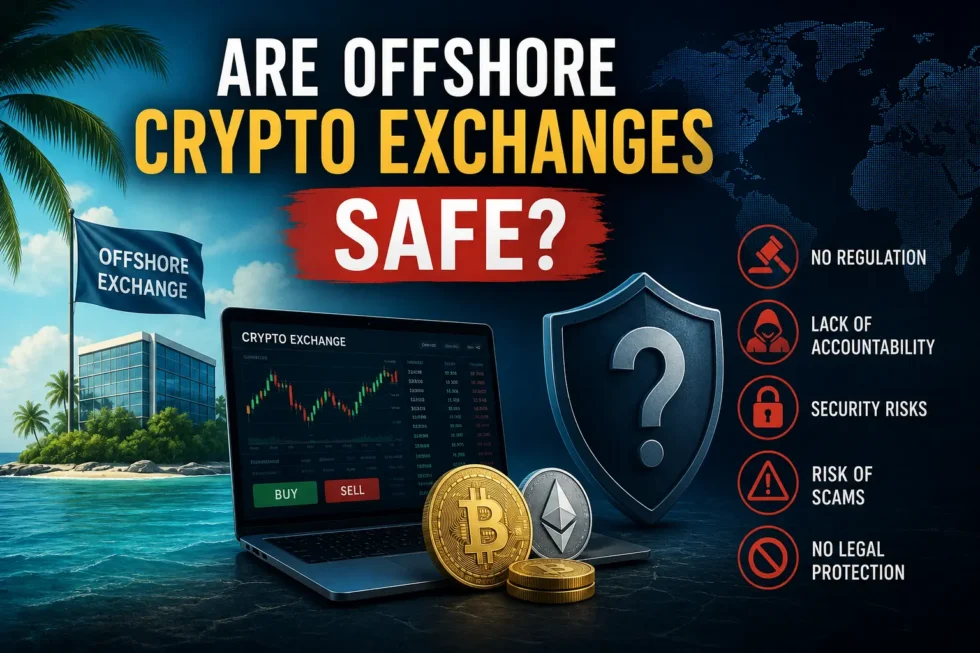
Are Offshore Crypto Exchanges Safe in 2026 Seychelles, BVI, and Dubai Licensing Rules, Real Enforcement Records, and What FTX and Bybit Proved About Offshore Risk
Why “offshore” isn’t the right question
Our pillar guide, The Global Crypto Exchange Cost Map 2026: 12 Trusted Platforms Compared by Trading Fees, Liquidity, Security, Withdrawal Speed & Regulatory Compliance, scores exchanges on regulatory compliance as one factor among several — not as a binary onshore/offshore flag. That’s deliberate. “Offshore” is a jurisdiction label, not a safety rating. A Seychelles-licensed exchange and an unlicensed Seychelles shell company are both technically “offshore,” and in 2026 those two things carry almost opposite risk profiles.
This article, part of the same cluster as Crypto Exchange Regulations Around the World: What Investors Need to Know in 2026, unpacks what offshore licensing actually requires today, what’s changed since the FTX collapse, and what the enforcement and collapse record says about which offshore structures hold up under stress and which don’t.
Offshore crypto regulation in 2026 is not what it was in 2021
The single most important fact for this question: the “no-license offshore” era is largely over for exchanges with real trading volume. <cite index=”55-1″>For the better part of a decade, Seychelles was the jurisdiction of choice for crypto businesses wanting a credible-looking offshore presence without real financial regulation — around 20% of global crypto exchanges incorporated there at one point, including OKX, KuCoin, HTX, BitMEX, and MEXC, using International Business Company structures that were fast and cheap but carried very little formal oversight</cite>.
<cite index=”55-1″>That ended on September 1, 2024, when Seychelles’ Virtual Asset Service Providers Act (VASP Act) came into force. Operating virtual asset services in or from Seychelles without an FSA license is now a criminal offense carrying fines of up to $350,000 or imprisonment of up to 15 years</cite>. <cite index=”55-1″>OKX, Bybit, eToro, and KuCoin were among the early FSA approvals, and the FSA now requires live system walk-throughs, genuine operational substance, and a new Code of Corporate Governance effective January 2026</cite>.
The same pattern has played out across essentially every classic offshore hub:
- <cite index=”52-1″>The BVI Financial Services Commission now requires VASP registration under the Virtual Assets Service Providers Act 2022 for any business exchanging virtual assets for fiat or crypto, or providing custodial wallet services</cite>.
- <cite index=”52-1″>Cayman Islands operates under the Virtual Asset (Service Providers) Act through CIMA</cite>, and <cite index=”51-1″>Cayman full licenses are the reference point for institutional prime brokerage and hedge fund counterparties</cite>.
- <cite index=”52-1″>The Bahamas regulates through the Digital Assets and Registered Exchanges Act (DARE Act) under the Securities Commission of The Bahamas</cite> — the same regulator that eventually froze FTX’s Bahamian assets in November 2022, discussed below.
- <cite index=”54-1″>Dubai’s Virtual Assets Regulatory Authority (VARA) published Version 2.0 of its rulebooks in May 2025, with mandatory compliance by June 30, 2025</cite>, and <cite index=”57-1″>introduced a “sponsored VASP” model where smaller firms operate under a licensed sponsor that handles capital adequacy, audits, and reporting</cite>.
The practical implication: “offshore” today usually means “licensed somewhere other than the US or EU,” not “unregulated.” <cite index=”49-1″>Offshore does not mean unregulated</cite> is now the operative reality — but the quality of that regulation varies enormously by jurisdiction, and that variance is the actual thing worth investigating.
What separates a real offshore license from a paperweight
Cost and setup speed correlate closely with regulatory rigor — that correlation itself is useful diligence information:
| Jurisdiction | Regulator | Typical setup cost | Timeline | Capital requirement |
|---|---|---|---|---|
| Seychelles | FSA (VASP Act 2024) | <cite index=”52-1″>~$10,000+</cite> | <cite index=”51-1″>5–9 months</cite> | <cite index=”51-1″>$30,000–$100,000 tier (Type B)</cite> |
| BVI | FSC (VASP Act 2022) | <cite index=”50-1″>$22,000–$70,000+ first year, $1,500+/month ongoing</cite> | <cite index=”50-1″>4–6 months (up to 12 for complex structures)</cite> | <cite index=”50-1″>No fixed minimum; must show 6–12 months of operating expenses</cite> |
| Cayman Islands | CIMA (VASP Act) | <cite index=”52-1″>$100,000+</cite> | <cite index=”51-1″>4–10 months</cite> | <cite index=”56-1″>No statutory minimum</cite> |
| Dubai | VARA | <cite index=”56-1″>From AED 100,000 capital</cite> | <cite index=”56-1″>6–12 months</cite> | <cite index=”56-1″>From AED 100,000</cite> |
| EU (MiCA CASP) | ESMA/national regulators | <cite index=”56-1″>€50,000–€150,000</cite> depending on activity tier | <cite index=”51-1″>3–12 months</cite> | <cite index=”56-1″>€50,000 (advisory) to €150,000 (trading platforms), per MiCA Article 67</cite> |
A jurisdiction that takes 4–6 weeks and a few thousand dollars with no capital requirement and no live compliance review is not offering the same protection as one that takes 6–12 months, requires six figures in capital, and conducts operational walk-throughs. When you’re evaluating whether an offshore-licensed exchange is safe, the license itself is only informative if you check which license, from which regulator, under which act — “licensed offshore” without those three details is close to meaningless.
Two failure modes, and they are not the same risk
The evidence splits offshore exchange risk into two genuinely distinct categories. Conflating them is where most “are offshore exchanges safe” content goes wrong.
Failure mode 1: the operator never had real compliance (fraud/AML failure)
This is the BitMEX and KuCoin pattern covered in our companion article on KYC vs. Anonymous Crypto Exchanges: an offshore entity deliberately avoided building AML/KYC infrastructure to save cost and attract volume, then got caught. <cite index=”43-1″>BitMEX, incorporated in Seychelles, pled guilty to willfully failing to establish an adequate AML program</cite> and <cite index=”47-1″>was fined $100 million</cite>. <cite index=”41-1″>KuCoin, also Seychelles-based, pled guilty to operating an unlicensed money-transmitting business and paid $300 million in combined fines and forfeitures</cite>. Both were “offshore” in the geographic sense; neither had the operational substance that a real VASP license now requires.
Failure mode 2: the operator had a license but lacked genuine solvency controls (custody/governance failure)
This is the more dangerous pattern, because it happened to an exchange that looked properly regulated. <cite index=”63-1″>FTX, a Bahamas-based exchange, was the third-largest cryptocurrency exchange by volume with over one million users when it filed for bankruptcy in November 2022</cite>. <cite index=”59-1″>By November 8, 2022, it had become clear FTX had an $8 billion shortfall because customer funds had been improperly transferred to Alameda Research, the affiliated trading firm, for trading and investments</cite>. <cite index=”64-1″>Alameda had secretly borrowed billions of dollars’ worth of FTX customer funds, leaving the exchange without sufficient funds to process withdrawals</cite>.
Critically: <cite index=”62-1″>the Bahamian regulator froze FTX’s assets on November 10, 2022</cite> — but that regulatory action came after the collapse was already underway, not before it. <cite index=”65-1″>One core failure was the absence of transparent, verifiable proof of reserves — FTX claimed full backing of customer deposits but provided no independent verification mechanism, and when the crisis hit, actual liquid assets turned out to be a fraction of customer liabilities</cite>. <cite index=”59-1″>Regulators in the Bahamas, Japan, and other jurisdictions where FTX operated all initiated separate actions after the fact</cite>, which underlines that even a nominally licensed offshore jurisdiction did not prevent — or catch in advance — a governance failure of this scale.
Why this distinction matters for the “is offshore safe” question: a jurisdiction’s licensing regime can screen out failure mode 1 (the deliberate non-compliance case) reasonably well, which is exactly what Seychelles’ 2024 VASP Act and similar regimes elsewhere are now doing. It’s much less effective against failure mode 2 (a licensed operator committing outright fraud with commingled funds), because that requires ongoing solvency verification — proof of reserves, independent audits, segregation of client assets — not just an initial licensing gate.
What actually protects you, regardless of jurisdiction label
Based on the post-FTX response across the industry, the meaningful safety signals are these, and none of them map cleanly to “onshore” vs. “offshore”:
Proof of reserves, independently verified. <cite index=”59-1″>Exchanges should publish regular proof-of-reserves attestations verified by independent third-party auditors, using cryptographic methods (Merkle tree proofs) to demonstrate they hold sufficient assets to cover customer balances</cite>. <cite index=”65-1″>This is not a complete solution on its own — Merkle proofs show an exchange holds what it says it holds at a point in time, but a sophisticated bad actor can still time asset movements around an audit window</cite> — but its absence, as at FTX, is a serious red flag on its own.
Segregation of client assets from operating capital. The core FTX failure was commingling — <cite index=”64-1″>FTX customer funds were used for venture investments, real estate, political donations, and covering Alameda’s trading losses</cite>, all of which should have been structurally impossible if client deposits were segregated. Real VASP frameworks now build this in explicitly — <cite index=”35-1″>CASPs under MiCA must place client fiat with an EU credit institution or central bank by the end of the next business day, and must never use client assets for their own account</cite>. Ask, for any offshore exchange, whether its license requires the same.
Protection/insurance funds. <cite index=”61-1″>Some exchanges maintain dedicated protection funds — one industry example is a $300 million+ fund tied to registrations across multiple jurisdictions</cite> — that exist specifically to backstop a security incident or shortfall. This is separate from, and complementary to, proof of reserves: reserves prove solvency today, a protection fund provides a buffer if something goes wrong tomorrow.
Regulatory substance, not just registration. The Seychelles case is instructive precisely because it shows the difference: <cite index=”55-1″>the pre-2024 IBC structure was “fast, cheap, and accepted by enough PSPs and banking partners to be commercially viable” but came with “very little in the way of formal oversight,” while the post-VASP Act regime requires live compliance walk-throughs and genuine operational substance</cite>. A license obtained in a 4-week, no-audit process is not the same signal as one obtained in a 9-month process involving live system reviews.
Multiple, layered jurisdictional registration. <cite index=”61-1″>Platforms with multiple regulatory registrations, substantial protection funds, and regular proof-of-reserves publications have generally presented lower counterparty risk than those relying on any single factor</cite>. An exchange licensed only in a minimal-substance jurisdiction, with no audits and no other registrations, is a materially different risk than one holding, say, both a Seychelles VASP license and a Dubai VARA license, each with their own review process.
A practical checklist before trusting an offshore exchange with funds
- Identify the specific license and act, not just the country. “Registered in Seychelles” pre-September 2024 meant almost nothing; “FSA VASP-licensed under the 2024 Act” means something specific and checkable against the FSA’s public register.
- Check whether the license covers the activity you’re using. <cite index=”53-1″>A VASP license authorizes operation from the licensing jurisdiction — it does not automatically authorize serving customers in their home countries. A BVI VASP license does not authorize serving US retail customers; a Seychelles VASP does not grant EU market access under MiCA</cite>. An exchange serving you without the right jurisdictional authorization for your location is a compliance gap, not a technicality.
- Look for independently audited proof of reserves, updated regularly, not a one-time snapshot.
- Confirm client-asset segregation is a stated policy, not an assumption.
- Cross-check the enforcement record. Has the entity — or its predecessor structure — been the subject of a DOJ, CFTC, SEC, FCA, or FSA enforcement action? BitMEX and KuCoin’s histories were publicly available before their respective guilty pleas; the AML gaps that led to both were long-standing and, in BitMEX’s case, <cite index=”39-1″>flagged internally as far back as May 2018</cite>.
- Treat licensing speed and cost as a signal, not a footnote. A jurisdiction with no capital requirement and a multi-week approval process filters out less than one requiring six-figure capital and a multi-month operational review.
The honest answer
Offshore crypto exchanges are not inherently unsafe, and “offshore” is no longer a synonym for “unregulated” the way it was before 2024 — <cite index=”55-1″>Seychelles’ criminal penalties for unlicensed VASP activity now reach 15 years’ imprisonment</cite>, and <cite index=”57-1″>Dubai’s VARA runs a full supervised rulebook</cite>. But the label tells you almost nothing on its own. The determining factors are the same ones that separated BitMEX and KuCoin’s failures from Bybit’s post-hack recovery, and the same ones FTX’s collapse showed were missing entirely: verified reserves, segregated custody, genuine — not nominal — regulatory substance, and a track record you can actually check. An offshore exchange with all four is a reasonable choice. An offshore exchange with none of them is a bet, regardless of how professional its marketing looks.
For the full jurisdiction-by-jurisdiction regulatory map this analysis draws on — including MiCA’s July 2026 deadline and FATF Travel Rule variations — see Crypto Exchange Regulations Around the World: What Investors Need to Know in 2026, and for how these regulatory factors weigh against fees and liquidity across specific platforms, see our Global Crypto Exchange Cost Map 2026.