Proof of Reserves Explained 2026: How Merkle Trees, zk Proofs, and Third Party Audits Really Verify Your Crypto Exchanges Solvency And Where They Still Fail
“Proof of Reserves” has become one of the most-cited trust signals in crypto — and one of the most misunderstood. Exchanges publish reserve ratios above 100% and users treat it as a solvency guarantee. It isn’t quite that, and the gap between what PoR proves and what people assume it proves has already caused real losses in 2026. This article breaks down exactly how PoR works mechanically, which major exchanges use which method, and — using a real April 2026 collapse as the case study — where the methodology has documented limits.
This is the third piece in our exchange security series. If you haven’t read them yet, start with [How Secure Are Crypto Exchanges? Security Features Every Investor Should Check] for the broader security framework, and see how PoR practices factor into the full platform comparison in [The Global Crypto Exchange Cost Map 2026: 12 Trusted Platforms Compared by Trading Fees, Liquidity, Security, Withdrawal Speed & Regulatory Compliance]. It also pairs directly with our piece on [Cold Wallet Storage vs. Exchange Custody], since PoR is specifically about verifying custodial (exchange-held) assets, not self-custodied ones.
What Proof of Reserves Actually Is
A Proof of Reserves review is an independent verification — typically performed by a third-party accountant or blockchain forensics firm — that confirms a custodian actually holds the assets it claims to hold on behalf of its users. It became a mainstream demand almost overnight after FTX’s November 2022 collapse revealed a roughly $8 billion gap between what FTX claimed to hold and what it actually had, following the platform’s misuse of customer funds through its affiliated trading firm, Alameda Research. FTX never published a PoR report before its collapse.
The mechanical process, as implemented by exchanges like Kraken and Binance, works like this:
- Snapshot. An independent accountant or auditor takes an anonymized snapshot of every client’s account balance at a specific point in time.
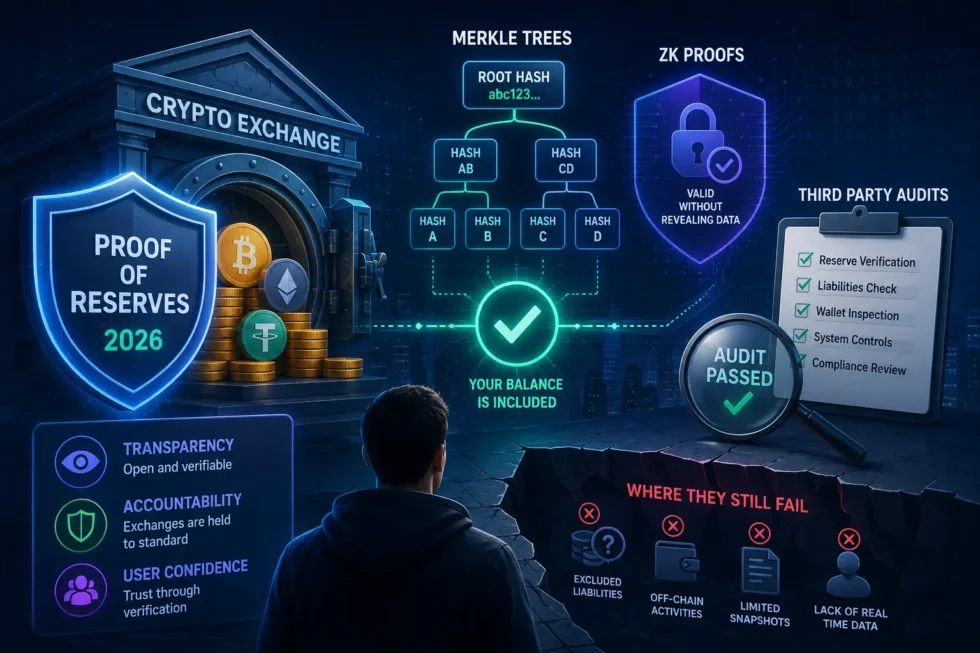
- Merkle tree construction. Those balances are hashed and aggregated into a Merkle tree — a cryptographic data structure that compresses all individual account balances into a single “root” hash, without exposing any individual user’s data to the public.
- On-chain verification. The auditor separately collects cryptographic signatures proving the exchange controls the on-chain wallet addresses holding the actual crypto, and compares the total on-chain holdings against the total client liabilities encoded in the Merkle tree.
- User self-verification. Each user can take their own “Merkle Leaf ID” or “Record ID” and confirm their specific balance was included in the snapshot, without needing to trust the exchange’s word for it.
This is the specific design that lets an exchange prove solvency to the public while keeping individual account balances private.
Merkle Trees vs. Zero-Knowledge Proofs: The Two Dominant Methods in 2026
By 2026, the major exchanges have split into two broad technical camps:
Merkle tree / third-party attestation — the original and still most widely used method. Kraken performs regular independent accountant reviews using this structure and gives users a Merkle Leaf ID to verify inclusion themselves. Binance uses the same core structure and states its Proof of Reserves shows user assets are backed 1:1, plus additional reserves on top.
Zero-knowledge proofs — a newer layer some exchanges have added on top of or instead of a plain Merkle tree, designed to prove solvency without revealing even the aggregate structure of balances. OKX uses zk-STARKs to verify that client assets held on the platform match assets held in OKX’s on-chain wallets while preserving privacy. Binance has also implemented zk-SNARK verification on top of its existing Merkle tree system specifically to prove that no user’s net balance is negative — meaning no hidden account is quietly owing more than it holds, which is a partial form of liability verification. Ethereum co-founder Vitalik Buterin has separately proposed extending zk-SNARK use in this space specifically to strengthen the privacy and robustness of Merkle-tree-based reserve proofs.
Coinbase takes a different route entirely. As a publicly traded, SEC-reporting company, Coinbase says it proves reserves through audited financial statements and quarterly external auditor review (Deloitte, under PCAOB standards) rather than a crypto-native Merkle/zk system. This gives U.S. users a regulatory-filing-based assurance model, but it does not offer the same self-verification experience — you can’t personally check your account was included in a Coinbase Merkle tree the way you can on Kraken, OKX, Binance, or Bitget.
Reserve Ratios: What the Actual Published Numbers Look Like
“Reserve ratio” is the percentage of user assets a platform actually holds relative to what it owes. 100% is full backing; anything above 100% is technically over-collateralization. Real, recently published figures include:
| Exchange | Method | Reported Ratio / Status |
|---|---|---|
| MEXC | Hacken third-party audit (Dec. 2025) | 135% BTC, 130% USDT, 124% USDC |
| Phemex | Merkle tree audit (April 2026) | 131% overcollateralization across major assets |
| Bitget | Merkle tree + $300M+ protection fund | Reports $1.50–$1.75 held per $1 deposited |
| Binance | Merkle tree + zk-SNARK | 1:1 backing claimed, plus additional reserves |
| Kraken | Independent accountant review, Merkle Leaf verification | User-verifiable per-account inclusion |
| OKX | zk-STARK verification | On-chain wallet balances compared to claimed liabilities |
| Coinbase | SEC-audited financial statements (Deloitte, PCAOB) | Full balance sheet, assets and liabilities |
| BitMEX | Merkle sum tree (proves liabilities, not just assets) | Users can compare stated assets vs. stated liabilities directly |
BitMEX’s approach is worth calling out specifically: most PoR systems only verify the asset side of the ledger — that the exchange holds what it says it holds. A Merkle sum tree additionally proves the total liabilities (what the exchange owes users), letting the public compare both sides directly. That distinction — proof of assets vs. proof of solvency — is the single most important nuance in this entire topic.
Proof of Assets ≠ Proof of Solvency (And Why That Gap Matters)
The formal distinction is: Proof of Solvency = Proof of Assets + Proof of Liabilities. Most exchange PoR programs only deliver the first half.
Verifying that an exchange controls $500 million in on-chain BTC tells you nothing about whether that exchange owes $400 million or $600 million to its users. Without a corresponding, verified liabilities figure, a reserve snapshot can look reassuring while still masking insolvency — which is exactly the scenario PoR was created to prevent in the first place, and exactly the gap FTX exploited before PoR became standard practice.
The 2026 Case Study: Zondacrypto and the Limits of Point-in-Time Snapshots
In April 2026, on-chain forensics firm Recoveris published an investigation into Polish exchange Zondacrypto that became, by some accounts, Europe’s most significant exchange failure since FTX. The firm found that Zondacrypto’s Bitcoin hot wallet balance had collapsed from 55.7 BTC to just 0.086 BTC — a 99.7% drop — while the exchange continued to represent itself as solvent, citing an inaccessible wallet whose private key was reportedly held by a missing founder.
This case is the clearest illustration available of a structural PoR weakness: a periodic, point-in-time snapshot only proves solvency at the moment it was taken. If reserves are moved, borrowed against, or become inaccessible between snapshots, users have no way of knowing until the next audit — or until a forensic investigation catches it after the fact, as happened here. Industry analysis following the collapse concluded that periodic PoR alone is insufficient without continuous, real-time monitoring layered on top.
What PoR Still Cannot Rule Out
Even a well-implemented PoR program with frequent snapshots and user-level verification has documented limits:
- Temporary asset borrowing (“audit window gaming”). Because most reviews are point-in-time snapshots, an exchange could theoretically borrow assets from a third party immediately before a snapshot and return them immediately after, temporarily inflating the appearance of reserves. This has long been considered achievable in theory; the industry response has been shifting toward more frequent (monthly, or in some cases continuous) reporting rather than quarterly snapshots specifically to shrink this window.
- Off-chain and hidden liabilities. On-chain proofs verify on-chain assets. They cannot see off-chain lending arrangements, undisclosed loans, or internal rehypothecation of customer funds unless liabilities are separately and independently verified — which is why the asset-only “Proof of Reserves” label is narrower than the “Proof of Solvency” claim it’s often mistaken for.
- No standardized audit methodology across the industry. There is currently no universal audit standard for PoR, meaning implementation quality, frequency, and rigor vary significantly exchange to exchange, and results are not directly comparable across platforms without reading each one’s actual methodology.
- A shrinking pool of qualified crypto auditors. After major accounting firms Armanino and Mazars both exited crypto-specific auditing work in late 2022 following scrutiny of their earlier crypto client attestations, the pool of auditors willing and able to perform this specialized work narrowed considerably — which is part of why the field is now dominated by a smaller set of specialist firms like Hacken alongside a few traditional Big Four engagements (as with Coinbase and Deloitte).
How to Actually Read an Exchange’s PoR Report
Given the above, a reserve-ratio headline number alone is not enough to evaluate an exchange. A more complete check includes:
- Does it verify liabilities, not just assets? BitMEX’s Merkle sum tree and Coinbase’s audited balance sheet are the two clearest examples of platforms proving both sides. A Merkle-tree-only proof (no liability component) is the weaker, more common standard.
- Can you self-verify your own balance was included? Kraken, Binance, OKX, and Bitget all provide user-level Merkle Leaf ID or hash-based verification tools. If an exchange only publishes an aggregate number with no individual verification path, you are trusting the report at face value.
- How frequently is it published? Monthly reports (Bitget, OKX) provide materially more assurance than quarterly reports (the minimum standard among regulated platforms), and quarterly is stronger than sporadic, irregular snapshots — precisely because of the audit-window gaming risk above.
- Who performed the audit? An independent, named third-party auditor (Hacken, Deloitte) carries more weight than a self-published, unaudited exchange statement.
- Is the verification code open source? Binance, OKX, and BitMEX have published their PoR verification code publicly, allowing independent security researchers to inspect it for flaws — a materially higher transparency bar than a closed, exchange-controlled dashboard.
None of this replaces the broader due diligence covered in [How Secure Are Crypto Exchanges? Security Features Every Investor Should Check] — PoR is one layer of assurance among several (regulation, insurance disclosures, security track record, and self-custody options), not a standalone guarantee. As Zondacrypto demonstrated in 2026, a platform can claim solvency and still be functionally insolvent in the gap between snapshots.
Where This Fits Into Your Custody Decision
Proof of Reserves is fundamentally a tool for evaluating exchange-held assets — it has no bearing on funds you’ve already moved to self-custody. If you’re weighing how much to keep on-platform versus in a hardware wallet, see our full breakdown in [Cold Wallet Storage vs. Exchange Custody], and compare reserve practices, fee schedules, and regulatory compliance side-by-side across 12 platforms in the pillar guide: [The Global Crypto Exchange Cost Map 2026: 12 Trusted Platforms Compared by Trading Fees, Liquidity, Security, Withdrawal Speed & Regulatory Compliance].