How Secure Are Crypto Exchanges: Security Features Every Investor Should Check
Exchange security failures are not rare edge cases confined to obscure offshore platforms. On 21 February 2025, Bybit — one of the world’s largest cryptocurrency exchanges by derivatives volume — suffered a breach resulting in the loss of approximately $1.4–1.5 billion in Ethereum, the largest cryptocurrency theft on record. The attack didn’t exploit an unknown platform with weak infrastructure; it compromised a signing process at an established, high-volume exchange using industry-standard multisignature wallet security.
This is the central lesson for investors evaluating exchange security in 2026: trading volume, brand recognition and even regulatory licensing are not reliable proxies for custody security. This guide explains the specific features investors should verify before depositing funds, and summarises the security track record of major platforms. For a side-by-side comparison of security history, insurance funds and regulatory status across twelve exchanges, see our Global Crypto Exchange Cost Map 2026.
About the Author
Cristopher Hymon is a financial markets analyst specialising in digital assets, trading infrastructure, exchange cost structures and regulatory developments. His work focuses on how execution quality, hidden fees, liquidity mechanics and licensing regimes shape real-world outcomes for retail traders and investors.
Why Exchange Size Doesn’t Equal Exchange Security
It is tempting to assume that the largest, longest-running exchanges are automatically the safest, on the logic that they have the most resources to invest in security infrastructure. The evidence does not consistently support this assumption:
- Bybit — a major, well-capitalised derivatives exchange — suffered the largest crypto exchange hack in history in February 2025, despite using multisignature cold-wallet security regarded as an industry-standard safeguard.
- Binance, the largest exchange globally by volume, suffered a $570 million BNB Chain hack in October 2022 and a $40 million exchange hack in May 2019, though it has reported no major user-fund-loss incidents since.
- KuCoin suffered a hack of approximately $281 million in 2020, later substantially recovered through investigation and negotiation with the attackers.
- Kraken, a mid-sized exchange by volume relative to Binance or OKX, has the longest hack-free record among major platforms — no reported user-fund loss since its 2011 founding, including a contained June 2024 intrusion attempt.
The pattern that emerges is that security outcomes correlate more closely with an exchange’s specific custody architecture, incident-response process and security culture than with its size or market share. This means investors need to evaluate security features directly, rather than relying on an exchange’s scale as a shortcut.
Cold Storage and Hot-Wallet Ratios
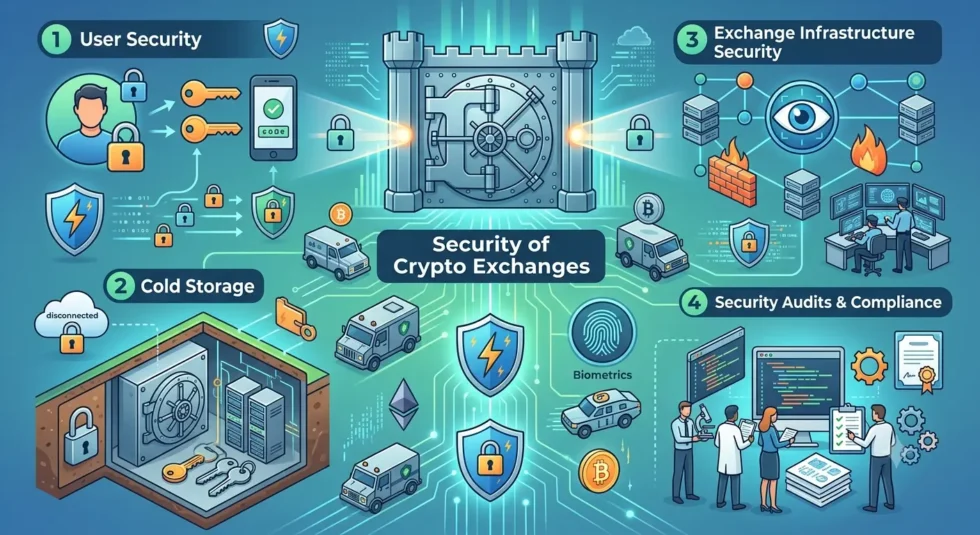
Crypto exchanges hold assets across two broad categories: cold storage (offline wallets, disconnected from the internet and therefore far harder to remotely compromise) and hot wallets (online wallets, needed to process real-time withdrawals but inherently more exposed to attack).
What to check: Reputable exchanges publish, or at least disclose on request, the approximate proportion of assets held in cold storage versus hot wallets. A materially higher proportion held in cold storage generally indicates a more conservative security posture, though it can also mean slower withdrawal processing during high-demand periods. The Bybit breach specifically involved manipulation of the process used to move funds from cold to hot storage — a reminder that even a strong cold-storage ratio doesn’t eliminate risk at the transfer stage.
Proof of Reserves: What It Does and Doesn’t Prove
Proof-of-reserves attestations, often using Merkle-tree cryptographic methods, allow an exchange to demonstrate it holds sufficient assets to cover client balances at a specific point in time, without necessarily revealing the exchange’s total holdings publicly.
What proof of reserves confirms: That the exchange held sufficient assets to cover liabilities at the moment of the snapshot.
What proof of reserves does not confirm:
- Whether the exchange holds sufficient reserves at any other point in time (it is typically a periodic snapshot, not continuous)
- Whether the exchange has offsetting liabilities not captured in the attestation (e.g. undisclosed loans against those reserves)
- The security of how those reserves are actually stored
Binance publishes monthly proof-of-reserves attestations; several other major exchanges, including Kraken and Crypto.com, publish similar periodic reports. Investors should treat these as a useful but partial signal — a necessary check, not a sufficient one.
Insurance Funds: Coverage Limits and Exclusions
Several exchanges maintain dedicated insurance or reserve funds intended to cover user losses in the event of a security breach. Binance’s SAFU (Secure Asset Fund for Users) is commonly cited at $1 billion; Coinbase maintains a $250 million crime insurance policy specifically covering hot-wallet holdings.
What to check before relying on an insurance fund:
- Whether the fund covers all assets or only specific categories (e.g. hot-wallet holdings only, as with Coinbase’s policy)
- Whether the fund size is fixed or scales with the exchange’s total holdings
- Whether the fund has ever been tested by an actual claim, and how that claim was resolved
An insurance fund is a meaningful risk-mitigation feature, but it is not a guarantee of full reimbursement in every scenario, particularly for breaches exceeding the fund’s stated size.
Account-Level Security Controls Investors Should Enable
Beyond the exchange’s own infrastructure, individual account security significantly affects an investor’s actual risk exposure:
| Control | Why It Matters |
|---|---|
| Two-factor authentication (app-based, not SMS) | SMS-based 2FA is vulnerable to SIM-swap attacks; authenticator apps or hardware keys are materially safer |
| Withdrawal address whitelisting | Restricts withdrawals to pre-approved addresses, blocking attackers even if they gain account access |
| Anti-phishing codes | A unique code shown in genuine exchange emails, making it easier to spot fraudulent communications |
| API key restrictions | If using API access, restrict keys to read-only or trading-only permissions, disabling withdrawal permissions where not needed |
| Login/withdrawal notifications | Immediate alerts for new-device logins or withdrawal attempts, enabling faster response to unauthorised access |
Most major exchanges in this comparison support all five controls; the gap between platforms is less about availability and more about how prominently they encourage users to enable them during onboarding.
Reading a Hack Disclosure: What a Strong Response Looks Like
Not every security incident is equally alarming — how an exchange responds matters as much as whether an incident occurred at all. Useful signals include:
- Speed of detection and containment — Kraken’s June 2024 intrusion was reportedly identified and contained within 47 minutes with no client losses, a materially different outcome from a breach that goes undetected for hours or days.
- Transparency of disclosure — clear, timely public communication about scope and user impact, versus delayed or minimised disclosure.
- Whether user funds were made whole — and how quickly, and from what source (insurance fund, company reserves, or otherwise).
- Post-incident changes — Bybit’s response to its 2025 breach included paying over $2.3 million in bounties to researchers who helped trace stolen funds, alongside pursuing additional regulatory licensing.
A hack history is not automatically disqualifying if the response was fast, transparent and fully compensated users — but a pattern of repeated incidents, or an incident that resulted in permanent user losses, is a materially different risk signal.
Security vs. Regulation: Why a Licence Is Not a Security Guarantee
One of the most important — and most commonly misunderstood — distinctions in crypto exchange evaluation is that regulatory licensing and custody security are separate things, assessed through different processes, and one does not guarantee the other.
The clearest recent illustration: Bybit obtained MiCA authorisation via Austria’s Financial Market Authority in May 2025, in the same year it suffered the largest crypto exchange hack in history. Separately, OKX obtained a MiCA licence via Malta in January 2025, and by March 2025 was facing EU regulatory scrutiny — including discussion of potential licence revocation — over whether its Web3 self-custody tools were used to launder roughly $100 million connected to the Bybit hack. A licence confirms that a firm met a regulator’s requirements at a specific point in time; it does not continuously audit custody security in real time, and it can be reviewed or challenged after the fact.
Practical implication: a MiCA licence or FCA registration should be treated as one input into a security assessment, not a substitute for checking an exchange’s own hack history, insurance coverage and cold-storage practices directly.
Security Track Record Snapshot
| Platform | Notable Security History | Independently Verifiable Safeguards |
|---|---|---|
| Kraken | No user-fund-loss hack since 2011; June 2024 intrusion contained in 47 minutes | Long operating history; MiCA authorised |
| Coinbase | No major exchange-level hack reported | $250M hot-wallet crime insurance; public company disclosure requirements |
| Binance | 2019 hack (~$40M); 2022 BNB Chain hack (~$570M); no major incidents reported since | $1B SAFU fund; monthly proof-of-reserves attestations |
| Bybit | ~$1.4–1.5B hack, February 2025 — largest in crypto exchange history | Post-incident bounty programme; MiCA authorised despite the breach |
| OKX | No major direct exchange hack reported; Web3 tool linked to Bybit-hack fund laundering | MiCA licensed, but under active EU regulatory scrutiny |
| KuCoin | 2020 hack (~$281M), later substantially recovered | — |
| Gemini | No reported major hack | $30M SEC fine (2023, unrelated to custody security) |
Full security, regulatory and fee comparison across all twelve platforms in this silo is available in The Global Crypto Exchange Cost Map 2026.
Investor Security Checklist
Before depositing significant funds on any exchange, verify:
- Does the exchange publish proof-of-reserves attestations, and how recently were they updated?
- Is there a disclosed cold storage / hot wallet ratio?
- Does the exchange maintain an insurance fund, and what specifically does it cover?
- What is the exchange’s public hack history, and how were any past incidents resolved?
- Is app-based or hardware-key 2FA available and enabled on your account (not SMS-only)?
- Is withdrawal address whitelisting available and enabled?
- Does the exchange’s regulatory status reflect current standing, not just a licence granted in the past? (Check the relevant regulator’s live register.)
Frequently Asked Questions
Is any crypto exchange completely safe from hacking?
No. Every centralised exchange carries some custody and counterparty risk, including exchanges with strong historical security records. Investors should evaluate relative risk, not assume any platform is risk-free.
Does a longer operating history mean a safer exchange?
Generally correlated but not guaranteed — Kraken’s long, largely incident-free history is a genuine positive signal, but newer exchanges can also implement strong security architecture, and older exchanges are not immune to future incidents.
Should I keep large crypto holdings on an exchange long-term?
Many experienced investors move larger, long-term holdings into self-custody wallets rather than leaving them on any exchange indefinitely, reserving exchange balances for active trading or amounts they are prepared to risk.
Does MiCA or FCA registration mean an exchange’s security has been independently audited?
Not directly. These are regulatory licensing frameworks primarily focused on anti-money-laundering compliance and, in the case of full authorisation, broader conduct and capital requirements — not a continuous, independent security audit of custody infrastructure.
What is the single most important security feature to check first?
There isn’t one universal answer, but a documented, verifiable hack history combined with a clearly disclosed insurance fund gives the clearest real-world signal, since it reflects how the exchange has actually performed under pressure rather than a theoretical security policy.
Sources and References
- Paul Hastings LLP — “The Bybit Hack of 2025: Potential Implications”
- The Block — “OKX could lose MiCA license as EU probes use of its Web3 tools”
- CryptoSlate — “Bybit earns MiCA license as hackers keep $644M from its $1.4B exploit out of reach”
- Bloomberg — “Bybit Crypto Hack Prompts EU Scrutiny of OKX Web3 Wallet Platform”
- Cryptopolitan — “EU investigates OKX for its role in Lazarus’ $1.5 billion Bybit hack”
- Kraken, Bitbo, CryptoNinjas — Kraken/Binance security comparisons
- This site’s pillar page: The Global Crypto Exchange Cost Map 2026