FCA vs Offshore Brokers: What UK Traders Need to Know Before Choosing a Platform
When comparing UK trading platforms, most traders focus on spreads, commissions, and execution speed. But one factor outweighs all others: regulation.
Choosing between a broker regulated by the Financial Conduct Authority (FCA) and an offshore broker can mean the difference between secure trading and significant financial risk.
This guide explains the real differences, hidden risks, and how regulation impacts your capital safety, execution quality, and long-term profitability.
What Is an FCA-Regulated Broker?
An FCA-regulated broker is authorised to provide financial services in the UK under strict legal and operational requirements.
Key Protections Under FCA Regulation:
- Segregation of client funds
- Negative balance protection
- Transparent fee disclosures
- Strict auditing and compliance rules
- Access to the Financial Services Compensation Scheme (FSCS)
These protections are designed to ensure that traders are not exposed to unnecessary broker-related risks.
What Are Offshore Brokers?
Offshore brokers are registered in jurisdictions outside the UK, often in regions with weaker financial regulation.
Common Offshore Locations:
- Belize
- Seychelles
- St. Vincent & the Grenadines
Typical Characteristics:
- High leverage (sometimes 1:500 or more)
- Minimal compliance requirements
- Limited or no investor protection
- Less transparency in pricing and execution
While they may appear attractive due to low costs and high leverage, the risks are significantly higher.
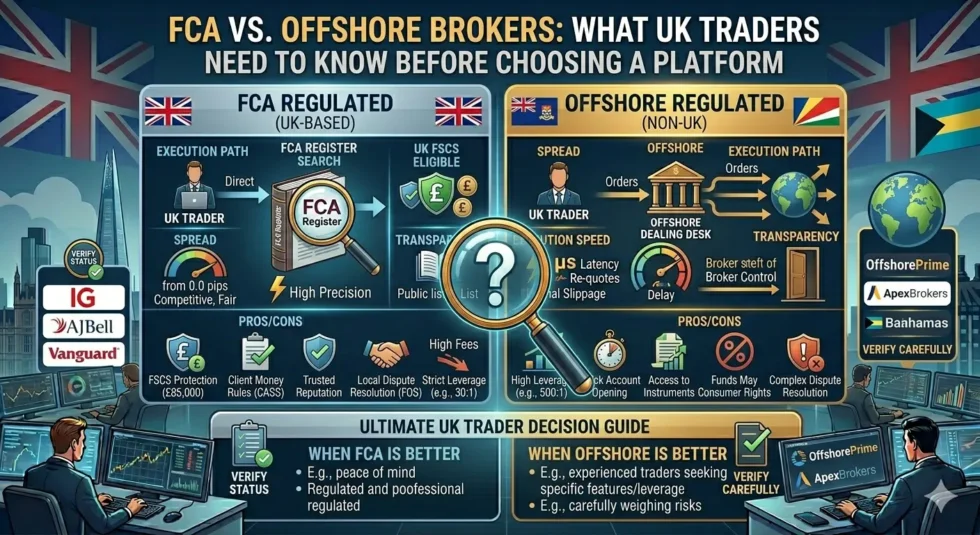
FCA vs Offshore Brokers: Key Differences
| Feature | FCA-Regulated Brokers | Offshore Brokers |
|---|---|---|
| Regulation Strength | Very High | Low to Moderate |
| Client Fund Protection | Strong | Weak or None |
| Compensation Scheme | Yes (FSCS) | Rare |
| Transparency | High | Often Limited |
| Legal Recourse | Available | Difficult |
| Leverage Limits | Restricted (safer) | Very High (riskier) |
| Trust Level | High | Variable |
For a detailed comparison of fees, spreads, and execution risks across regulated platforms, see our full guide: The UK Day Trading App Cost Map 2026.
Why Offshore Brokers Attract UK Traders
Despite the risks, many traders still consider offshore platforms.
Main Reasons:
- Higher leverage → Potential for larger profits
- Lower apparent costs → Tighter advertised spreads
- Fewer restrictions → Flexible trading conditions
However, these benefits often come with hidden trade-offs.
The Hidden Risks of Offshore Brokers
1. Withdrawal Issues
Many traders report delays or inability to withdraw funds.
2. Price Manipulation
Without strict oversight, some brokers may:
- Widen spreads artificially
- Trigger stop losses unfairly
- Manipulate execution prices
3. No Legal Protection
If a dispute arises, recovering funds is extremely difficult.
4. Lack of Transparency
Important details like execution policies and liquidity providers may not be disclosed.
5. No Compensation Scheme
Unlike FCA-regulated brokers, offshore platforms typically do not offer protection like the FSCS.
How FCA Regulation Impacts Trading Performance
Regulation is not just about safety—it also affects cost and execution quality.
With FCA-Regulated Brokers:
- Fair and consistent order execution
- Transparent spreads and commissions
- Reduced risk of slippage manipulation
With Offshore Brokers:
- Hidden costs may exceed visible savings
- Execution reliability can vary
- Increased counterparty risk
In many cases, traders who choose offshore brokers for “lower costs” end up paying more due to execution inefficiencies and hidden fees.
Real-World Insight (E-E-A-T Focus)
From practical trading experience, one of the most common mistakes is underestimating broker risk.
A platform offering:
- 0.0 spreads
- High leverage
- Bonus incentives
…can still be a poor choice if:
- Withdrawals are unreliable
- Pricing is manipulated
- Regulation is weak or nonexistent
Professional traders prioritise capital protection first, then optimise for cost and speed.
How to Check If a Broker Is Safe
Before choosing any platform:
Step 1: Verify on the FCA Register
Search the broker on the Financial Conduct Authority website.
Step 2: Match the Details
Ensure:
- Firm Reference Number (FRN) matches
- Website domain is identical
- Contact information is correct
Step 3: Check for Clone Warnings
The FCA regularly lists scam firms impersonating legitimate brokers.
Step 4: Review Execution Policy
Look for transparency in:
- Order routing
- Slippage handling
- Liquidity providers
When (If Ever) Offshore Brokers Might Make Sense
In limited cases, experienced traders may consider offshore brokers for:
- Access to higher leverage
- Specific instruments not available in the UK
However, this should only be done with:
- Strict risk management
- Small capital allocation
- Full awareness of risks
Final Verdict: FCA vs Offshore Brokers in 2026
- Safest Choice: FCA-Regulated Brokers
- Higher Risk Option: Offshore Brokers
While offshore brokers may offer attractive features, the lack of protection and transparency introduces significant risk.
For most traders—especially beginners and serious day traders—FCA-regulated UK trading platforms are the smarter long-term choice.
Conclusion
When selecting among UK trading platforms, regulation should never be an afterthought.
FCA-regulated brokers provide:
- Security of funds
- Transparent pricing
- Reliable execution
Offshore brokers may offer flexibility, but they come with substantial risks that can outweigh any cost advantage.
In trading, protecting your capital is the first step toward profitability.
1. What is the difference between FCA-regulated and offshore brokers?
FCA-regulated brokers are authorised by the Financial Conduct Authority and must follow strict rules on client protection, transparency, and fair execution. Offshore brokers operate in loosely regulated jurisdictions with fewer protections, making them riskier for traders.
2. Are offshore brokers legal for UK traders?
Offshore brokers are not illegal to access, but they are not authorised to provide services in the UK. This means traders use them at their own risk without the protections offered by UK regulators.
3. Which is safer: FCA or offshore brokers?
FCA-regulated brokers are significantly safer due to strict compliance rules, fund segregation, and investor protection schemes like the Financial Services Compensation Scheme. Always verify FCA authorisation before depositing funds at register.fca.org.uk.
4. Do offshore brokers offer better trading conditions?
They may offer higher leverage and lower advertised spreads, but these often come with hidden risks such as poor execution, withdrawal issues, and lack of transparency.
5. What protection do FCA-regulated brokers provide?
FCA-regulated brokers provide:
- Segregation of client funds
- Negative balance protection
- Transparent pricing
- Access to compensation schemes
- Strong legal oversight
6. Can offshore brokers refuse withdrawals?
Yes, this is one of the most reported issues. Without strong regulation, some offshore brokers delay or deny withdrawals, making it difficult to recover funds.
7. Why do offshore brokers offer high leverage?
They operate outside strict regulatory limits, allowing leverage levels like 1:500. While this increases profit potential, it also significantly raises risk.
8. What is FSCS protection and who qualifies?
The Financial Services Compensation Scheme (FSCS) compensates eligible traders up to £85,000 if an FCA-regulated broker fails. Offshore brokers do not provide this protection.
9. Can FCA-regulated brokers manipulate trades?
FCA-regulated brokers must follow strict rules to ensure fair execution. While slippage can occur due to market conditions, deliberate manipulation is highly restricted and monitored.
10. How do I verify if a broker is FCA regulated?
Visit the FCA register, search for the broker’s name, check the Firm Reference Number (FRN), and confirm that the website and contact details match the official listing.
11. Are offshore brokers cheaper than FCA brokers?
They may appear cheaper due to lower spreads or zero commissions, but hidden costs such as slippage, execution delays, and withdrawal issues can make them more expensive overall.
12. What are the risks of using offshore trading platforms?
Major risks include:
- Loss of funds due to lack of protection
- No legal recourse
- Price manipulation
- Withdrawal restrictions
- Lack of transparency
13. Can beginners use offshore brokers?
It is not recommended. Beginners should prioritise safety and transparency, which FCA-regulated platforms provide.
People Also Ask
• Is it safe to use offshore brokers in the UK?
No, offshore brokers are generally not considered safe because they lack strong regulation, investor protection, and legal accountability compared to FCA-regulated platforms.
• Why do traders choose offshore brokers?
Traders are attracted by high leverage, lower apparent costs, and fewer restrictions, but these benefits come with significant risks.
• What happens if an offshore broker scams you?
Recovering funds is extremely difficult because offshore jurisdictions often lack strong legal enforcement or investor protection mechanisms.
• How can I avoid fake or scam brokers?
Always verify the broker on the Financial Conduct Authority register, check the FRN, and confirm all contact details match the official listing.
• Are FCA-regulated brokers more expensive?
Not necessarily. While they may have slightly higher visible fees, they offer better transparency and protection, reducing hidden costs and overall risk.
• Can offshore brokers manipulate spreads?
Yes, without strict regulation, some offshore brokers may widen spreads or manipulate pricing, especially during volatile market conditions.
• Do FCA brokers offer compensation if they fail?
Yes, eligible traders are protected by the Financial Services Compensation Scheme, which covers up to £85,000.
• Should professional traders use offshore brokers?
Some experienced traders may use them for specific reasons like high leverage, but this involves higher risk and requires strict risk management.
• What is the biggest risk of offshore trading platforms?
The biggest risk is losing your funds without any legal protection or compensation if the broker fails or acts fraudulently.
• How do I choose the best UK trading platform?
Prioritise FCA regulation, verify the broker’s credentials, compare real costs (not advertised), and review execution policies.