Bitcoin Diversification Why Your Crypto Portfolio Needs More
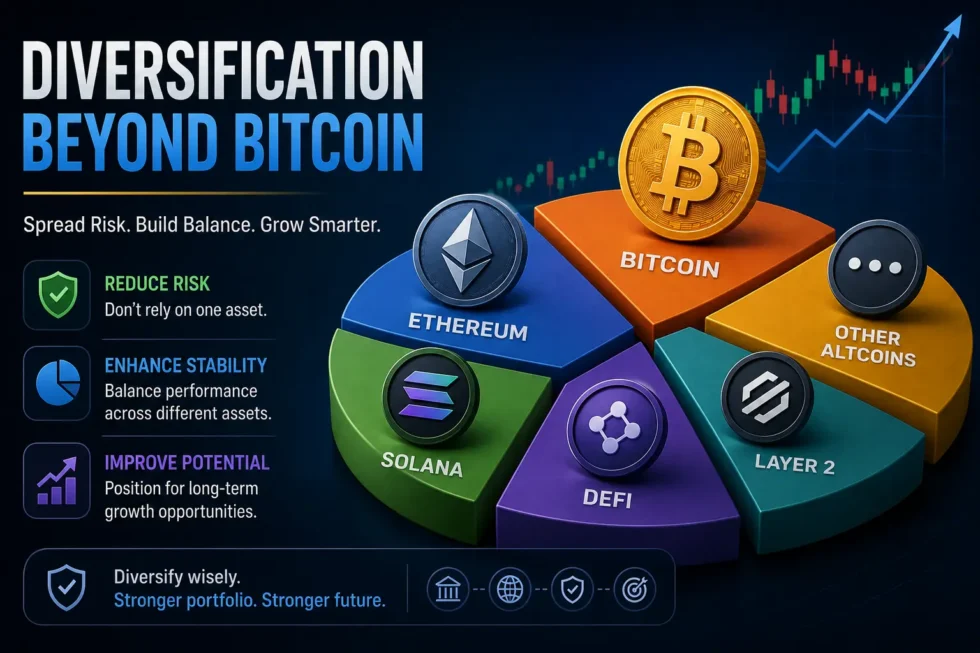
Bitcoin diversification means spreading your crypto holdings beyond a single asset to reduce risk and capture growth across the digital asset market. The Bitcoin remains the foundation of most portfolios, but relying on it alone leaves you exposed to concentration risk. Smart investors treat Bitcoin as a starting point, not a finish line.
This article explores practical ways to diversify beyond Bitcoin and builds on the strategies covered in our Crypto Risk Management Strategies Every Investor Should Follow guide. It also expands on the core framework from The Smart Crypto Investing Blueprint 2026, our complete guide to building a diversified digital asset portfolio.
Why Bitcoin Diversification Matters for Crypto Investors
Bitcoin dominates the crypto market, but dominance doesn’t equal safety. A portfolio concentrated entirely in one asset moves entirely with that asset’s price swings, offering no cushion when Bitcoin itself enters a downturn.
Spreading capital across multiple crypto categories reduces this single-asset dependency. When one segment of the market underperforms, other holdings can help offset the impact.
The Risk of Overconcentration in a Single Crypto Asset
Overconcentration creates a fragile portfolio structure. Even strong long-term believers in Bitcoin benefit from holding assets that respond differently to market conditions, regulatory news, and technological shifts.
Key Categories for Diversifying Beyond Bitcoin
Several distinct crypto categories offer different risk and growth profiles. Understanding each one helps you build a more balanced allocation.
Large-Cap Altcoins Like Ethereum
Ethereum and other large-cap altcoins offer exposure to smart contract platforms and decentralized applications. These assets often carry more volatility than Bitcoin but also provide access to different growth drivers, such as network usage and developer activity.
Stablecoins for Portfolio Stability
Stablecoins provide a low-volatility component within a crypto portfolio. Holding a portion of your capital in stablecoins gives you dry powder to deploy during market dips, without needing to convert back to fiat currency.
Layer-1 and Layer-2 Blockchain Tokens
Blockchain infrastructure tokens power the networks that support decentralized apps, transactions, and scaling solutions. Adding exposure to competing Layer-1 chains and Layer-2 scaling projects diversifies your portfolio across different technological approaches within the crypto ecosystem.
DeFi and Utility Tokens
Decentralized finance tokens offer exposure to lending platforms, decentralized exchanges, and yield-generating protocols. These assets tend to carry higher risk than large-cap coins, so smaller allocations usually make sense here.
How Much of Your Portfolio Should Be Bitcoin?
There’s no universal answer, since your ideal allocation depends on your risk tolerance and investment timeline. Conservative investors often keep 50% or more of their crypto holdings in Bitcoin, treating it as the stable core of the portfolio.
More aggressive investors sometimes reduce Bitcoin’s share to 30% or less, redirecting the remainder toward altcoins, DeFi tokens, and emerging projects with higher growth potential. Either approach can work, as long as it aligns with your broader risk management plan.
Common Mistakes When Diversifying Beyond Bitcoin
Chasing every new trending token creates unnecessary risk rather than genuine diversification. Adding dozens of small, unrelated positions doesn’t spread risk effectively if those assets all react similarly during a market-wide downturn.
Ignoring correlation is another frequent error. Many altcoins move in close alignment with Bitcoin during major market swings, so true diversification requires selecting assets with genuinely different risk drivers, not just different names.
Skipping research before allocating capital leads to poor outcomes too. Each category deserves its own due diligence, since project fundamentals vary dramatically even within the same crypto sector.
Building a Balanced Crypto Portfolio Structure
A balanced approach typically combines Bitcoin as a core holding with smaller allocations across large-cap altcoins, stablecoins, and select higher-risk projects. Position sizing plays a critical role here, since even a well-diversified portfolio can suffer if individual allocations are too large.
For guidance on sizing each position appropriately, see our article on Position Sizing for Crypto Investing, which pairs directly with the diversification principles covered here.
Final Thoughts: Diversification as a Long-Term Crypto Strategy
Bitcoin diversification isn’t about abandoning Bitcoin. It’s about building a portfolio resilient enough to withstand volatility in any single asset while capturing growth across the broader crypto market.
For the complete risk management approach this strategy supports, revisit Crypto Risk Management Strategies Every Investor Should Follow, and explore the full portfolio framework in The Smart Crypto Investing Blueprint 2026: Building a Diversified Digital Asset Portfolio with Lower Risk and Higher Long-Term Growth.