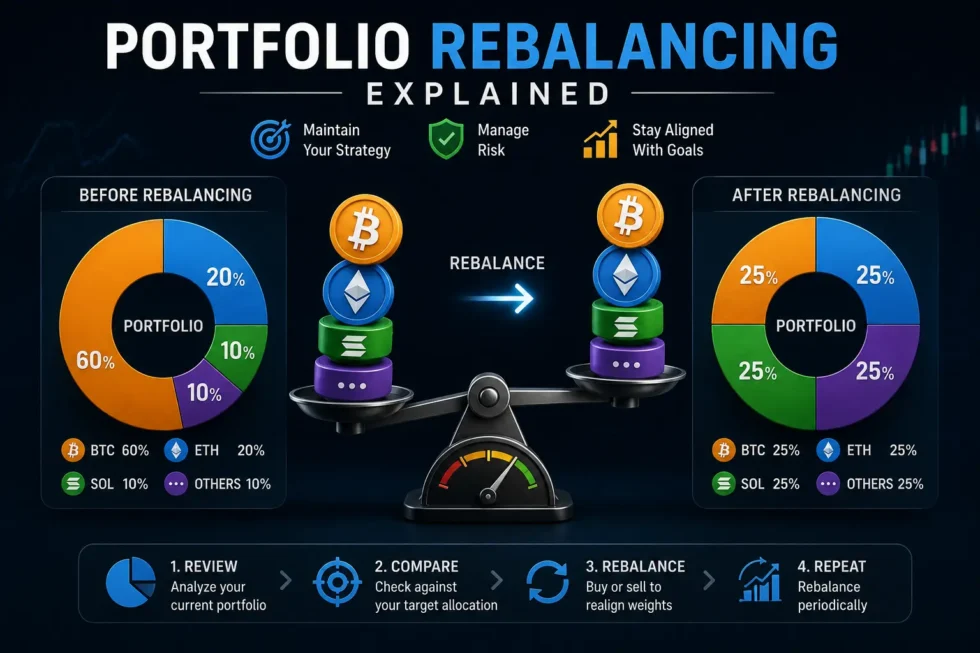
Portfolio Rebalancing Explained How to Keep Your Crypto Allocation on Track
Portfolio rebalancing explained simply means adjusting your holdings back toward their original target allocation after market moves push them out of alignment. In crypto, this happens fast. A single strong rally in one altcoin can shift an entire portfolio’s risk profile within weeks.
This article builds on our pillar guide, The Smart Crypto Investing Blueprint 2026, and expands on the risk-tier framework from How to Build a Balanced Crypto Portfolio for Different Risk Levels. Below, we cover why rebalancing matters, when to do it, and the most common methods investors use.
What Portfolio Rebalancing Actually Means
Rebalancing restores a portfolio to its intended weightings. If your target allocation is 50% bitcoin and 50% altcoins, and bitcoin rallies hard, that ratio might drift to 65/35 without any action on your part.
Left unchecked, this drift quietly changes your risk exposure. You end up holding a portfolio that no longer matches the risk tolerance you originally planned for.
Rebalancing simply brings the numbers back in line. It usually involves selling a portion of an overweighted asset and reinvesting the proceeds into underweighted positions.
Why Rebalancing Matters More in Crypto Than Other Markets
Crypto assets move faster and more dramatically than most traditional investments. A 40% swing in a single month isn’t unusual for mid-cap altcoins.
This volatility means allocation drift happens quickly and often. Without regular check-ins, a carefully built portfolio can become unrecognizable within a single market cycle.
Rebalancing also forces a disciplined habit: selling strength and buying weakness. Emotional investors often do the opposite, chasing whatever asset just performed best.
Common Crypto Rebalancing Strategies
Several approaches work well depending on your available time and preferred level of involvement.
Calendar-Based Rebalancing
This method sets a fixed schedule, such as quarterly or semi-annual reviews. On each date, you compare current allocations against targets and adjust as needed.
Calendar-based rebalancing works well for investors who want a predictable, low-maintenance routine. It also removes the temptation to constantly react to short-term price swings.
Threshold-Based Rebalancing
Instead of a fixed date, this approach triggers action once an asset drifts beyond a set percentage, often 5–10 points from its target. A bitcoin allocation set at 40% might trigger a rebalance once it crosses 50%.
Threshold-based rebalancing responds more directly to actual market movement. It can require more frequent monitoring, since drift can happen at any time.
Hybrid Rebalancing
Many experienced investors combine both methods. They check allocations on a set schedule, but only rebalance if a threshold has also been crossed.
This hybrid model reduces unnecessary trading during calmer periods. It still catches major drift during volatile stretches without demanding constant attention.
How Rebalancing Reduces Risk Over Time
Rebalancing enforces a form of built-in discipline. Selling part of an outperforming asset locks in gains before a potential pullback erases them.
Buying underweighted assets at relatively lower prices also improves long-term entry points. Over multiple cycles, this “sell high, buy low” mechanism can smooth out portfolio returns.
This process matters just as much for bitcoin-heavy portfolios as it does for portfolios spread across many altcoins. Even a two-asset allocation benefits from periodic realignment.
Tax and Cost Considerations Before Rebalancing
Selling crypto assets can trigger taxable events in many jurisdictions. Frequent rebalancing without considering tax impact can quietly erode returns through short-term capital gains.
Trading fees also add up, especially with frequent threshold-based adjustments. Wider rebalancing bands or less frequent calendar checks can help minimize both tax drag and transaction costs.
Consulting a tax professional familiar with crypto regulations in your region is worth the effort before committing to an aggressive rebalancing schedule.
Common Rebalancing Mistakes to Avoid
A few patterns tend to undermine otherwise solid rebalancing plans.
- Rebalancing too frequently, which racks up fees and tax liabilities
- Ignoring the plan entirely during emotional market swings
- Setting thresholds so tight that normal volatility triggers constant trades
- Forgetting to account for taxes and fees when calculating true returns
- Rebalancing based on price predictions rather than the original target allocation
Sticking to a predefined plan, rather than reacting emotionally, tends to produce better long-term outcomes.
Building Rebalancing Into Your Overall Crypto Strategy
Rebalancing works best as one piece of a broader plan rather than a standalone tactic. Your target allocation should already reflect your risk tolerance, time horizon, and the diversification principles covered in our cluster guide on building a balanced crypto portfolio for different risk levels.
Once that target is set, rebalancing simply keeps your portfolio honest over time. It’s a maintenance habit, not a prediction tool.
Final Thoughts on Crypto Portfolio Rebalancing
Portfolio rebalancing explained in simple terms comes down to one idea: markets drift, and disciplined investors correct for it. Choosing calendar-based, threshold-based, or hybrid rebalancing depends on your available time and risk tolerance.
For the complete framework behind diversified, lower-risk crypto investing, revisit our pillar resource, The Smart Crypto Investing Blueprint 2026.