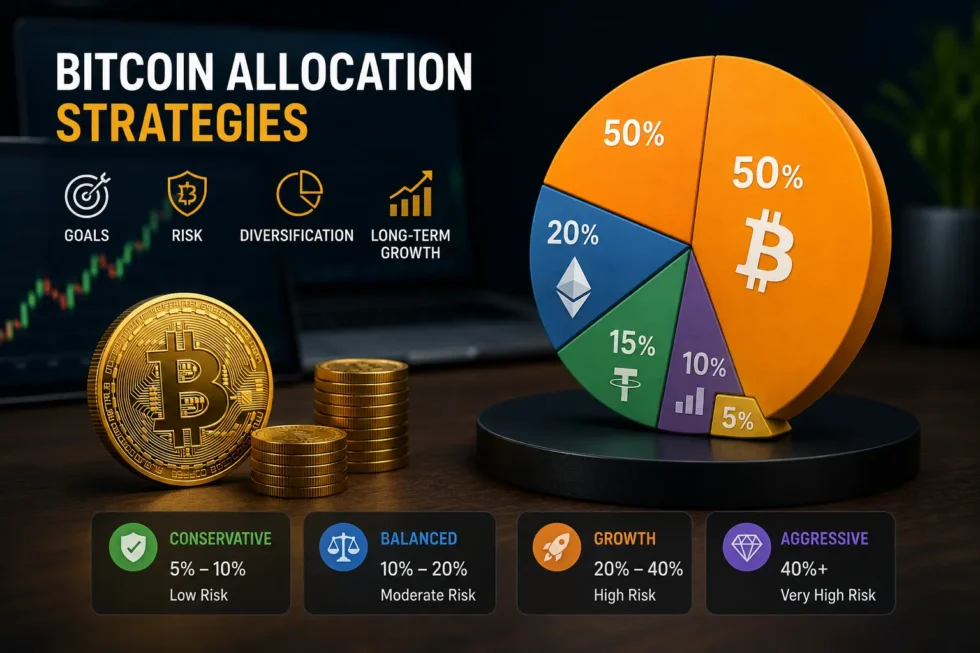
Bitcoin Allocation Strategies How Much BTC Should You Hold in 2026
Bitcoin allocation strategies sit at the center of every serious crypto portfolio decision. Investors constantly ask how much BTC they should hold, when to buy it, and how to fit it alongside altcoins without taking on unnecessary risk. This article builds directly on our pillar guide, The Smart Crypto Investing Blueprint 2026, and expands on the risk-based framework from How to Build a Balanced Crypto Portfolio for Different Risk Levels.
Here, we break down practical bitcoin allocation strategies for conservative, balanced, and aggressive investors, along with rebalancing tactics and common mistakes to avoid.
Why Bitcoin Allocation Strategies Matter in a Diversified Crypto Portfolio
Bitcoin remains the largest and most liquid crypto asset by market capitalization. It also tends to move with less volatility than most altcoins over multi-year periods.
Choosing the right BTC weighting shapes the overall risk profile of your holdings. A portfolio with too little bitcoin often chases speculative gains without a stable anchor. A portfolio with too much bitcoin, on the other hand, misses diversification benefits from other digital assets.
Smart allocation isn’t about picking one “correct” number. It’s about matching your bitcoin exposure to your goals, time horizon, and comfort with drawdowns.
Core Bitcoin Allocation Models by Risk Level
Different investors need different starting points. The three models below map closely to the risk tiers introduced in our balanced portfolio cluster article, so you can pair them with a broader asset mix.
Conservative Bitcoin Weighting (10–20%)
Conservative investors typically hold bitcoin as a smaller satellite position. This range works well for people who want crypto exposure without letting it dominate their net worth.
Under this model, the remaining allocation usually spreads across stablecoins, blue-chip altcoins, and sometimes traditional assets. Drawdowns hurt less, but upside during bull runs is also more limited.
Balanced BTC Portfolio Allocation (30–50%)
A balanced approach treats bitcoin as the core holding while leaving meaningful room for Ethereum, large-cap altcoins, and select mid-cap projects. Many long-term investors default to this middle range.
This weighting captures much of bitcoin’s stability while still allowing growth from higher-beta assets. Rebalancing becomes more important here, since altcoin rallies can quickly shift your original ratios.
Aggressive Bitcoin-Heavy Allocation (60%+)
Investors with a high risk tolerance sometimes push bitcoin above 60% of their crypto holdings. This model treats BTC as both a growth asset and a hedge against the extreme volatility of smaller tokens.
It suits people who believe strongly in bitcoin’s long-term thesis and want reduced exposure to altcoin-specific risks like project failure or regulatory crackdowns.
Bitcoin Position Sizing Based on Investment Goals
Position sizing should never be arbitrary. Three factors typically drive the decision: time horizon, income needs, and emotional tolerance for volatility.
Someone investing for a goal ten years out can usually absorb a higher bitcoin weighting, since short-term price swings matter less. Someone who might need to liquidate holdings within a year should generally lean toward a smaller, more conservative BTC position.
Emotional discipline matters just as much as math. If a 30% drawdown would push you toward panic selling, your bitcoin allocation is probably too aggressive for your current temperament.
Dollar-Cost Averaging vs Lump-Sum Bitcoin Buying
Two main methods exist for building a bitcoin position: dollar-cost averaging (DCA) and lump-sum investing.
DCA spreads purchases across weeks or months, which smooths out entry price and reduces the stress of timing the market. Many new investors prefer this method because it removes the pressure of guessing short-term price movements.
Lump-sum investing puts capital to work immediately. Historical data shows this approach often outperforms DCA over long periods, simply because markets trend upward more often than not. It also carries more short-term risk if the entry point coincides with a local price peak.
A hybrid approach works well for many portfolios. Investors deploy a portion of capital immediately and dollar-cost average the rest over several months.
Rebalancing Your Bitcoin Allocation Over Time
Bitcoin allocation strategies only work if they get revisited regularly. Crypto markets move fast, and a 40% bitcoin position can easily balloon to 60% after a strong rally, or shrink after a correction in the other assets.
Quarterly or semi-annual rebalancing keeps your portfolio aligned with your original risk tolerance. Selling a portion of outperforming bitcoin to fund other positions locks in gains and prevents overconcentration.
Some investors set percentage-based triggers instead of calendar dates. For example, a 5-point deviation from the target allocation can automatically prompt a rebalance.
Common Mistakes When Allocating Bitcoin
Several patterns show up again and again among new crypto investors.
- Chasing hype cycles and dumping bitcoin into speculative altcoins right before a downturn
- Ignoring correlation, since many altcoins move in tandem with bitcoin during market-wide selloffs
- Failing to rebalance, which lets one strong rally distort the entire portfolio
- Treating bitcoin allocation as a one-time decision instead of an ongoing process
- Letting fear during drawdowns override the original risk-based strategy
Avoiding these mistakes matters more than finding a perfect percentage. Consistency and discipline tend to outperform any single allocation formula.
Final Thoughts on Building Your Bitcoin Allocation Strategy
There’s no universal answer to how much bitcoin belongs in a portfolio. The right strategy depends on your risk tolerance, investment horizon, and broader financial goals.
Start with one of the three core models above, then adjust based on your comfort level and ongoing market conditions. For a deeper look at combining bitcoin with altcoins, stablecoins, and other risk tiers, revisit our cluster guide on building a balanced crypto portfolio for different risk levels.
For the complete framework behind diversified, lower-risk crypto investing, check out our pillar resource, The Smart Crypto Investing Blueprint 2026.