Crypto Market Analysis Explained Fundamental vs Technical Analysis
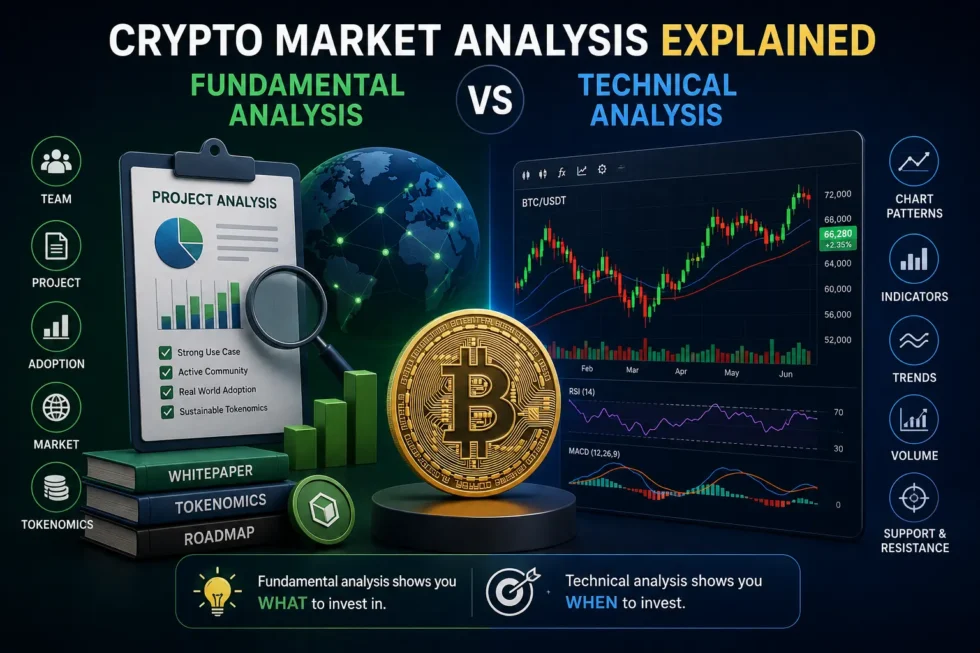
Crypto market analysis generally falls into two distinct approaches, and confusing them leads investors to make decisions based on incomplete information. Fundamental analysis asks whether a project has real value and long-term staying power, while technical analysis studies price charts and trading patterns to time entries and exits. Neither approach works well in isolation, and most experienced investors blend both to build a fuller picture before committing capital.
This guide breaks down how each method works, where each one falls short, and how combining them produces a more reliable read on any given asset. It builds on the broader framework introduced in our complete guide, The Smart Crypto Investing Blueprint 2026: Building a Diversified Digital Asset Portfolio with Lower Risk and Higher Long-Term Growth, and focuses specifically on the research process behind smart asset selection.
Why Crypto Market Analysis Looks Different From Traditional Markets
Traditional equity analysis relies on decades of standardized reporting, audited financials, and regulatory disclosure requirements that most crypto projects simply don’t have. Crypto market analysis instead draws on a mix of on-chain data, developer activity, tokenomics, and community metrics that don’t map cleanly onto traditional valuation models. This gap explains why so many crypto-specific analytical frameworks have emerged over the past several years, each attempting to fill in for the missing structure that traditional finance takes for granted.
Market maturity has narrowed some of this gap by 2026, as more projects publish transparent metrics and institutional research desks apply more rigorous standards to crypto coverage. The core challenge remains, however: separating genuine value creation from speculative momentum requires a different toolkit than reading a quarterly earnings report.
Key Data: Crypto Market Analysis Benchmarks for 2026
| Metric | Approximate Figure | Relevance to Analysis |
|---|---|---|
| Bitcoin price (Aug 2026) | ~$65,000 | Common reference point for technical chart analysis |
| Bitcoin market dominance | ~59% | Key fundamental metric for gauging altcoin risk appetite |
| Bitcoin market capitalization | ~$1.29 trillion | Core input for relative valuation comparisons |
| Combined top-10 crypto market cap | Over $2 trillion | Baseline for sizing the broader analyzable market |
| Dominant investor focus in 2026 | Utility, liquidity, developer activity | Signals a shift toward fundamentals-driven analysis |
| Institutional research adoption | Expanding through spot ETFs and treasuries | Improves data quality and analytical rigor available to retail investors |
Analyst focus has shifted noticeably as the market has matured through 2026. <cite index=”1-1″>Investors screening the best cryptocurrencies to invest in increasingly prioritize infrastructure, adoption, liquidity, and utility over short-term momentum</cite>, a trend that reflects fundamental analysis gaining ground relative to pure price-chart speculation.
Core Definitions for Crypto Market Analysis
- Fundamental analysis: evaluating an asset’s underlying value based on factors like technology, adoption, team, tokenomics, and real-world use case.
- Technical analysis: studying historical price and volume data, chart patterns, and indicators to forecast future price movement.
- On-chain data: information recorded directly on a blockchain, such as transaction volume, wallet activity, and network usage, used to gauge real adoption.
- Tokenomics: the economic design of a token, including supply schedule, distribution, inflation rate, and utility within its ecosystem.
- Support and resistance: price levels where an asset has historically struggled to fall below (support) or rise above (resistance), used in technical analysis.
- Moving average: a technical indicator that smooths price data over a set period to identify trend direction.
- Market sentiment: the overall attitude of investors toward an asset or the broader market, often measured through social data and trading volume.
- Developer activity: a fundamental metric tracking code commits, updates, and ongoing development on a project’s public repositories, used as a proxy for project health.
Comparison: Fundamental Analysis vs. Technical Analysis
| Factor | Fundamental Analysis | Technical Analysis |
|---|---|---|
| Core question answered | Is this asset worth holding long-term? | When is a good time to buy or sell? |
| Primary data sources | Whitepapers, tokenomics, on-chain activity, team background | Price charts, volume, trading indicators |
| Time horizon best suited for | Long-term investing | Short-to-medium-term trading |
| Strength | Identifies genuine value and adoption trends | Identifies timing opportunities and momentum shifts |
| Weakness | Slow to react to sudden sentiment shifts | Can generate false signals in highly volatile markets |
| Best paired with | Portfolio construction and asset selection | Entry and exit timing within a chosen position |
Comparison: Common Crypto Analysis Tools by Method
| Tool or Metric | Analysis Type | What It Measures | Limitation |
|---|---|---|---|
| Market capitalization | Fundamental | Relative size and liquidity of an asset | Doesn’t reflect actual usage or value creation |
| On-chain transaction volume | Fundamental | Real network activity and adoption | Can be inflated by wash trading on some networks |
| Developer commit activity | Fundamental | Ongoing project development and maintenance | Doesn’t guarantee successful execution |
| Moving averages | Technical | General price trend direction | Lags actual price action, especially in fast reversals |
| Relative Strength Index (RSI) | Technical | Whether an asset is overbought or oversold | Can stay extreme for extended periods during strong trends |
| Trading volume | Technical | Strength of conviction behind a price move | Doesn’t distinguish organic activity from manipulation |
How Fundamental Analysis Works in Practice
Fundamental crypto market analysis starts with the project’s core purpose, examining whether it solves a genuine problem or fills a real market need. Reviewing the tokenomics comes next, since a project with strong technology can still make a poor investment if token supply grows too quickly or distribution concentrates ownership among a small group of early holders. On-chain data adds an objective layer to this process, since actual transaction volume and wallet growth reveal whether adoption matches the marketing narrative.
Team background and governance structure round out a thorough fundamental review. Projects with transparent, experienced teams and clear governance processes have historically shown more resilience through market downturns than anonymous teams making bold promises without a track record to support them.
How Technical Analysis Works in Practice
Technical crypto market analysis treats price charts as a record of collective investor psychology, looking for repeatable patterns that suggest where the market might move next. Support and resistance levels help identify likely turning points, while moving averages smooth out short-term noise to reveal the broader trend direction. Volume confirms or undermines a price move, since a breakout on low volume carries far less conviction than one backed by strong trading activity.
Crypto’s extreme volatility makes technical analysis both more useful and more unreliable than in traditional markets. Patterns that took weeks to develop in equity markets can compress into days or hours in crypto, which rewards traders who can read charts quickly but also increases the risk of false signals during periods of thin liquidity.
Editorial Observations: Where Analysis Methods Get Misapplied
Watching how investors actually use these tools reveals a common and costly pattern: applying technical analysis to a long-term holding decision, or applying fundamental analysis to a short-term trade, produces mismatched expectations either way. An investor who buys Bitcoin for its long-term fundamental case shouldn’t panic-sell based on a short-term technical indicator that flashes “oversold,” since that signal wasn’t designed to answer a multi-year question.
A second pattern worth noting involves over-reliance on a single data point instead of building a fuller picture. <cite index=”2-1″>Bitcoin’s fixed supply, institutional adoption, and deep liquidity support its long-term investment case</cite>, but investors who focus exclusively on price momentum while ignoring these fundamental drivers often misread short-term volatility as a signal about long-term value, when the two frequently have little to do with each other.
A third observation concerns how quickly crypto-specific fundamentals can change compared to traditional assets. Regulatory shifts, network upgrades, and competitive threats can alter a project’s fundamental case far faster than in traditional industries, which means fundamental analysis in crypto requires more frequent revisiting than the “buy and forget” approach that sometimes works with established equities.
Combining Both Methods for Smarter Decisions
The strongest crypto market analysis blends fundamental research for asset selection with technical analysis for timing decisions, rather than treating the two as competing philosophies. An investor might use fundamental analysis to build a watchlist of projects with genuine adoption and sound tokenomics, then use technical analysis to identify favorable entry points within that shortlist rather than buying at an arbitrary moment. This combined approach reduces the risk of holding a fundamentally weak asset just because its chart looked attractive, while also avoiding entries into a fundamentally strong asset at a technically poor price.
Frequently Asked Questions
Which is more important for crypto investing: fundamental or technical analysis?
Neither method works well alone, but fundamental analysis generally matters more for long-term holding decisions, while technical analysis adds the most value for timing entries and exits within a position already chosen for fundamental reasons.
Can technical analysis alone predict crypto price movements reliably?
Technical indicators can highlight probable trends and reversal points, but crypto’s volatility and susceptibility to sudden news events mean no technical method predicts price movement with certainty. Treating indicators as probability tools, rather than guarantees, produces more realistic expectations.
What on-chain metrics matter most for fundamental crypto market analysis?
Active wallet growth, transaction volume, and developer commit activity together provide a reasonably reliable picture of genuine adoption, though each metric carries its own limitations and works best when considered alongside the others.
Is fundamental analysis harder in crypto than in traditional stock markets?
In some ways yes, since crypto lacks the standardized financial reporting that equity analysis relies on. Investors compensate by leaning more heavily on on-chain data, tokenomics review, and community and developer activity as substitute indicators of health.
Should beginners start with fundamental or technical analysis?
Starting with fundamental analysis helps beginners build a sound watchlist of assets worth holding long-term, before layering in technical analysis to refine timing once the underlying research is complete.
Conclusion: Analysis Should Inform the Blueprint, Not Replace It
Crypto market analysis, done well, combines the long-term perspective of fundamental research with the timing insight of technical patterns, giving investors a fuller picture than either method provides alone. Neither approach removes risk entirely, and both work best inside a broader, disciplined portfolio strategy rather than as a standalone decision-making system. For the complete framework on turning that analysis into a structured, diversified portfolio, revisit our full guide: The Smart Crypto Investing Blueprint 2026.
Sources and References
- Analytics Insight — Top Cryptocurrencies to Buy in August 2026
- Bitcoin Foundation — Top 5 Crypto Assets to Invest In: Best Cryptocurrencies for Maximum ROI
- Forbes Advisor — Top 10 Cryptocurrencies of August 10, 2026
- CoinDCX — Top 10 Cryptos to Invest in August 2026 (By Market Cap)
This article is for educational purposes only and does not constitute financial, investment, tax, or legal advice. Digital assets are volatile and speculative. Consult a licensed financial advisor before making investment decisions.