How to Build a Balanced Crypto Portfolio for Different Risk Levels
A balanced crypto portfolio looks different for a 25-year-old with decades of investing runway than it does for someone five years from retirement, and treating every investor the same way leads to mismatched risk. Risk tolerance depends on time horizon, income stability, existing investments, and personal comfort with volatility, so the “right” mix of assets shifts from person to person even within the same market conditions.
This guide breaks down how to structure a crypto portfolio across conservative, balanced, and aggressive risk levels, using clear allocation ranges and concrete asset examples for each. It builds directly on the tiered framework introduced in our complete guide, The Smart Crypto Investing Blueprint 2026: Building a Diversified Digital Asset Portfolio with Lower Risk and Higher Long-Term Growth, and focuses specifically on matching portfolio structure to individual risk capacity.
Why Risk Level Should Drive Crypto Portfolio Structure
Two investors can hold the exact same coins and end up with very different outcomes simply because their allocation percentages don’t match their actual risk tolerance. An investor who can’t stomach a 40% drawdown shouldn’t hold a portfolio weighted heavily toward small-cap tokens, regardless of how strong the long-term thesis looks. Matching structure to temperament matters as much as matching it to financial goals, since panic-selling during a downturn locks in losses that a properly sized position would have survived.
Time horizon plays an equally important role in this calculation. Funds needed within the next few years should carry far less crypto exposure than money earmarked for a horizon of ten years or more, since a longer runway gives volatile assets time to recover from cyclical downturns.
Key Data: Risk and Volatility Benchmarks Across Crypto Assets
| Metric | Approximate Figure | Relevance to Portfolio Risk Level |
|---|---|---|
| Bitcoin price (Aug 2026) | ~$65,000 | Reference point for core-tier sizing |
| Bitcoin market dominance | ~59% | Indicates how concentrated “safer” crypto exposure remains |
| Bitcoin market capitalization | ~$1.29 trillion | Confirms deepest liquidity among major crypto assets |
| Typical large-cap crypto volatility | Multiple times higher than equities | Sets realistic drawdown expectations for the core tier |
| Small-cap and emerging-token volatility | Substantially higher than large caps | Justifies smaller position sizing for opportunistic holdings |
| 2026 investor focus | Utility, liquidity, and developer activity | Shifts risk assessment away from pure hype-driven tokens |
Even within “safer” large-cap holdings, dominant assets carry distinct risk characteristics worth separating in a portfolio plan. <cite index=”2-1″>Bitcoin remains the largest cryptocurrency with a market capitalization of around $1.29 trillion and approximately 59% market dominance, supported by its liquidity, institutional adoption, and fixed supply</cite>, which explains why conservative and balanced portfolios alike tend to anchor around it before adding higher-volatility assets.
Core Definitions for Risk-Based Portfolio Building
- Risk tolerance: an investor’s psychological and financial ability to withstand losses without abandoning their strategy.
- Risk capacity: the objective financial ability to absorb losses, based on income, savings, and time horizon, distinct from emotional comfort with volatility.
- Drawdown: the percentage decline from a portfolio’s peak value to its lowest point before recovery, used to measure downside severity.
- Beta (in crypto context): a measure of how much an asset’s price swings relative to the broader crypto market; higher-beta assets amplify both gains and losses.
- Core-satellite structure: a portfolio design that places stable, liquid assets at the center and smaller, higher-risk positions around the edges.
- Time horizon: the length of time before an investor expects to need the invested funds, which directly influences appropriate risk level.
- Rebalancing band: a percentage threshold that triggers a portfolio adjustment once an asset drifts too far from its target weight.
Comparison: Crypto Portfolio Allocation by Risk Level
| Risk Level | Core Assets (BTC/ETH) | Growth/Infrastructure Tier | Opportunistic Tier | Typical Investor Profile |
|---|---|---|---|---|
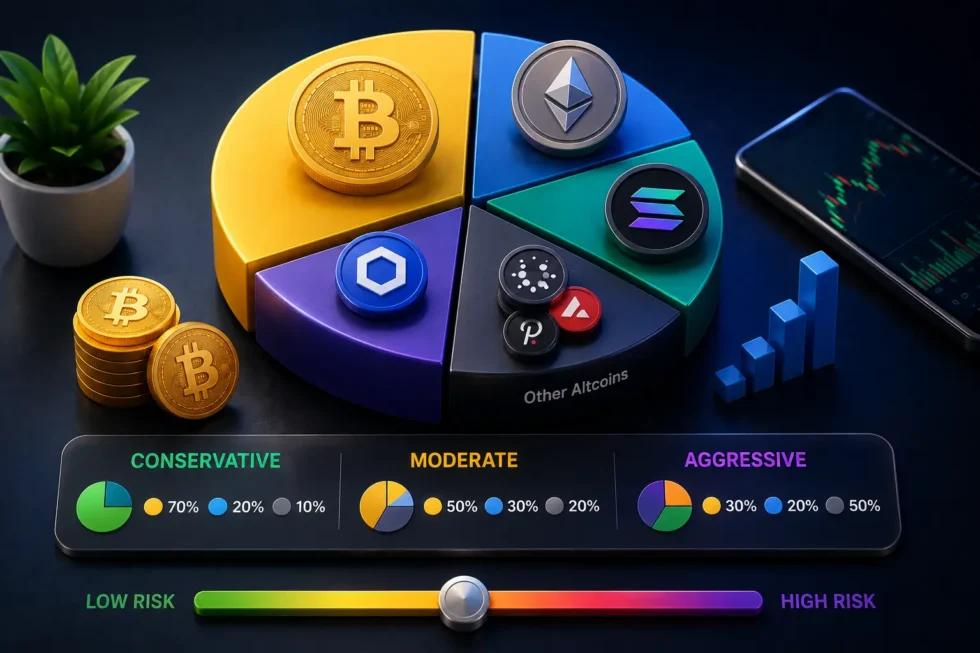
| Conservative | 70–80% | 10–20% | 5–10% (including stablecoin buffer) | Shorter horizon, low volatility tolerance |
| Balanced | 50–60% | 25–35% | 10–20% | Multi-year horizon, moderate volatility tolerance |
| Aggressive | 35–45% | 30–40% | 20–30% | Long horizon, high volatility tolerance |
Comparison: Risk-Level Trade-Offs at a Glance
| Risk Level | Expected Volatility | Growth Potential | Drawdown Risk | Rebalancing Frequency |
|---|---|---|---|---|
| Conservative | Lower | Lower | Smaller peak-to-trough declines | Less frequent, wider bands |
| Balanced | Moderate | Moderate-to-high | Meaningful but manageable declines | Quarterly or semi-annual |
| Aggressive | Higher | Highest | Large, sometimes severe declines | Frequent, tighter bands |
Structuring a Conservative Crypto Portfolio
Conservative investors should prioritize capital preservation over maximum growth, which means weighting the portfolio heavily toward Bitcoin and Ethereum. A meaningful stablecoin allocation adds a liquidity cushion that can absorb short-term needs without forcing a sale of volatile assets during a downturn. Limiting the growth and opportunistic tiers to a small combined percentage keeps overall portfolio volatility closer to what a risk-averse investor can tolerate without emotional decision-making.
Structuring a Balanced Crypto Portfolio
A balanced structure spreads risk more evenly across core, growth, and opportunistic tiers while still keeping Bitcoin and Ethereum as the largest single positions. This approach suits investors with a multi-year horizon who accept meaningful short-term volatility in exchange for higher long-term growth potential. Regular rebalancing becomes more important at this risk level, since growth-tier assets can swing significantly and drift the portfolio away from its intended weighting within a matter of months.
Structuring an Aggressive Crypto Portfolio
Aggressive investors shift a larger share of the portfolio into growth and opportunistic assets, accepting substantially higher volatility in pursuit of outsized returns. This structure only suits investors with a long time horizon, stable finances outside of crypto, and genuine psychological readiness for large drawdowns. Position sizing discipline matters most at this risk level, since concentrated bets in small-cap or emerging-sector tokens carry a real possibility of total loss on individual positions.
Editorial Observations: What Separates Successful Portfolios Across Risk Levels
Watching how different portfolios perform across a full market cycle reveals a pattern that doesn’t get discussed enough: risk level matters less than consistency in sticking to it. Investors who choose an aggressive structure and abandon it during the first serious drawdown often end up worse off than investors who chose a conservative structure and held it patiently. The mismatch between stated risk tolerance and actual behavior during stress causes more damage than the initial allocation choice itself.
Another pattern worth noting involves how investors treat the “safe” portion of their crypto portfolio. <cite index=”4-1″>The proof-of-work model underlying Bitcoin has drawn scrutiny for its energy footprint, with the U.S. Energy Information Administration estimating that crypto mining accounts for up to 2.3% of U.S. electricity consumption</cite>, a fact that doesn’t change Bitcoin’s role as a liquid core holding but does factor into some investors’ broader values-based screening when structuring a portfolio.
A third observation concerns rebalancing discipline across risk levels. Aggressive portfolios need tighter rebalancing bands precisely because their volatility can compound quickly, yet many aggressive investors rebalance the least often, chasing momentum instead of trimming winners back to target. Ironically, the risk level that needs the most portfolio discipline often receives the least.
Common Mistakes When Matching Risk Level to Portfolio Structure
Overestimating personal risk tolerance ranks as the most frequent error, often revealed only after a significant drawdown tests an investor’s actual behavior rather than their stated preferences. Underestimating time horizon causes a related mistake, where investors build an aggressive structure around money they’ll actually need within a few years. Failing to revisit the structure as circumstances change compounds both problems, since a portfolio built for a 30-year-old’s risk tolerance may no longer fit that same investor a decade later. Reviewing and adjusting the structure periodically keeps the crypto portfolio aligned with the investor’s real financial situation, not just their initial assumptions.
Frequently Asked Questions
How do I know which risk level fits my crypto portfolio?
Consider both risk tolerance and risk capacity together: how much volatility you can handle emotionally, and how much loss you can financially absorb without disrupting your broader life plans. A conservative structure suits shorter horizons and lower volatility comfort, while an aggressive structure suits longer horizons and higher comfort with drawdowns.
Can a crypto portfolio combine different risk levels for different goals?
Yes, and many experienced investors do exactly that, using a conservative structure for near-term goals and a more aggressive structure for long-term, discretionary capital. Keeping these buckets separate, even mentally, helps prevent short-term volatility from disrupting long-term strategy.
Should risk level change over time?
Generally yes. As time horizon shortens or financial circumstances change, gradually shifting a crypto portfolio toward a more conservative structure protects accumulated gains from being wiped out by a late-cycle downturn.
How often should a balanced crypto portfolio be rebalanced?
Quarterly or semi-annual rebalancing works well for most balanced structures, enforcing discipline without generating excessive trading costs or unnecessary tax events.
Does a conservative crypto portfolio eliminate risk?
No. Even a conservative structure weighted toward Bitcoin and Ethereum remains far more volatile than traditional conservative assets like bonds or cash, and it can still experience significant drawdowns during broad market stress.
Conclusion: Build the Portfolio That Matches the Investor, Not the Market
A well-structured crypto portfolio starts with an honest assessment of risk tolerance and time horizon, not with chasing whichever asset performed best last quarter. Conservative, balanced, and aggressive structures each serve a different type of investor, and the real skill lies in choosing the right one and sticking with it through full market cycles. For the broader framework behind tiered allocation, custody practices, and long-term portfolio strategy, revisit our complete guide: The Smart Crypto Investing Blueprint 2026.
Sources and References
- Analytics Insight — Top Cryptocurrencies to Buy in August 2026
- Bitcoin Foundation — Top 5 Crypto Assets to Invest In: Best Cryptocurrencies for Maximum ROI
- Forbes Advisor — Top 10 Cryptocurrencies of August 10, 2026
- CoinDCX — Top 10 Cryptos to Invest in August 2026 (By Market Cap)
This article is for educational purposes only and does not constitute financial, investment, tax, or legal advice. Digital assets are volatile and speculative. Consult a licensed financial advisor before making investment decisions.