

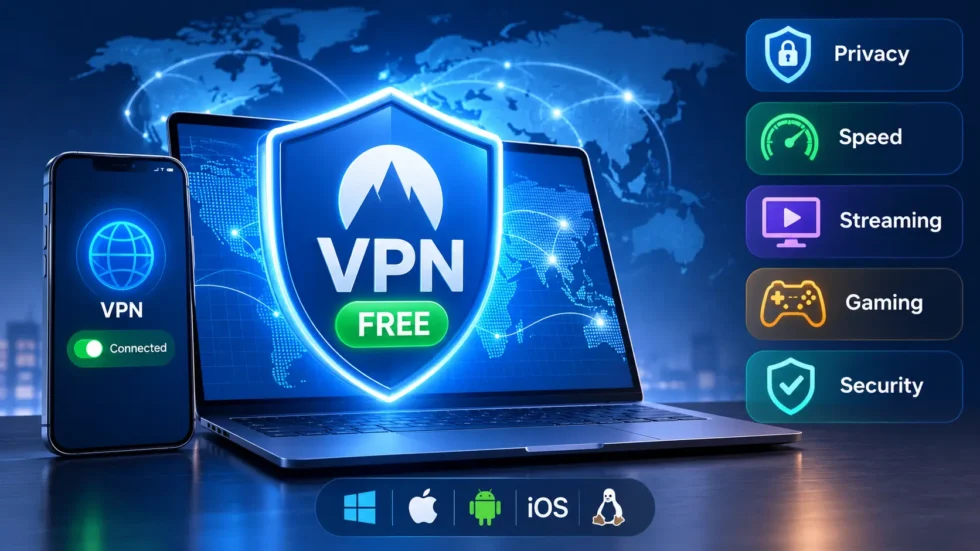
Free VPN Complete Guide 2026 Best Free VPNs, Safety, Privacy, Speed, Streaming, Gaming, and Security Compared
A free VPN sounds like the perfect deal. You get private browsing, a hidden IP address, and zero monthly cost. Millions of people search for a free VPN every month, hoping to unblock a show, protect their data on airport Wi-Fi, or dodge a subscription fee. Yet the free VPN market hides a wide gap between a handful of trustworthy providers and a much larger pool of apps that quietly sell data, inject ads, or bundle malware.
This guide breaks down everything worth knowing about a free VPN in 2026: which providers actually protect you, how fast they run, whether they unblock Netflix and other streaming platforms, how they perform for gaming, and what separates a legitimate no-cost VPN from a privacy trap. Independent research, provider audits, and current policies shaped every recommendation below, so you can make an informed choice rather than gamble on a random app store listing.
Free VPN at a Glance: Key Data Table
The table below summarizes the most relevant free VPN services tested by independent reviewers in 2026. Data caps, server counts, and streaming access change frequently, so treat these figures as a snapshot rather than a permanent guarantee.
| Provider | Monthly Data Limit | Server Locations | No-Logs Verification | Streaming Access | Speed Rating | Best Suited For |
|---|---|---|---|---|---|---|
| Proton VPN Free | Unlimited | 10 countries | Independently audited | Limited | Good | Daily privacy and censorship workarounds |
| PrivadoVPN Free | 10GB fast tier, then throttled | 12+ countries | Unaudited, no-logs claimed | Several major platforms | Very good | Streaming and quick downloads |
| Windscribe Free | 10GB per month | 10 countries | Independently audited | Some platforms | Good | Power users who want firewall tools |
| Hide.me Free | Unlimited, capped server pool | 5 locations | Audited | Unreliable | Fair | Occasional torrenting |
| TunnelBear Free | 2GB per month | Auto-selected only | Audited | Unreliable | Fair | First-time VPN users |
| Hotspot Shield Basic | Unlimited, ad-supported | US-focused | Unaudited | Limited | Good | Casual US-based browsing |
Notice how every provider on this shortlist trades away something. Proton VPN offers unlimited data but removes manual server selection. TunnelBear caps you at 2GB but delivers the friendliest onboarding experience. That trade-off pattern defines the entire free VPN category, and understanding it helps you pick the right limitation for your own habits.
What Is a Free VPN? Core Definitions You Need First
Before comparing providers, it helps to define the terms that show up throughout every free VPN review. Skipping this section often leads people to misjudge what a “no-cost VPN” can realistically deliver.
VPN (Virtual Private Network): Software that routes your internet traffic through an encrypted tunnel to a remote server, hiding your real IP address from websites and your internet provider.
Free VPN: A VPN service offered at no monetary cost, either as a limited version of a paid product (freemium) or as a standalone app funded through ads, data collection, or bandwidth reselling.
Freemium VPN: A scaled-down free tier from an established paid provider, such as Proton VPN or Windscribe. These tiers usually include real encryption and a published privacy policy, unlike many fully free apps.
No-logs policy: A provider’s written commitment not to record your browsing activity, IP address, or connection timestamps. Independent audits, not marketing claims, determine whether this promise holds up.
Kill switch: A safety feature that blocks all internet traffic if your VPN connection drops unexpectedly, preventing your real IP address from leaking during the gap.
DNS leak: A flaw that lets your device send domain lookup requests outside the encrypted VPN tunnel, exposing your browsing activity even while the VPN appears connected.
Data cap: A monthly bandwidth limit, commonly between 2GB and 10GB on free tiers, after which speeds drop sharply or the connection stops working entirely.
WireGuard: A modern, lightweight VPN protocol favored for its speed and lower latency compared to older standards like OpenVPN.
How Do Free VPNs Actually Make Money?
Nothing about running global server infrastructure comes cheap, so every truly free VPN service needs a revenue model. Three broad categories exist, and knowing which one applies to a given app tells you a lot about its trustworthiness.
The first category covers freemium tiers from paid providers. Companies like Proton, Windscribe, and PrivadoVPN offer a limited free plan to attract new users, hoping some will eventually upgrade. These providers already run audited infrastructure for paying customers, so the free version typically inherits the same encryption standards and privacy commitments, just with tighter limits.
The second category relies on advertising and bandwidth partnerships. Some apps display ads inside the client or sell excess bandwidth to third-party networks, a practice that turns your idle connection into someone else’s proxy exit node.
The third category, and the most concerning one, involves direct data harvesting. Security researchers have repeatedly found that a large share of “100% free forever” VPN apps log browsing activity, sell it to advertisers, or embed hidden trackers. Analysts have projected that roughly six in ten free VPNs may sell user data to third parties, while close to eight in ten embed some form of tracking technology. That statistic alone should change how you evaluate any app promising unlimited free access with no strings attached.
Best Free VPNs of 2026, Compared Side by Side
Reviewers at Security.org, Salon, RTINGS, Top10VPN, TechRadar, and Tom’s Guide converged on a similar shortlist this year, even though their rankings differ slightly by category. The table below expands on pricing and standout features for each finalist.
| Provider | Upgrade Price (Paid Tier) | Simultaneous Devices | Kill Switch | Standout Feature |
|---|---|---|---|---|
| Proton VPN Free | From ~$4/mo | 1 | Yes | Fully audited, unlimited data |
| PrivadoVPN Free | From ~$2/mo | 1 | Yes | Netflix and torrent-friendly |
| Windscribe Free | From ~$2/mo | Unlimited | Yes | Built-in ad and malware blocker |
| Hide.me Free | From ~$2/mo | 1 | Yes | Advanced connection settings |
| TunnelBear Free | From ~$3/mo | 1 | Yes | GhostBear obfuscation mode |
| Hotspot Shield Basic | From ~$8/mo | 1 | Limited | No time restriction on free use |
Proton VPN Free: Best Zero-Cost VPN for Privacy
Proton VPN earns the top spot among privacy-focused reviewers because it removes the usual free-tier catch: the data cap. You can leave it running all day without hitting a limit, and Switzerland’s strong privacy laws back the company’s operations. Independent audits confirm the no-logs policy, and open-source code lets researchers verify the claims directly rather than trusting marketing copy.
The free plan now spans ten countries, a notable expansion the company made specifically to help users facing sudden censorship or internet restrictions. A built-in Stealth protocol disguises VPN traffic as regular HTTPS, which matters if you travel somewhere that actively blocks VPN connections. The main drawback involves server selection: free users get auto-assigned to a server rather than choosing a specific country, which limits usefulness for streaming or location spoofing.
PrivadoVPN Free: Fastest Free VPN for Streaming and Downloads
PrivadoVPN Free stands out in lab testing for raw speed, making it a strong pick for anyone who wants to stream or download without excessive buffering. You get 10GB of full-speed data each month, then unlimited access at reduced speed once that runs out. A built-in ad blocker and basic malware protection round out the package.
The apps remain fairly basic compared to premium competitors, and the no-logs policy has not undergone a court test or independent audit yet. For everyday browsing and moderate streaming, though, reviewers consistently rate it as one of the most capable options in the free VPN space.
Windscribe Free: Best Free VPN for Power Users
Windscribe built its reputation on a clearly written, independently audited no-logs policy that explicitly states it does not log user traffic. The free tier includes 10GB of monthly data, a built-in firewall, ad-blocking tools, and access to servers across ten countries including Canada, Germany, the Netherlands, and the US.
Speeds run solid, typically landing around 60 to 75 percent of an unrestricted baseline connection. Streaming support has weakened over time, though, since several major platforms now detect and block Windscribe’s free server IPs. Customer support also lags behind competitors, offering no live chat for complex troubleshooting.
Hide.me Free: Best Free VPN for Torrenting
Hide.me allows unlimited data usage on its free tier, a rarity that appeals to anyone who downloads large files regularly. The catch involves server access: free users get just five locations across Europe and North America, and speeds run noticeably slower than the paid tier. Advanced settings like protocol switching give more technical users flexibility that many other free VPNs skip entirely.
TunnelBear Free: Most Beginner-Friendly Free VPN
TunnelBear wins praise for making VPN technology approachable rather than intimidating. Its bear-themed interface, GhostBear traffic obfuscation, and AES-256 encryption create a genuinely pleasant first-time experience. McAfee has owned the company since 2018, and independent audits back its no-logs claims.
The free plan caps out at just 2GB per month, an amount that disappears quickly if you stream video. A 2026 policy change also removed manual server selection for free users, replacing it with automatic location assignment. For casual browsing and social media, the limitations rarely become a problem, but heavier users will hit the wall fast.
Hotspot Shield Basic: Best No-Cost VPN for US-Based Access
Hotspot Shield distinguishes itself with unlimited data and no time restriction on its free tier, a combination few competitors match. Strong US server coverage makes it a reasonable pick for domestic streaming and browsing. The trade-offs include intrusive in-app advertising and server crowding during peak hours, which can drag down real-world speeds despite decent benchmark numbers.
Is a Free VPN Safe? Privacy and Security Risks Explained
Safety concerns dominate every serious conversation about free VPN services, and the evidence backs up the caution. A 2024 analysis of 100 free Android VPN apps found that roughly one in five carried flagged malware. A broader academic study led by Australia’s CSIRO reached a similar conclusion, finding that free apps made up the majority of VPNs most likely to contain malicious code.
Data leaks compound the malware problem. Research from Top10VPN found that 88 percent of the most popular free Android VPNs leaked user data through IPv4, IPv6, DNS, or WebRTC channels, exposing real identities and locations despite an active connection. Excessive app permissions add another layer of concern; a 2026 review of eighteen popular free Android VPNs found that nearly all included embedded trackers, and many requested access to contacts, precise location, or the device camera.
Ownership transparency remains a persistent weak spot across the category. Investigations have repeatedly traced popular free VPN apps back to opaque holding companies, some with undisclosed links to jurisdictions with weak data protection laws. Security researcher Jeremiah Fowler discovered a striking example in 2023, when an exposed database tied to SuperVPN revealed over 360 million user records sitting unprotected online.
Government agencies have started weighing in directly. The US Cybersecurity and Infrastructure Security Agency published guidance in late 2024 warning that personal VPNs can shift risk from your internet provider to the VPN company itself, sometimes expanding your overall attack surface rather than shrinking it. That warning applies most sharply to unaudited free apps with unclear ownership.
None of this means every free VPN endangers your privacy. Audited freemium tiers from Proton VPN, Windscribe, and similar established providers operate under real scrutiny and published policies. The danger concentrates in the long tail of “100% free forever” apps with no corporate transparency, vague privacy policies, and business models that depend on monetizing your traffic.
Free VPN Speed and Performance: What to Expect
Speed loss comes with the territory when you choose a free VPN over a paid subscription. Server networks run smaller, often limited to eight or ten total locations compared to the thousand-plus servers many paid providers maintain. Fewer servers means more crowding, and crowded servers translate directly into slower, less consistent connections during peak hours.
Bandwidth caps compound the issue further. Once you exhaust a 2GB or 10GB monthly allowance, most providers throttle your connection dramatically rather than cutting it off outright. Testing across providers shows real variation, too: some services reduce download speeds by less than ten percent under load, while upload speeds on certain networks drop by half or more.
If speed matters most to you, prioritize providers with documented benchmark testing over marketing claims. Reviews that publish relative speed percentages against an unrestricted baseline give you a far more honest picture than raw Mbps numbers pulled from a single test session.
Free VPNs for Streaming: Netflix, Hulu, and Beyond
Streaming represents one of the toughest tests for any free VPN, since platforms like Netflix actively hunt for and block known VPN server IP ranges. Free tiers struggle here more than paid plans because their smaller server pools become public knowledge quickly, making them easy targets for detection systems.
PrivadoVPN Free currently performs best among free options for streaming, thanks to its fast 10GB tier and server network built with entertainment access in mind. Windscribe still unblocks a handful of platforms, including some regional libraries, but has lost ground on major US services as detection has improved. Proton VPN Free, despite its privacy strengths, was never designed with streaming as a priority, and its lack of manual server selection makes location-specific unblocking unreliable.
Paid VPN subscriptions maintain a clear edge here. Surfshark, for example, reportedly works with over twenty separate Netflix libraries and multiple other platforms including Disney+ and Max, a scale of access that free tiers simply cannot match with their limited infrastructure. Free CapCut Premium Templates The Complete 2026 Guide to Unlocking CapCut Pro Features Legally.
Free VPNs for Gaming: Latency, Ping, and Lag
Gaming punishes latency in ways that browsing and even streaming do not. A jump of even ten or twenty milliseconds in ping can decide a match in competitive titles, which makes free VPN infrastructure a risky choice for serious players.
Three structural problems affect free VPNs specifically during gaming sessions. First, smaller server networks mean fewer nearby options, so your traffic often travels a longer physical distance before reaching the game server. Second, most free tiers exclude split tunneling, a feature that lets you route only your game traffic through the VPN while everything else uses your normal connection. Third, monthly data caps run out fast during extended gaming sessions, especially with modern titles that download large patches mid-session.
Protocol choice matters as much as provider choice. WireGuard consistently delivers lower latency than older protocols like OpenVPN over TCP, and providers that expose protocol selection on their free tier give you a real performance edge. Proton VPN Free notably includes WireGuard access even without a paid subscription, which helps explain why some gaming-focused reviewers rate it favorably despite its other free-tier limits.
For casual gaming or masking your IP from harassment, a well-chosen free VPN can work reasonably well if you pick the nearest available server and avoid peak usage hours. Competitive players chasing every possible millisecond, however, will likely find the tradeoffs frustrating enough to justify a paid alternative with dedicated low-latency infrastructure.
Free VPN for Torrenting and P2P: What You Should Know
Torrenting adds its own set of demands, and not every no-cost VPN handles them well. Many free tiers block P2P traffic outright, restricting torrenting to a handful of designated servers or blocking it entirely to protect their limited bandwidth for other users. Providers that do allow torrenting on a free plan, such as Hide.me, still expect you to respect the monthly data ceiling, which large downloads can exhaust within a single session.
Encryption strength matters more here than almost anywhere else, since torrenting exposes your IP address to every peer in a swarm unless a VPN masks it properly. A free VPN without a reliable kill switch creates real exposure: if the connection drops mid-download, your real IP address becomes visible to strangers sharing the same file. Before torrenting through any free VPN, confirm the provider explicitly permits P2P traffic, check for a working kill switch, and avoid downloading anything close to your monthly data cap.
Legal risk deserves a mention too. A VPN changes your visible IP address, but it does not change the legality of the content you download. Free VPN providers with weak logging practices offer little real protection if a copyright holder or law enforcement agency requests connection records, particularly from services based in jurisdictions with limited privacy protections.
Free VPN on Mobile vs. Desktop: Does the Platform Matter?
Platform choice changes the risk profile of a free VPN more than most people expect. Mobile app stores host thousands of VPN listings, and research consistently finds mobile-first free VPNs carrying more malware and tracking code than their desktop counterparts. Android faces the sharpest exposure, since sideloading and looser store policies let lower-quality apps slip through more easily than on iOS.
Desktop clients from established providers tend to receive more security scrutiny, partly because desktop users skew toward more technical audiences who report bugs and flag suspicious behavior. That said, a reputable provider’s mobile app, downloaded directly from the official app store, generally matches the safety of its desktop version. The real danger comes from unofficial APK files, cloned apps, and unfamiliar developers with no public track record, not from mobile devices themselves.
Free VPN vs. Paid VPN: Security Feature Comparison
| Feature | Typical Free VPN | Typical Paid VPN |
|---|---|---|
| Server network size | 8-50 locations | 1,000+ servers, 90+ countries |
| Monthly data | 2-10GB or unlimited with caveats | Unlimited |
| Split tunneling | Rarely available | Usually included |
| Multi-hop/double VPN | Not available | Often available |
| Kill switch | Sometimes included | Standard |
| Independent audit | Varies by provider | Common among top providers |
| Simultaneous devices | Often limited to 1 | 5-unlimited |
| Customer support | Basic, limited chat | 24/7 live support |
| Streaming reliability | Inconsistent | Strong across major platforms |
This comparison explains why security professionals often recommend a free VPN only as a starting point, not a long-term solution for anyone with serious privacy or performance needs. The gap narrows for casual users, but it widens quickly for streaming, gaming, or torrenting.
How to Choose a Safe Free VPN: A Practical Checklist
Selecting a trustworthy free VPN takes more effort than picking the top search result. Use this checklist before installing anything:
- Verify the provider has published an independently audited no-logs policy, not just a self-written claim.
- Research company ownership and headquarters location before trusting the app with your data.
- Download only from the official website or a verified first-party app store listing, never a third-party mirror.
- Check what permissions the app requests; a privacy tool should never need camera, contacts, or call log access.
- Favor a freemium tier from an established paid provider over a fully free, ad-supported app with no clear business model.
- Read the actual privacy policy, paying close attention to data-sharing language and third-party partnerships.
- Confirm the app includes a kill switch and basic leak protection before relying on it for sensitive activity.
- Avoid any service promising “unlimited free VPN forever” with no visible revenue source; that combination rarely ends well.
Editorial Observation: What the Free VPN Market Really Tells Us
Stepping back from individual provider reviews, a clear pattern emerges across this entire category. The free VPN market has effectively split into two very different worlds. On one side sit a small number of established, audited freemium tiers that treat the free plan as a genuine customer-acquisition strategy rather than a monetization scheme built on user data. On the other side sits a much larger, murkier field of apps chasing app-store downloads through vague promises, funded by tracking and data resale rather than subscriptions.
Proton VPN’s decision to double its free-tier country count in 2025 signals where the credible end of this market is heading: providers are investing more in their free plans specifically because trust has become a competitive advantage. That investment matters most for users in regions facing sudden censorship, where a reliable free option can serve as a genuine lifeline rather than a convenience.
At the same time, regulatory scrutiny keeps intensifying. Warnings from CISA and ongoing FTC enforcement actions against deceptive VPN marketing suggest that the “free forever, no catch” pitch will face growing legal pressure in the years ahead. Anyone shopping for a free VPN today would do well to treat a provider’s transparency, audit history, and business model as more predictive of safety than any single speed benchmark or server count.
Frequently Asked Questions
Is any free VPN completely safe to use?
No option offers absolute safety, but audited freemium tiers from providers like Proton VPN and Windscribe carry far less risk than fully free, ad-supported apps with unclear ownership.
Can a free VPN unblock Netflix reliably?
Occasionally, though detection systems block known free VPN IP ranges quickly. PrivadoVPN Free currently performs best among free options, but consistency varies month to month.
Do free VPNs work well for online gaming?
They can work for casual play, especially with a nearby server and a modern protocol like WireGuard, but data caps and missing split-tunneling features make them a poor fit for extended or competitive sessions.
Why do most free VPNs limit monthly data?
Running server infrastructure costs money, so providers cap free usage to encourage upgrades to paid plans while still offering a genuine, if limited, service.
Is Proton VPN’s free tier permanently free?
Yes, Proton VPN Free has no time limit and no forced expiration, though it restricts server selection and device count compared to the paid plan.
Should I install a free VPN on my phone?
Only from a reputable provider’s official app store listing. Independent research has found a meaningful share of free mobile VPN apps request excessive permissions or contain tracking code.
What is currently the safest free VPN in 2026?
Reviewers most consistently point to Proton VPN Free for privacy, citing its independent audits, open-source code, and Swiss legal protections.
Are free VPN browser extensions as safe as full apps?
Generally no. Browser extensions often have looser oversight and fewer security features than standalone apps, so stick with a provider’s dedicated application when possible.
References
- Security.org, “The Best Free VPNs for 2026,” 2026.
- Salon, “Best free VPNs for 2026: Safe, reliable and truly free options,” June 2, 2026.
- RTINGS.com, “The 2 Best Free VPNs of 2026,” June 11, 2026.

Best Free VPN Services in 2026 Fast, Secure, and Truly Free Options Compared - MSNewsfeed