Cold Wallet Storage vs Exchange Custody: What the Data Says About Where Your Crypto Is Actually Safest 2026 Evidence Based Comparison
Every crypto investor eventually asks the same question: should my coins sit on the exchange where I trade them, or should they move to a device I control myself? The honest answer isn’t “cold storage always wins” — it’s more specific than that, and the specifics matter.
This article breaks down custody risk using actual incidents, actual insurance policy limits, actual regulatory text, and actual hardware costs — not the generic “not your keys, not your coins” slogan you’ve probably already heard. If you want the broader context on how exchanges stack up against each other on fees, liquidity, and compliance, see our full comparison in [The Global Crypto Exchange Cost Map 2026: 12 Trusted Platforms Compared by Trading Fees, Liquidity, Security, Withdrawal Speed & Regulatory Compliance]. And if you haven’t yet, it’s worth reading the broader security landscape first in [How Secure Are Crypto Exchanges? Security Features Every Investor Should Check], which this article builds directly on.
The Core Distinction: What “Custody” Actually Means
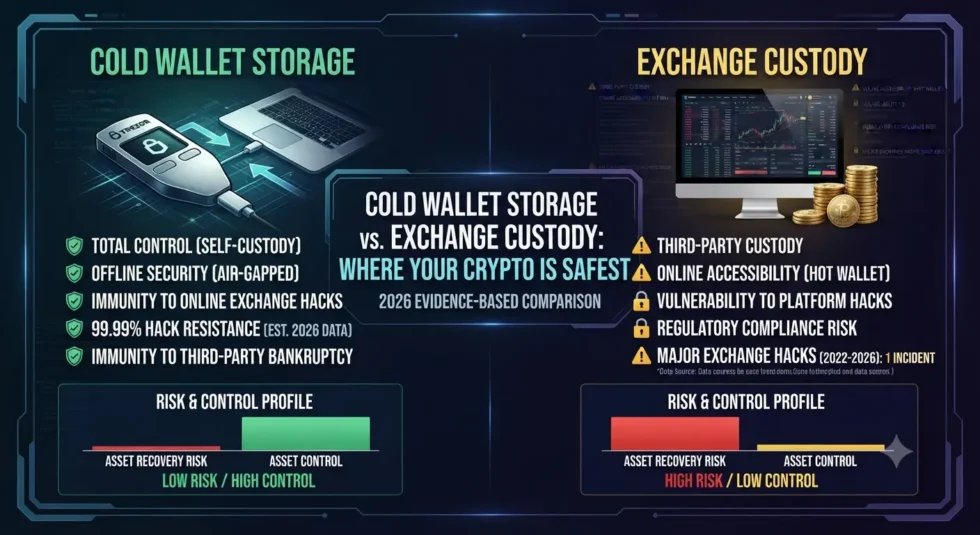
When you hold crypto on an exchange, the exchange controls the private keys. Your account balance is an IOU — a database entry that the exchange promises to honor. When you hold crypto in a cold wallet, you control the private keys directly, and the exchange (or anyone else) is no longer part of the equation.
This distinction sounds abstract until you look at what’s happened when it’s gone wrong on each side.
Exchange Custody: The Hack and Failure Record
Custodial risk isn’t hypothetical. Here is the documented track record of centralized exchange losses, largest to most recent:
| Incident | Year | Amount Lost | Root Cause |
|---|---|---|---|
| Bybit | 2025 | ~$1.4–1.5B (401,347 ETH) | Supply-chain attack on Safe{Wallet} multisig UI — cold wallet transaction spoofed during routine transfer |
| FTX collapse | 2022 | ~$8.9B customer shortfall | Commingling of customer funds with Alameda Research; not a hack, a fraud/mismanagement failure |
| Mt. Gox | 2011–2014 | ~$460–470M at the time (850,000 BTC) | Years of undetected security lapses and poor internal controls |
| Coincheck | 2018 | ~$530–547M (NEM/XEM) | Entire balance held in a single internet-connected hot wallet, no multisig |
| DMM Bitcoin | 2024 | ~$308–320M (4,502.9 BTC) | Unauthorized outflow from exchange wallet infrastructure; exchange later wound down operations |
| Bitfinex | 2016 | ~$72M at the time (120,000 BTC) | Vulnerability in exchange’s multisig wallet structure |
| Binance | 2019 | ~$40M (7,000 BTC) | API key/2FA compromise; reimbursed via Binance’s SAFU reserve fund |
| Coinbase (data breach) | 2025 | Est. $180–400M in remediation costs | Overseas support contractors bribed to exfiltrate customer data (not crypto keys directly) |
Two patterns are worth pulling out of this table specifically:
Cold storage on an exchange is not automatically safe from exchange failure. The Bybit incident is the most important data point for this article, because Bybit’s ETH was sitting in a cold, multisig wallet — the exact setup most security guides recommend — when it was stolen. The attackers didn’t crack the cold wallet’s cryptography; they compromised the interface Bybit’s own signers used to approve a routine transfer, so the approvers thought they were signing a normal cold-to-hot wallet transfer when they were actually handing control of the wallet to the attackers. NCC Group’s technical review of the incident found that the operational process around the cold wallet, not the offline storage itself, was the point of failure. This matters because it shows that “the exchange holds it in cold storage” is not the same guarantee as “you hold it in cold storage” — the exchange’s operational security is now your risk, not the cryptography’s.
Insurance covers the platform, not your account specifically, and coverage is thin relative to total holdings. Coinbase’s parent company carries a commercial crime policy described as the largest of its kind covering hot wallets in the industry — but the policy documented in SEC filings caps at $320 million, covering employee collusion, theft, and hacks across Coinbase Global and all its subsidiaries combined, while the company reports safeguarding roughly $193 billion in total digital holdings. That’s insurance covering under 0.2% of assets held. Binance’s Secure Asset Fund for Users (SAFU) is a $1 billion reserve funded by 10% of trading fees, and it has paid out before — it covered the 2019 API hack in full and paid $7 million for a Trust Wallet vulnerability in December 2025 — but SAFU only responds to exchange-side failures, not to phishing, SIM-swapping, or credential theft on your individual account. Critically, the FDIC’s proposed 2026 rulemaking explicitly states that crypto assets held by supervised institutions will not receive deposit insurance protection, unlike a bank account. There is no FDIC- or SIPC-equivalent backstop for crypto custody the way there is for cash deposits or brokerage securities.
For more on how these security postures compare across specific platforms, see the exchange-by-exchange breakdown in our pillar guide, [The Global Crypto Exchange Cost Map 2026].
Cold Wallet Storage: The Actual Cost and Risk Profile
Self-custody removes exchange counterparty risk, but it isn’t free and it isn’t risk-free either — it trades one risk profile for another.
Real hardware costs (2026 pricing)
| Device | Price (2026) | Security Element | Notable Feature |
|---|---|---|---|
| Trezor Safe 3 | ~$79–129 | Infineon Optiga Trust M, EAL6+ | Open-source firmware, Shamir Backup (SLIP-39) |
| Ledger Nano S Plus | ~$79 | CC EAL5+ certified secure element | USB-only, budget tier |
| Ledger Nano X | ~$149 | CC EAL5+ certified secure element | Bluetooth, mobile pairing |
| Trezor Safe 5 | ~$129 | Secure element + touchscreen | Color touchscreen, haptic confirmation |
| Coldcard Mk4 | ~$130–177 | Secure element, fully air-gapped | Bitcoin-only, no wireless radios at all |
| Trezor Safe 7 | ~$249 | Secure element, wireless | Bluetooth + magnetic wireless charging |
| Ledger Flex | ~$207–249 | CC EAL5+ | Touchscreen signer |
| Ledger Stax | ~$332–399 | CC EAL5+ | 3.7″ E Ink touchscreen, wireless charging |
For context: a hardware wallet is a one-time cost of roughly $50–$400, versus an exchange, where custody is nominally “free” but you pay indirectly through trading fees, withdrawal fees, and — as shown above — the tail risk of platform insolvency or breach on assets exceeding insurance coverage. See the exact fee schedules for withdrawal and trading costs across major exchanges in [The Global Crypto Exchange Cost Map 2026].
What cold storage actually protects against — and what it doesn’t
Cold wallets keep private keys offline and require physical confirmation of every transaction on the device screen, which eliminates remote malware from silently signing transactions on your behalf. This is meaningfully different from the Bybit failure mode: on a personal hardware wallet, you — not a third-party UI — are the one confirming the transaction details on a screen you control. Hardware wallet vendors and post-Bybit analysis both point to “clear signing” (seeing the literal recipient address, amount, and network on the device before approving) as the direct lesson from that hack, since blind-signing through a compromised interface was the actual attack vector, not a broken cryptographic key.
What cold storage does not protect against:
- Seed phrase loss or exposure. If you lose your 24-word recovery phrase, or if it’s stolen (photographed, stored digitally, phished), the hardware device itself provides no recovery mechanism — most vendors explicitly cannot restore access without it.
- Single point of failure without a backup plan. The QuadrigaCX case is the canonical cautionary tale here: it wasn’t an exchange hack, but the exchange founder was reportedly the only person with the cold wallet keys, and his sudden death left customer funds permanently inaccessible. Self-custody without a documented, secure inheritance/backup plan can create the exact same failure mode at an individual level.
- Physical theft or coercion of the device plus the PIN/passphrase.
- User error during setup or transfers — sending to the wrong address or network, which is irreversible on-chain and has no customer support line to call.
Fee Schedules: What Custody Actually Costs You Over Time
Because “which is cheaper” is rarely asked directly but almost always matters, here’s the real comparison:
- Exchange custody: no direct custody fee on most retail platforms, but cost shows up in trading spreads, withdrawal fees per transaction (often $1–$25+ depending on network and asset, higher for slower/blocked networks), and — for institutional custody specifically — Coinbase Custody and comparable providers charge customized, typically annualized custodial fees rather than flat retail rates.
- Cold wallet: one-time hardware purchase ($50–$400 as shown above), zero ongoing custody fee, but you absorb 100% of the operational risk (backup, storage, transaction verification) that an exchange or custodian would otherwise manage for you.
For side-by-side trading fee, withdrawal fee, and liquidity comparisons across 12 platforms, the full breakdown lives in the pillar page: [The Global Crypto Exchange Cost Map 2026: 12 Trusted Platforms Compared by Trading Fees, Liquidity, Security, Withdrawal Speed & Regulatory Compliance].
Regulatory Status: Custody Rules Are Tightening on Both Sides
Regulation is moving toward stricter custody standards everywhere, but the frameworks differ meaningfully by jurisdiction, and none of them replace the practical trade-offs above.
In the EU, the Markets in Crypto-Assets Regulation (MiCA) is now the operative framework. Crypto-Asset Service Providers (CASPs) offering custody must physically and legally segregate client assets from their own, maintain an individual register of each client’s holdings reconciled daily, and are explicitly barred from using client-held assets for their own purposes. CASPs offering custody or exchange services must hold minimum capital of €125,000, rising to €150,000 for operating a trading platform. The transitional grace period for firms operating without full MiCA authorization ends July 1, 2026 — after that, unauthorized firms serving EU clients face fines up to €5 million or 3% of annual turnover.
In the US, New York’s NYDFS BitLicense remains the strictest state-level regime, requiring a $5,000 application fee, DFS-determined minimum capital, and ongoing cybersecurity obligations under 23 NYCRR Part 500. NYDFS enforcement has been active: a 2024 action imposed a $30 million penalty on a major exchange over inadequate transaction monitoring, and in early 2026 the agency issued cease-and-desist orders with civil penalties of $100,000–$500,000 against unlicensed platforms. Importantly, none of this creates deposit-style insurance — the FDIC’s April 2026 proposed rulemaking explicitly excludes crypto assets from deposit insurance coverage, even at FDIC-supervised institutions offering crypto safekeeping.
The practical takeaway: regulation increasingly forces exchanges to segregate and account for your custodial assets properly, which reduces (but doesn’t eliminate) misappropriation risk. It does nothing to protect against the kind of operational/technical breach that hit Bybit, and it creates no insurance-like guarantee comparable to bank deposits. For the full regulatory comparison across all 12 platforms in this series, see [The Global Crypto Exchange Cost Map 2026], and for the broader question of what security features to check before trusting any platform with custody, see [How Secure Are Crypto Exchanges? Security Features Every Investor Should Check].
So Which Should You Use? A Framework, Not a Verdict
The evidence above doesn’t support a blanket answer — it supports a threshold-based one:
- Active trading capital you’re moving frequently benefits from staying on a regulated, insured (to the extent insurance exists), audited exchange — self-custody adds friction and transfer risk for capital in motion.
- Long-term holdings you don’t plan to touch for months or years are better suited to cold storage, where the $50–$400 one-time hardware cost is trivial against six- or seven-figure holdings, and where the Bybit-style operational/UI attack surface simply doesn’t apply to a device you physically confirm transactions on.
- Mid-size holdings are where most investors land in a hybrid approach: keep trading capital on a platform with strong track record and disclosed insurance limits (compare all 12 in the pillar guide), and periodically sweep the rest to a hardware wallet with a documented, tested backup procedure — not just a seed phrase written once and forgotten.
Whichever side of this you land on, the underlying lesson from every incident in this article — Bybit, Coincheck, Mt. Gox, QuadrigaCX — is the same: security failures happen at the process level as often as the cryptography level. A cold wallet only delivers on its promise if your backup process is as disciplined as the hardware is secure, and an exchange only delivers on its promise if its operational controls match its marketing.
For a full walkthrough of what security features to verify before you trust any exchange with custody — proof-of-reserves practices, multisig implementation, insurance disclosures, and audit history — read [How Secure Are Crypto Exchanges? Security Features Every Investor Should Check], and for the complete fee, liquidity, and compliance comparison across the 12 platforms most commonly used in 2026, see [The Global Crypto Exchange Cost Map 2026: 12 Trusted Platforms Compared by Trading Fees, Liquidity, Security, Withdrawal Speed & Regulatory Compliance].