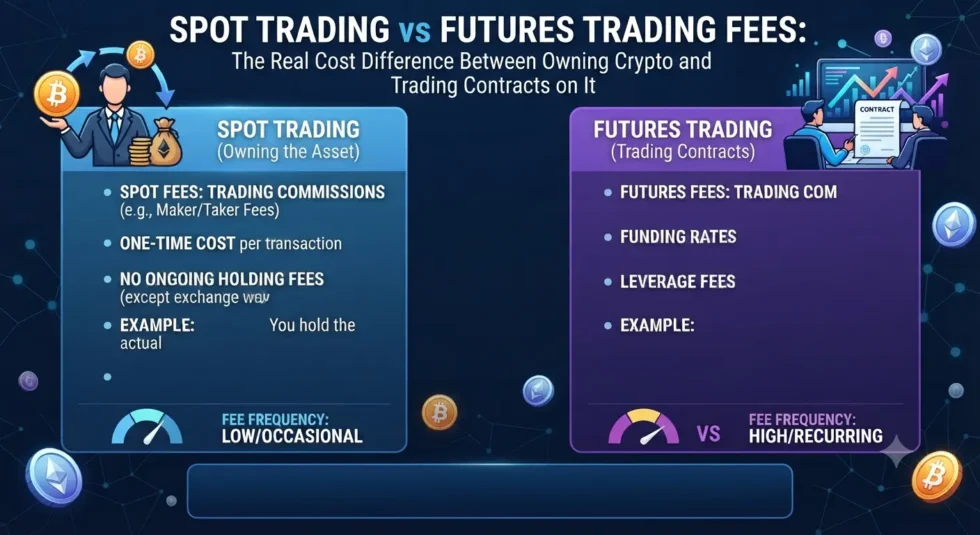
Spot Trading vs Futures Trading Fees: The Real Cost Difference Between Owning Crypto and Trading Contracts on It
Spot and futures trading are often compared on risk — leverage, liquidation, margin calls. What gets less attention is that they’re also priced on completely different cost structures, and the futures side has at least two recurring charges that never appear on a spot fee schedule at all. A trader who evaluates futures using only the advertised maker/taker rate is missing the majority of what a leveraged position actually costs to hold.
This article breaks down the full cost stack for both markets using documented fee schedules, published funding-rate data, and liquidation-fee mechanics — not a simplified “futures are riskier” summary. It’s a companion piece to our Global Crypto Exchange Cost Map 2026, which ranks 12 platforms on fees, liquidity, security, withdrawal speed, and regulatory compliance, and builds on Crypto Trading Fees Explained: How Exchange Costs Affect Long-Term Investment Returns and Maker vs Taker Fees Explained, which cover the order-book pricing mechanics that apply — differently — to both markets.
The fundamental difference: spot has one fee event, futures has several
A spot trade is a single, complete transaction. You pay a maker or taker fee once, on execution, and you own the underlying asset outright. There is no ongoing cost for continuing to hold it — the only thing eroding a spot position over time is opportunity cost.
A futures position, by contrast, generates cost on four separate occasions: when you open it, continuously while you hold it, potentially at forced closure, and again when you close it voluntarily. Understanding futures pricing means pricing all four, not just the first.
1. Maker/taker fees: futures are cheaper per trade, but that’s not the whole story
Base-tier futures maker/taker rates are consistently lower than spot rates on the same exchange. Binance charges 0.10%/0.10% on spot at the base tier versus 0.02% maker / 0.05% taker on USD-M futures — roughly a fifth to a half of the spot rate. Kraken, OKX, and Bybit follow the same pattern: futures execution fees running well below their spot equivalents, generally clustering around 0.02% maker / 0.05% taker industry-wide at the retail tier.
On its own, this makes futures look like the cheaper way to trade. It is, for execution cost alone. But execution cost is only one line in the futures cost stack, and it’s frequently the smallest one for anyone holding a position for more than a few hours.
2. Funding rate: the recurring cost that has no equivalent in spot trading
Perpetual futures — the dominant product on nearly every major exchange — don’t expire, so exchanges use a funding rate mechanism to keep the contract price tethered to the spot price. Every 1 to 8 hours (8 hours is standard on most platforms), traders on one side of the market pay traders on the other directly; when the perpetual price trades above spot, longs pay shorts, and when it trades below spot, shorts pay longs. This is a peer-to-peer payment, not a fee collected by the exchange, but it is a real, recurring cost to whichever side is paying, and it applies to the position’s full notional value — not just the margin actually posted.
The scale of this cost is easy to underestimate. In a strongly bullish market, funding rates can climb to roughly 0.1% per 8-hour interval or higher, which works out to about 0.3% per day and over 2% across a single week of simply holding a long position — regardless of whether the price moves in the trader’s favor. Data through early 2026 shows this isn’t a hypothetical extreme: average BTC funding reached roughly +0.51% in January 2026, meaning a $10,000 long position cost approximately $51 every 8 hours to hold — about $153 per day, or roughly $4,590 per month, entirely separate from any maker/taker fee paid on entry or exit.
Because funding only accrues on open positions, day traders who close out within a single session pay effectively none of it, while swing traders holding positions across multiple days or weeks can find funding costs exceeding their execution fees by a wide margin. Spot traders, by definition, never pay this cost at all — buying and holding an asset outright carries no funding rate under any circumstance, which is a structural, not incidental, advantage of spot for anyone with a multi-day or longer time horizon.
3. Liquidation fees: the cost that only exists because leverage exists
Spot positions cannot be liquidated — you own the asset, and its price falling to zero costs you the value of your investment, nothing more. Leveraged futures positions carry a fundamentally different risk: if the market moves against a position far enough that posted margin falls below the maintenance threshold, the exchange force-closes it automatically, and that forced closure carries its own fee, charged on the remaining position value at the moment of closure. Depending on the exchange, this liquidation fee typically runs 0.5% to 1.5% — charged on top of the trading loss already sustained from the adverse price move, not instead of it.
Most exchanges also maintain an insurance fund, financed partly by liquidation fees, designed to absorb the difference when a liquidated position’s actual closing price is worse than its calculated bankruptcy price — a mechanism that protects the exchange and other traders from cascading losses, but doesn’t return any value to the trader whose position was closed. The practical implication is that leverage doesn’t just amplify market risk — it introduces an entirely new fee category, layered directly on top of the loss it was meant to help capture.
Putting the two cost stacks side by side
| Cost component | Spot | Futures (perpetual) |
|---|---|---|
| Execution fee (maker/taker) | Charged once per trade, typically 0.10%–0.60% at base tier | Charged once per trade, typically 0.02%–0.05% at base tier — cheaper per trade |
| Holding cost | None | Funding rate, charged every 1–8 hours on full notional value; can exceed 2% per week in trending markets |
| Forced-closure cost | Not applicable — no liquidation mechanism | Liquidation fee of roughly 0.5%–1.5% on remaining position value, on top of the trading loss |
| Maximum loss | Bounded at 100% of capital deployed | Can exceed deposited margin in extreme conditions, and is amplified in direct proportion to leverage used |
The comparison makes clear why the two products aren’t really substitutes for the same task. Futures offer lower per-trade execution costs and the ability to short or use leverage, but every one of those benefits comes bundled with a cost dimension — funding and liquidation risk — that spot trading structurally does not have. A trader deciding between the two based on the advertised maker/taker rate alone is comparing roughly a quarter of the real cost picture.
When each cost structure actually favors the trader
The framework that follows from the fee mechanics, rather than general risk tolerance, comes down to holding period and directional need:
- Short-term, same-session trades: futures’ lower execution fees dominate, and funding rarely accrues meaningfully within a single session — this is the scenario where futures’ cost advantage is real and largely uncontested.
- Multi-day or longer holds with directional conviction: spot’s zero funding cost typically outweighs the lower futures execution fee, especially in trending markets where funding rates skew persistently in one direction — a long held for a week during a funding rate averaging even 0.05% per 8-hour interval accrues roughly 1.5% in holding cost alone, which a spot position of the same size and duration never pays.
- Any strategy requiring a short position or leverage: futures are the only option, since spot trading provides no mechanism for either — the cost comparison in this case isn’t spot-versus-futures but rather which exchange’s funding schedule and liquidation-fee structure is least punitive for the specific holding period intended.
None of this makes one market objectively cheaper than the other — it makes them priced for different jobs. Spot is priced for ownership and indefinite holding. Futures is priced for short-term execution and leveraged or directional exposure, with the funding rate acting as the ongoing rent charged for that flexibility.
What to check before choosing either
- On spot: confirm whether you’re trading through the exchange’s advanced/order-book interface or its simplified buy screen — the spread on simplified interfaces, covered in our piece on hidden crypto exchange fees, can dwarf the maker/taker rate difference between spot and futures entirely.
- On futures: check the current and historical funding rate for the specific contract before opening a position intended to be held longer than a day — funding rate aggregators display this data directly, and a consistently elevated rate in one direction is both a cost warning and a sentiment signal.
- On both: remember that maker orders qualify for the lower rate on either market only if the order rests on the book rather than filling instantly — the mechanics covered in Maker vs Taker Fees Explained apply identically to spot and futures order books.
For the full ranked comparison of how 12 exchanges handle trading fees, liquidity, security, withdrawal speed, and regulatory compliance across both spot and derivatives products, see the Global Crypto Exchange Cost Map 2026.