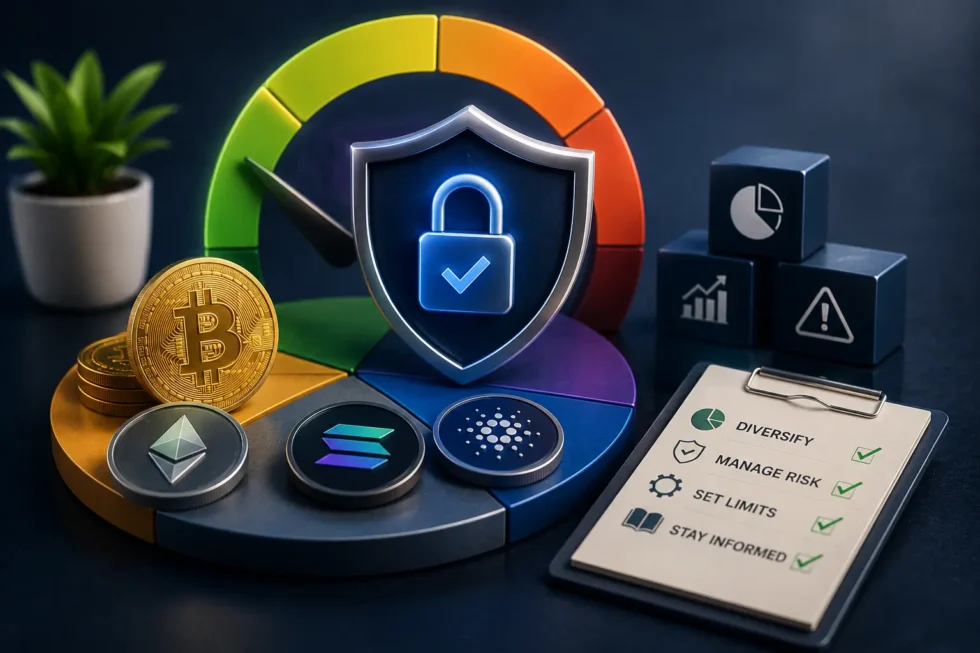
Crypto Risk Management Strategies Every Investor Should Follow
Crypto risk management strategies determine long-term investment survival far more than picking the “right” coin ever does. Two investors can hold identical assets and end up with completely different outcomes, simply because one controlled position size, security, and emotional decision-making while the other didn’t. Volatility in this market isn’t a temporary phase to wait out; it’s a permanent feature that every serious investor needs a plan for.
This guide covers the core risk-management techniques that protect a crypto portfolio from avoidable losses, including position sizing, diversification, security practices, and psychological discipline. It builds on the broader framework introduced in our complete guide, The Smart Crypto Investing Blueprint 2026: Building a Diversified Digital Asset Portfolio with Lower Risk and Higher Long-Term Growth, and focuses specifically on the defensive side of portfolio construction.
The Three Categories of Crypto Risk
Effective crypto risk management strategies address three distinct categories of risk, and conflating them leads to incomplete protection. Market risk covers price volatility and broad downturns that affect the entire asset class simultaneously. Operational risk covers custody failures, exchange hacks, and lost private keys, which can destroy value regardless of what the market does. Regulatory risk covers policy shifts that can restrict access, change tax treatment, or affect specific assets differently depending on jurisdiction.
Treating these as separate problems, each requiring its own mitigation approach, produces a far more resilient portfolio than assuming diversification alone solves everything. A well-diversified portfolio still fails completely if an investor loses their private keys or falls victim to a phishing scam, since that loss has nothing to do with market movement.
Key Data: Crypto Risk Benchmarks Investors Should Know
| Metric | Approximate Figure | Relevance to Risk Management |
|---|---|---|
| Bitcoin price (Aug 2026) | ~$65,000 | Reference point for position-size calculations |
| Bitcoin market dominance | ~59% | Reflects how concentrated liquidity remains among top assets |
| Bitcoin market capitalization | ~$1.29 trillion | Confirms the deepest liquidity for risk-managed entry and exit |
| Typical large-cap crypto drawdown range | 30–50%+ during major corrections | Sets realistic stop-loss and position-size expectations |
| Small-cap token failure rate | Substantially higher than large caps | Justifies capping opportunistic-tier exposure |
| U.S. electricity use attributed to crypto mining | Up to 2.3% | Relevant to infrastructure and regulatory risk considerations |
Liquidity concentration among the largest assets directly shapes how risk-managed portfolios are typically structured. <cite index=”2-1″>Bitcoin remains the largest cryptocurrency with a market capitalization of around $1.29 trillion and approximately 59% market dominance, supported by its liquidity, institutional adoption, and fixed supply</cite>, which is precisely why most risk-management frameworks treat it as the most defensible core holding during periods of market stress.
Core Definitions for Crypto Risk Management
- Position sizing: determining how much capital to allocate to a single asset, calibrated to that asset’s risk level and the investor’s overall risk tolerance.
- Stop-loss order: an instruction to automatically sell an asset once it falls to a specified price, limiting downside on a single position.
- Diversification: spreading capital across assets, sectors, and custody methods to reduce the impact of any single failure point.
- Counterparty risk: the risk that another party in a transaction, such as an exchange or lending platform, fails to meet its obligations.
- Cold storage: keeping private keys offline on a hardware device, removing exposure to online hacking attempts.
- Value at Risk (VaR): a statistical estimate of the maximum expected loss over a given time period at a given confidence level, borrowed from traditional finance and increasingly applied to crypto portfolios.
- Correlation risk: the risk that assets expected to diversify a portfolio instead move together during market stress, reducing the actual protective benefit.
- Liquidity risk: the risk of being unable to sell an asset quickly without significantly affecting its price, more common among smaller-cap tokens.
Comparison: Core Crypto Risk Management Strategies
| Strategy | How It Works | Primary Risk Addressed | Trade-Off |
|---|---|---|---|
| Position sizing limits | Cap any single asset at a defined percentage of the portfolio | Concentration risk | Requires discipline to avoid overweighting a “favorite” asset |
| Stop-loss thresholds | Automatically exit a position past a set drawdown level | Market risk on individual positions | Can trigger during short-term volatility, locking in losses |
| Cold storage custody | Move long-term holdings to offline wallets | Operational and counterparty risk | Slower access, added responsibility for key management |
| Stablecoin reserve | Hold a cash-like buffer for liquidity and rebalancing | Market risk during downturns | Reduces upside exposure during rallies |
| Cross-platform diversification | Spread holdings across multiple exchanges and wallets | Single-platform operational risk | More accounts to monitor and secure |
| Scheduled rebalancing | Adjust holdings back to target weights on a fixed schedule | Drift and correlation risk | May trigger taxable events depending on jurisdiction |
Comparison: Risk Management by Investor Type
| Investor Type | Primary Risk Focus | Recommended Strategy Mix | Rebalancing Approach |
|---|---|---|---|
| Long-term holder | Operational and custody risk | Cold storage, minimal trading, core-heavy allocation | Annual or semi-annual |
| Active trader | Market and liquidity risk | Stop-losses, tighter position sizing, liquid assets only | Frequent, often weekly |
| Institutional-style allocator | Regulatory and counterparty risk | Regulated custodians, diversified platforms, compliance tracking | Quarterly with formal review |
| New investor | All three categories simultaneously | Small position sizes, established assets, strong account security | Simple, infrequent, rule-based |
Position Sizing: The Foundation of Every Strategy
Position sizing does more to protect a portfolio than any other single technique on this list, since it directly limits how much damage a single bad outcome can cause. Capping any individual non-core asset at a modest percentage of total crypto holdings prevents one failed project from producing catastrophic losses. This principle applies even to assets an investor feels highly confident about, since conviction has historically proven to be an unreliable predictor of outcomes in this market.
Sizing decisions should also account for correlation between holdings, not just individual asset risk. A portfolio spread across ten tokens that all move together during a downturn offers far less real protection than the number of holdings suggests, which is why risk management frameworks emphasize category and custody diversification alongside simple asset count.
Security as a Risk Management Discipline
Security failures cause permanent, irreversible losses in a way that market volatility usually doesn’t, which makes operational risk arguably the most urgent category to address. Enabling two-factor authentication through an authenticator app, using hardware wallets for long-term holdings, and never sharing private keys or recovery phrases form the baseline every investor should follow regardless of portfolio size. Phishing attempts and fake support requests remain a leading cause of fund loss, and treating any unsolicited request for wallet information as a scam prevents the majority of these incidents.
Editorial Observations: Where Risk Management Actually Breaks Down
Watching how portfolios perform through full market cycles reveals that most risk-management failures happen before a downturn even starts, not during it. Investors who skip position-sizing discipline during a bull market often don’t discover the problem until a correction forces the issue, by which point the damage has already compounded. Building the discipline early, while a portfolio is still small, costs far less than learning it after a large position has gone wrong.
A related pattern involves overconfidence in diversification alone. Many investors assume that holding a dozen different tokens automatically reduces risk, without checking whether those tokens actually move independently of each other. <cite index=”4-1″>The proof-of-work consensus mechanism underlying Bitcoin has also drawn regulatory and environmental scrutiny, with the U.S. Energy Information Administration estimating that crypto mining accounts for up to 2.3% of U.S. electricity consumption</cite>, a factor that feeds into regulatory risk considerations some investors overlook entirely when building a risk-management plan focused only on price.
A third observation concerns emotional discipline under stress. The best-documented risk-management plans on paper frequently fail in practice because investors abandon their own rules during a sharp downturn, exactly when those rules matter most. Writing the plan down in advance, and treating it as a fixed commitment rather than a flexible guideline, measurably improves the odds that an investor actually follows it when volatility spikes.
Common Risk Management Mistakes to Avoid
Ignoring position-size limits during a strong rally ranks among the most frequent mistakes, since rising prices tempt investors to abandon their own sizing rules just as risk is building. Skipping security basics compounds the danger, turning a manageable market risk into an entirely avoidable total loss. Overreliance on a single exchange or custodian concentrates counterparty risk in a way that diversification across assets alone can’t fix. Finally, treating risk management as a one-time setup, rather than an ongoing practice revisited as the portfolio and market conditions change, leaves a plan outdated exactly when it needs to adapt most.
Frequently Asked Questions
What is the most important crypto risk management strategy for beginners?
Position sizing and account security together form the strongest foundation, since they address the two most common and most preventable sources of loss for new investors.
How much of a crypto portfolio should be in stablecoins for risk management?
There’s no universal figure, but many risk-managed portfolios keep a meaningful stablecoin reserve, often in the range covered by the broader diversification framework, specifically to fund rebalancing and cover near-term liquidity needs without forced selling.
Do stop-loss orders work well in crypto markets?
Stop-losses can limit downside on individual positions, but crypto’s volatility means they can also trigger during short-term swings that later reverse, so many long-term investors use them selectively rather than on every position.
How is crypto risk management different from traditional investment risk management?
Crypto adds significant operational and custody risk on top of the market risk found in traditional investing, since losing a private key or falling victim to a hack can destroy value independent of any price movement.
How often should a risk management plan be reviewed?
Reviewing the plan at least annually, or whenever personal financial circumstances change significantly, keeps the strategy aligned with both current market conditions and the investor’s actual risk capacity.
Conclusion: Discipline Determines Long-Term Outcomes
Crypto risk management strategies work because they remove the guesswork and emotional reactivity that cause most avoidable losses in this market. Position sizing, security discipline, diversification across custody methods, and a written plan followed consistently through volatility protect a portfolio far more reliably than trying to predict every market move. For the complete framework on building that portfolio from the ground up, revisit our full guide: The Smart Crypto Investing Blueprint 2026.
Sources and References
- Analytics Insight — Top Cryptocurrencies to Buy in August 2026
- Bitcoin Foundation — Top 5 Crypto Assets to Invest In: Best Cryptocurrencies for Maximum ROI
- Forbes Advisor — Top 10 Cryptocurrencies of August 10, 2026
- CoinDCX — Top 10 Cryptos to Invest in August 2026 (By Market Cap)
This article is for educational purposes only and does not constitute financial, investment, tax, or legal advice. Digital assets are volatile and speculative. Consult a licensed financial advisor before making investment decisions.