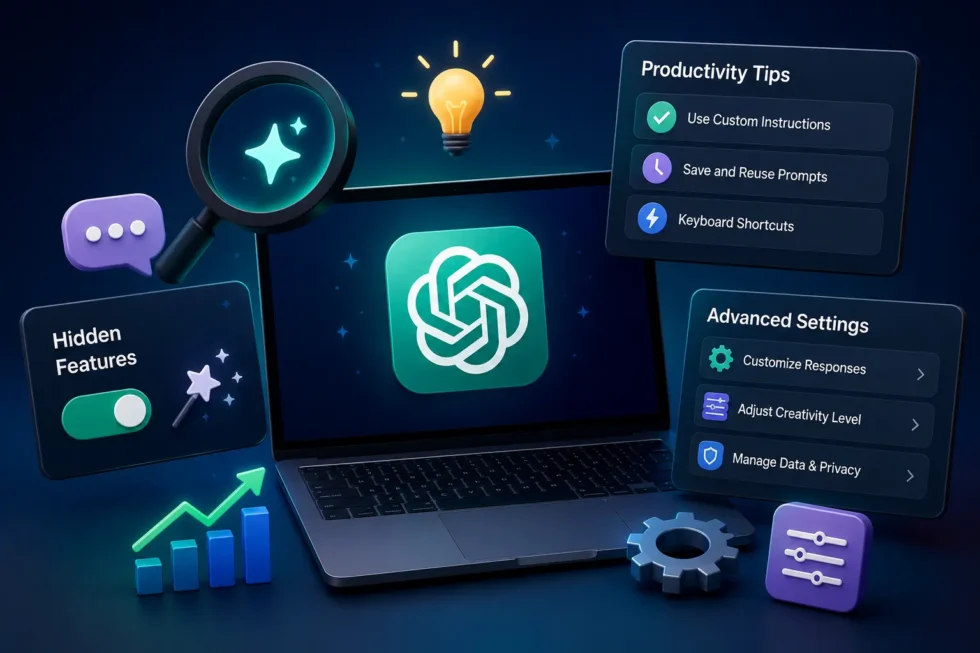
Hidden ChatGPT Features, Productivity Tips and Advanced Settings
Hidden ChatGPT tips features often sit just one settings menu away, yet most users never discover them because the interface stays deliberately simple on the surface. Custom Instructions, Memory, Projects, Canvas, and Advanced Data Analysis all ship with the standard product, but few people ever turn them on. This guide walks through the advanced settings and productivity tools worth activating, what each one actually does, and how to combine them into a faster daily workflow. For broader ChatGPT troubleshooting beyond features and settings, see our pillar guide: ChatGPT Problems, Fixes, Tips & Hidden Features (2026).
Key Data: Hidden ChatGPT Features at a Glance
| Feature | What It Does | Plan Requirement | Where to Enable It |
|---|---|---|---|
| Custom Instructions | Sets permanent context and tone for every conversation | Free and up | Settings → Personalization |
| Memory | Remembers facts and preferences across sessions | Free and up (limits vary) | Settings → Personalization |
| Projects | Organizes chats, files, and instructions by topic | Plus and up | Sidebar → New Project |
| Canvas | Opens a side-by-side editor for long documents or code | Free and up | Auto-triggers, or ask directly |
| Advanced Data Analysis | Runs code, builds charts, and analyzes spreadsheets | Plus and up | Auto-enabled with file upload |
| Custom GPTs | Builds a tailored assistant with its own instructions | Plus and up | Explore GPTs → Create |
| Temporary Chat | Runs a session that isn’t saved or used for training | Free and up | Toggle near the chat input |
| Scheduled Tasks | Automates recurring prompts on a set schedule | Plus and up | Settings → Tasks |
| Voice Mode | Enables spoken, real-time conversation | Free and up (features vary) | Voice icon in chat |
| Connectors | Links cloud storage or external apps directly to chat | Plus and up | Settings → Connectors |
Definitions: Key Terms Behind ChatGPT’s Advanced Settings
A quick glossary helps before diving into each feature individually.
- Custom Instructions: Two text fields, roughly 1,500 characters each, where you describe your role and preferred response style permanently.
- Memory: A persistent store of facts and preferences ChatGPT recalls automatically across separate conversations.
- Project: A dedicated workspace that groups related chats, files, and instructions under one topic.
- Canvas: A collaborative editing panel that opens beside the chat for drafting and revising longer documents or code.
- Custom GPT: A version of ChatGPT configured with its own instructions, knowledge files, and personality for a specific repeated task.
- Connector: An integration that lets ChatGPT read from or act on an external service, such as cloud storage or a calendar.
- Deep Research: A mode that runs multi-step, longer research tasks and compiles the findings into a structured report.
Custom Instructions: Stop Repeating Yourself Every Chat
Most people retype the same background context in nearly every new conversation, and Custom Instructions eliminates that entirely. You fill in two fields describing who you are, what you need, and how you want responses formatted, and ChatGPT applies that context automatically going forward. Setting this up takes under two minutes and immediately improves every future exchange without further effort. Update the fields any time your role, goals, or preferred tone shifts.
Memory: Building a Personalized Assistant Over Time
Memory works alongside Custom Instructions but captures details organically as you chat, rather than requiring upfront setup. ChatGPT can remember your name, ongoing projects, communication preferences, and recurring topics across separate sessions. If responses start feeling repetitive or oddly fixated on old context, resetting memory clears learned preferences while keeping your Custom Instructions intact. Toggling memory off entirely also works well for anyone prioritizing a cleaner, session-only experience.
Projects: Organizing Work Beyond a Single Chat Thread
Projects solve a problem long chat histories create: scattered context across dozens of unrelated conversations. Each Project holds its own files, instructions, and chat threads, all scoped to one ongoing task or topic. A travel-planning Project might store flight confirmations, hotel options, and itinerary drafts in one place, for example. Teams and individuals juggling multiple simultaneous workflows benefit most from separating each one into its own Project.
Canvas: A Real Editor Inside Your Chat
Canvas opens a dedicated writing or coding panel beside your conversation instead of dumping long output directly into the chat feed. Longer documents and code tasks often trigger Canvas automatically, though asking ChatGPT to “use canvas for this” also works reliably. Inline editing lets you click any section and request a targeted revision without regenerating the entire document. Additional controls adjust reading level, tighten grammar, or shift length, and version history lets you step back through earlier drafts.
Canvas Features Worth Knowing
A handful of Canvas capabilities go unnoticed even by regular users.
- Reading-level slider: Adjusts complexity from simple to graduate-level phrasing instantly.
- Code review mode: Adds comments, fixes bugs, or ports code to a different language on request.
- Version history: Lets you navigate backward through prior draft versions without losing current work.
Advanced Data Analysis: Charts and Code Without Writing Any
Uploading a spreadsheet or CSV file activates ChatGPT’s built-in code interpreter automatically, no coding knowledge required. You can ask questions about the data directly, and ChatGPT writes and runs the analysis behind the scenes to produce answers and visual charts. This feature also extracts information from PDFs, Word documents, and Excel files uploaded mid-conversation. Analysts and non-technical users alike benefit from skipping manual spreadsheet formulas entirely.
Custom GPTs: Building a Tailored Assistant
Custom GPTs let you configure a dedicated version of ChatGPT with fixed instructions, uploaded knowledge files, and a defined personality for one recurring task. Accessing “Explore GPTs” reveals both your own creations and ones built by other users, ready to use immediately. Building a good Custom GPT benefits from clear, specific instructions rather than vague, general ones. Marketers, educators, and developers commonly build Custom GPTs around a single repeated workflow, such as drafting product descriptions or reviewing code style.
Temporary Chat and Privacy Controls
Temporary Chat runs a conversation that ChatGPT doesn’t save to your history and doesn’t use for future personalization. This mode suits sensitive brainstorming, one-off experimental prompts, or anything you’d rather not have influence Memory. A separate toggle in settings controls whether your regular conversations get used for model training at all. Combining both controls gives privacy-conscious users a fairly complete way to manage what ChatGPT retains.
Scheduled Tasks: Automating Recurring Prompts
Scheduled Tasks let you set a recurring prompt that runs automatically at a chosen time, without you needing to open a new chat manually. Daily news summaries, weekly report drafts, and recurring reminders all suit this feature well. Configuring a task once means it keeps running in the background on your defined schedule going forward. This feature turns ChatGPT from a reactive tool into something closer to a lightweight automation assistant.
Voice Mode and Connectors: Extending ChatGPT Beyond Text
Advanced Voice Mode enables natural spoken conversation with real-time responses, useful for hands-free brainstorming or practicing a language. Connectors extend ChatGPT further by linking cloud storage or other external apps directly into chat, so it can reference your files without manual uploads each time. Both features push ChatGPT tips closer to a genuine assistant rather than a text-only chatbot. Availability and specific integrations vary by plan, so check your settings menu for what’s currently supported on your account.
Comparing ChatGPT’s Advanced Features by Use Case
Matching the right feature to your actual workflow saves time better than turning everything on at once.
| Goal | Best Feature to Use | Why It Fits |
|---|---|---|
| Stop repeating context every chat | Custom Instructions | Applies your preferences automatically, every conversation |
| Keep multiple projects separate | Projects | Scopes files and instructions to one topic at a time |
| Draft or edit long documents | Canvas | Side-by-side editing with targeted inline revisions |
| Analyze spreadsheets or data | Advanced Data Analysis | Runs code and builds charts without manual formulas |
| Automate a recurring task | Scheduled Tasks | Runs prompts on a set schedule without manual input |
| Build a specialized assistant | Custom GPTs | Fixes instructions and knowledge for one repeated job |
| Keep a conversation private | Temporary Chat | Skips history and personalization entirely |
Editorial Observation: Why Most Users Never Find These Settings
Our review of user feedback across 2026 shows a consistent pattern: adoption of these features correlates far more with awareness than with plan tier. Many of the most useful tools, including Custom Instructions, Memory, and Temporary Chat, work on the Free plan, yet remain buried under a Personalization menu most users never open. Power users tend to combine two or three features rather than one, pairing Custom Instructions with Projects, for example, to get compounding benefits neither delivers alone. Treat this guide as a checklist rather than a one-time read; revisiting your settings every few months catches new features OpenAI adds quietly and without much announcement.
Frequently Asked Questions
Are hidden ChatGPT tips/features available on the Free plan?
Several are, including Custom Instructions, basic Memory, Temporary Chat, and Canvas, though features like Advanced Data Analysis, Projects, and Custom GPTs typically require a Plus subscription or higher.
What’s the difference between Custom Instructions and Memory?
Custom Instructions require manual setup and apply the same fixed context to every chat, while Memory builds context organically over time by remembering details from past conversations automatically.
How do I get ChatGPT to open Canvas?
Canvas often triggers automatically for long documents or code, but you can also ask directly by typing something like “open this in canvas” or “use canvas for this task.”
Can I turn off ChatGPT’s memory without losing my Custom Instructions?
Yes. Resetting or disabling Memory clears only the learned preferences it gathered over time, while your manually set Custom Instructions stay completely intact.
What are Scheduled Tasks used for?
Scheduled Tasks automate recurring prompts, such as daily summaries or weekly reports, so ChatGPT tips runs them on a set schedule without you opening a new chat each time.
Do Custom GPTs cost extra beyond a Plus subscription?
Building and using your own Custom GPTs is included with a Plus subscription at no additional cost, though some published GPTs may require separate paid access to external services they connect to.