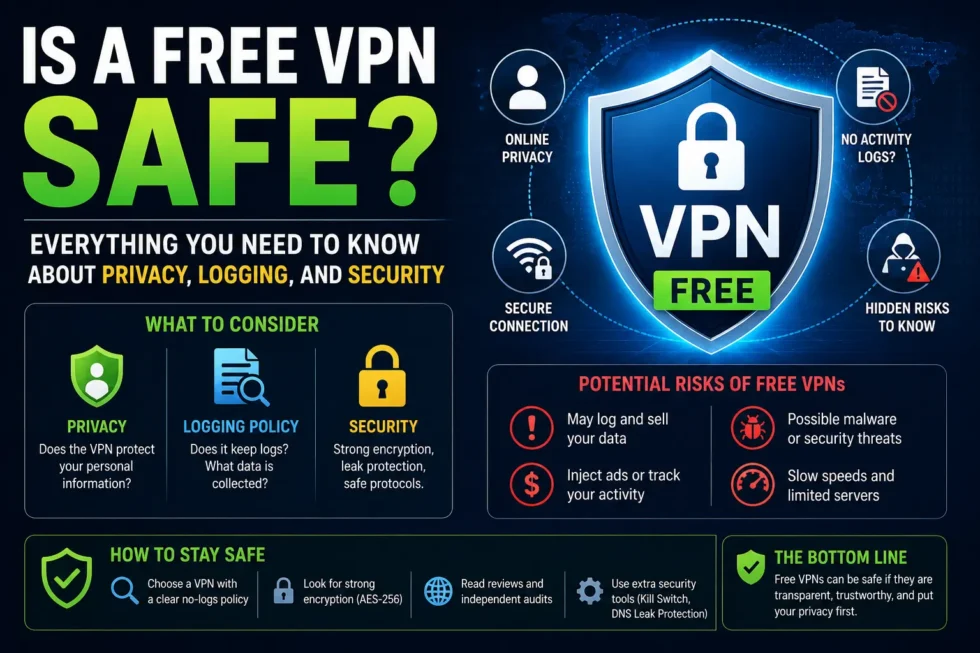
Is Free VPN Safe Everything You Need to Know About Privacy, Logging, and Security
Is a free VPN safe? The honest, evidence-based answer is: it depends entirely on which one you pick, and the odds are not in your favor by default. Independent research has repeatedly found that a majority of free VPN apps log more than they claim, embed hidden trackers, or fail to encrypt traffic properly. A smaller group of audited, freemium options, by contrast, hold up well under scrutiny.
This guide walks through the documented risks behind free VPN apps, explains what logging and no-logs claims actually mean in practice, and shows you how to tell a trustworthy provider from a dangerous one. For a full ranking of the providers that pass this scrutiny, see our Free VPN Complete Guide and our roundup of the best free VPN services in 2026.
Key Data: What Independent Research Says About Free VPN Safety
The numbers below come from multiple independent studies conducted between 2020 and 2026. Figures vary slightly by methodology, but the overall pattern stays consistent year after year.
| Risk Factor | Documented Finding | Source Type |
|---|---|---|
| Malware presence | Roughly 20-38% of free VPN apps tested contained malware or malicious code | Academic and antivirus research |
| Third-party tracking | 75-80% of free VPNs embed tracking libraries | Independent security audits |
| Data leaks | Up to 84-88% of tested apps leaked identifiable data through DNS, IPv4, IPv6, or WebRTC | Lab-based leak testing |
| Data selling | An estimated 60% of free VPNs may sell user data to third parties | Industry analyst projections |
| Confirmed mass breaches | At least three documented incidents (Hola, SuperVPN, Urban VPN Proxy) exposed more than 30 million combined user records | Security researcher disclosures |
These figures explain why security professionals treat “free VPN” as a category that needs individual vetting rather than blanket trust or blanket rejection.
Core Definitions: Logging, No-Logs Audits, and Jurisdiction
Understanding whether a free VPN is safe requires a working grasp of a few technical terms that show up throughout provider privacy policies.
Logging: The practice of recording user activity, connection timestamps, IP addresses, or bandwidth usage. Some logging is operationally necessary; excessive logging becomes a privacy risk.
No-logs policy: A provider’s written claim that it does not retain identifying data about your browsing sessions. This claim only carries weight when backed by an independent audit.
Independent audit: A third-party security firm’s formal review of a VPN provider’s servers, source code, or policies, confirming whether stated privacy claims match actual practice.
RAM-only servers: Infrastructure that runs entirely in temporary memory rather than on hard drives, meaning stored data disappears whenever a server restarts, which limits what could be seized or subpoenaed.
Jurisdiction and intelligence alliances: The country where a VPN company is legally based, and whether that country participates in international surveillance-sharing arrangements often called the Five Eyes, Nine Eyes, or Fourteen Eyes alliances.
Warrant canary: A regularly updated public statement confirming a company has not received a secret government data request; its sudden disappearance can signal a gag order.
DNS and WebRTC leaks: Technical failures that let your device send information outside the encrypted VPN tunnel, exposing your real IP address or browsing activity despite an active connection.
Is Using a Free VPN Safe? The Documented Risks Explained
Data Logging and Selling Practices
Many free VPN privacy policies read well on the surface, then quietly carve out broad exceptions that allow extensive data retention. A provider might promise not to log browsing history while still collecting device identifiers, approximate location, and connection metadata, then sharing that information with advertising partners. This gap between marketing language and actual policy text represents one of the most common ways a free VPN misleads its users.
Malware and Fake VPN Apps
Security researchers keep finding malware embedded inside free VPN apps at troubling rates. Studies place the figure anywhere between one in five and nearly four in ten tested apps, depending on the sample and testing year. Fake VPN apps designed purely to infect devices have also surged, often mimicking the branding of legitimate services to trick people into installing them from unofficial sources.
IP, DNS, and WebRTC Leaks
Even well-intentioned free VPN apps sometimes fail at the basic technical job of keeping your traffic inside the encrypted tunnel. Leak testing across popular free Android VPNs found the vast majority leaking some form of identifying data, undermining the entire purpose of using a VPN in the first place. A leak defeats privacy protection just as thoroughly as intentional logging does, only without any obvious warning sign to the user.
Excessive App Permissions
A privacy tool should request very little from your device. Reviews of popular free VPN apps have found many requesting access to the camera, microphone, contacts, and call logs, none of which a VPN needs to function. That mismatch between stated purpose and requested permissions often signals a business model built around data collection rather than connection security.
Hidden or Opaque Ownership
Knowing who actually operates a free VPN matters as much as reading its privacy policy. Investigations have repeatedly traced popular apps back to holding companies with limited public information, sometimes with links to jurisdictions offering little legal protection for user data. Without transparent ownership, a written no-logs promise carries little practical weight.
Documented Free VPN Data Breaches and Scandals
History provides a clearer picture than any single privacy policy. The incidents below stand out as some of the largest and best-documented failures in the free VPN space.
| Incident | Approximate Scale | What Happened |
|---|---|---|
| Hola VPN | Millions of users | Users’ idle bandwidth was resold through a commercial proxy network without clear consent |
| SuperVPN, GeckoVPN, ChatVPN | Over 20 million exposed records | An unsecured server left personally identifiable user data publicly accessible |
| SuperVPN standalone incident | Over 360 million records | A separate exposed database revealed extensive user connection details |
| Urban VPN Proxy | Roughly 6 million users affected | Reports linked the service to unauthorized data harvesting tied to AI training practices |
| IMSOFT-linked free VPN apps | Around 25 million records | An exposed database contradicted the provider’s own stated no-logging policy |
Each of these cases shares a common thread: a free VPN’s privacy policy promised one thing, while its actual infrastructure or business practice delivered another. That gap, more than any single technical flaw, defines the core safety problem across much of the free VPN market.
How Safe Is a Free VPN, Really? Government and Regulator Warnings
Official warnings about free VPN risk have grown louder in recent years. The US Cybersecurity and Infrastructure Security Agency published guidance cautioning that personal VPNs can shift risk from your internet provider to the VPN company itself, sometimes expanding rather than shrinking your overall exposure. The agency specifically flagged providers with unclear security practices and vague privacy commitments, a description that fits a large share of the free VPN category.
The Federal Trade Commission has pursued enforcement actions against VPN providers over deceptive privacy claims, reinforcing that regulators now treat misleading no-logs marketing as a genuine consumer protection issue rather than a niche technical concern. Data protection frameworks like GDPR in Europe add another layer of accountability for providers operating in or serving users within those jurisdictions, though enforcement against smaller free VPN operators remains inconsistent in practice.
Signs a Free VPN Is Safe vs. Signs It Is Not
| Signal | Safe Free VPN | Risky Free VPN |
|---|---|---|
| Privacy policy | Specific, plain-language, matches marketing claims | Vague, filled with broad data-sharing exceptions |
| Independent audit | Completed and published by a recognized security firm | None, or claims an audit without naming the firm |
| Ownership | Publicly disclosed corporate structure | Hidden or difficult to verify |
| App permissions | Limited to what a VPN needs to function | Requests camera, contacts, or microphone access |
| Business model | Clear paid tier funds free plan | No visible revenue source besides the free app |
| Server infrastructure | RAM-only or otherwise documented | No public information available |
Which Free VPNs Actually Pass This Safety Test?
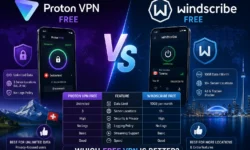
A short list of providers consistently clears these safety benchmarks in independent testing. Proton VPN Free operates under Swiss privacy law with open-source, independently audited code. Windscribe Free and Hide.me Free both carry completed third-party audits backing their no-logs claims. These three share a common trait worth remembering: each one funds its free tier through a legitimate paid subscription business, rather than through advertising or data monetization. Our full comparison in the Best Free VPN Services guide breaks down speed, data caps, and features for each of these safer options in more detail.
How to Test Whether Your Free VPN Is Actually Safe
Reading a privacy policy only gets you so far. A few hands-on checks reveal far more about whether a specific free VPN behaves the way it claims.
Start with a basic leak test. Connect to your free VPN, then visit a dedicated DNS leak testing site and compare the displayed IP address against your real one. If your actual location or internet provider shows up instead of the VPN server’s information, the app is leaking traffic outside its encrypted tunnel.
Next, check WebRTC separately, since browsers can expose your real IP address through this feature even when a VPN otherwise works correctly. Several free browser-based tools test WebRTC leaks specifically, and running this check takes less than a minute.
Finally, review the permissions your free VPN app actually requests on your device, not just what its policy page describes. Your phone or computer’s settings menu shows this directly. A mismatch between a “privacy-focused” app and a long list of unrelated permission requests is one of the clearest red flags available to any non-technical user.
Free VPN vs. Paid VPN: Which Offers More Accountability?
Accountability separates trustworthy VPN providers from risky ones more reliably than price alone. Paid providers generally have stronger incentive structures: a subscription business depends on maintaining trust, since users who feel misled can cancel immediately and take their complaints public. That incentive drives many paid providers toward regular independent audits, transparent ownership disclosures, and detailed transparency reports documenting government data requests.
Free VPN providers without a paying customer base lack that same built-in pressure. Some, particularly freemium tiers from established paid companies, inherit the parent company’s accountability structure. Others operate with no comparable incentive at all, since their revenue depends on advertising, bandwidth resale, or data monetization rather than subscriber retention. This structural difference explains why audit history and business model matter more than price tag alone when judging whether a specific free VPN deserves your trust.
Common Free VPN Safety Myths, Corrected
Myth: A VPN with a padlock icon or “256-bit encryption” badge is automatically safe. Encryption strength matters, but it only protects data in transit. It says nothing about what the provider logs, stores, or sells once your traffic reaches their servers.
Myth: If millions of people use a free VPN, it must be trustworthy. Popularity reflects marketing reach and app-store visibility, not security practice. Several of the largest documented breaches involved apps with tens of millions of downloads.
Myth: A “no-logs” claim on the app store listing is proof enough. App store descriptions are unverified marketing text. Only a named, published third-party audit provides real evidence behind that claim.
Myth: Free VPNs and paid VPNs use fundamentally different, weaker encryption. Most legitimate free VPNs use the same AES-256 encryption standard as paid services. The real gap between free and paid tiers usually involves server access, data caps, and business-model transparency, not encryption strength itself.
Editorial Observation: Why “Is a Free VPN Safe” Has No Single Answer
Treating this question as a yes-or-no proposition misses the more useful insight buried in the research. The free VPN market has split into two genuinely different products that happen to share a price tag. A handful of freemium tiers from established, audited companies behave essentially like scaled-down versions of trustworthy paid services. Everything else in this category ranges from mediocre to actively dangerous, funded by data practices that directly contradict what a privacy tool is supposed to deliver.
What stands out most across the documented breaches is how often the exposed provider’s own privacy policy explicitly promised the opposite of what its infrastructure actually did. That pattern suggests the real safety question is not just “does this app encrypt my traffic,” but “does this company have a verified track record of matching its promises to its practice.” A policy nobody has audited is a marketing document, not a guarantee, and the difference between those two things has cost tens of millions of free VPN users their privacy over the past several years.
Frequently Asked Questions
Is a free VPN safe for everyday browsing?
An audited, freemium option like Proton VPN Free or Windscribe Free carries reasonable safety for everyday browsing. Fully free, ad-supported apps with no visible paid tier carry meaningfully higher risk based on documented research.
Can a free VPN actually make me less safe than no VPN at all?
Yes, in specific cases. A free VPN that leaks your real IP address, logs your activity and sells it, or bundles malware can leave you worse off than browsing without any VPN, since it creates a false sense of protection.
How can I check if a free VPN’s no-logs claim is legitimate?
Look for a named, independent auditing firm and a published audit report rather than a general claim on the provider’s marketing page. Reputable providers link directly to these reports.
Do free VPN apps really sell my data?
Some do. Industry analysis suggests a majority of free VPNs may share or sell user data to third parties as part of their revenue model, particularly apps without a visible paid subscription funding them.
Is a free VPN safe to use on public Wi-Fi?
A reputable, audited free VPN adds meaningful protection against local network snooping on public Wi-Fi. An unaudited app with unclear ownership offers far less assurance in that same scenario.
What is the biggest documented free VPN safety failure?
The SuperVPN-linked exposure, which revealed over 360 million user records from an unsecured database, ranks among the largest documented incidents tied to a free VPN provider.
Should I trust a free VPN based in a Five Eyes country?
Jurisdiction matters, but it works alongside audit history and transparency rather than replacing them. A well-audited provider in a surveillance-alliance country can still outperform an unaudited provider based elsewhere.