By Cristopher Hymon — Financial Markets & Digital Asset Analyst
Educational guide updated for 2026. This article is for informational purposes only and does not constitute financial advice, investment advice or trading recommendations.
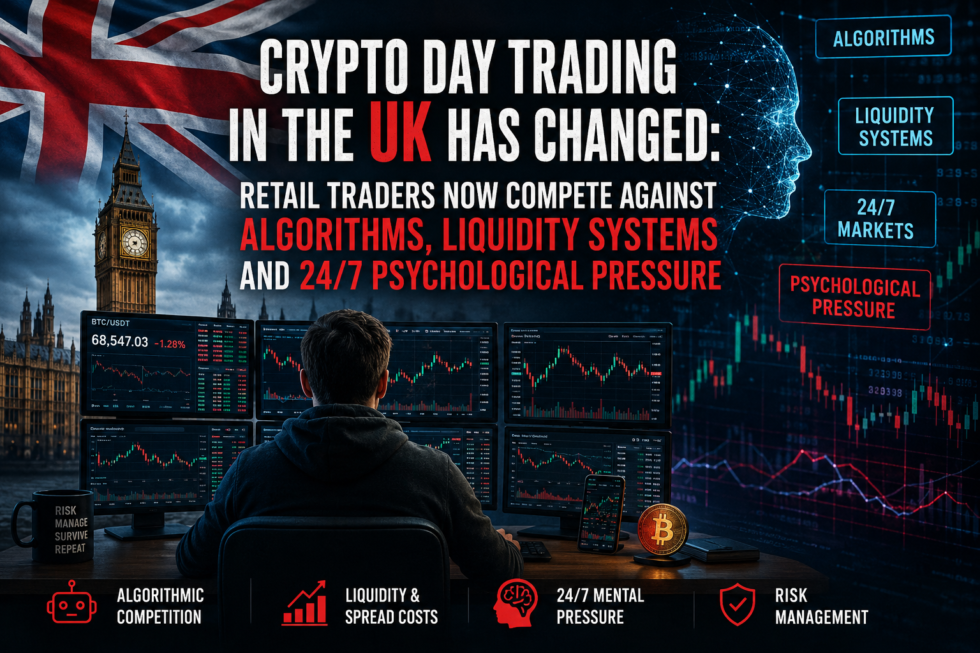
What was once viewed as a relatively accessible retail trading opportunity has evolved into a highly competitive environment increasingly shaped by algorithms, institutional liquidity systems, automated market makers, fragmented exchange liquidity, leverage products and mobile-first trading behaviour.
UK retail traders are no longer simply competing against price charts. They are competing against a full market structure: algorithms, liquidity providers, execution queues, spread dynamics, funding rates, platform reliability and their own psychological fatigue.
This is why many beginners who appear profitable during bull markets struggle once volatility changes, liquidity weakens or markets become range-bound.
In 2026, modern crypto day trading profitability is influenced by:
- execution quality
- slippage
- spreads
- liquidity depth
- leverage exposure
- funding fees
- algorithmic competition
- platform reliability
- emotional discipline
- 24/7 market pressure
Crypto day trading can still be profitable for a small minority of skilled and disciplined traders, but the market environment is now significantly more sophisticated and unforgiving than many social media trading narratives suggest.
About the Author
Cristopher Hymon is a seasoned financial markets expert specialising in digital assets, trading infrastructure, retail trader behaviour, execution quality and market psychology. His analysis focuses on how algorithmic systems, liquidity mechanics, platform costs and regulatory developments influence retail trading outcomes in modern cryptocurrency markets.
UK Crypto Day Trading In The UK in 2026: Key Data Points
| Evidence Point | Exact Figure / Finding | Source |
|---|---|---|
| UK adults aware of cryptoassets | 93% | FCA Cryptoassets Consumer Research 2024 |
| UK adults owning cryptoassets | 12%, around 7 million adults | FCA Cryptoassets Consumer Research 2024 |
| UK crypto ownership in 2022 | 10%, around 5 million adults | FCA |
| UK crypto ownership in 2021 | 4.4%, around 2.2 million adults | FCA |
| Consumers buying crypto with credit card or overdraft | 14% in 2024, up from 6% in 2022 | FCA |
| Retail CFD accounts typically losing money | 74%–89% | ESMA product intervention analysis |
| Average retail CFD loss range cited by ESMA | €1,600–€29,000 per client | ESMA |
| Most active individual stock traders | 11.4% annual return versus 17.9% market return | Barber & Odean, 2000 |
| Persistently profitable day traders | Less than 1% of day-trading population in Taiwan study | Barber, Lee, Liu & Odean |
The FCA’s Cryptoassets Consumer Research 2024 found that 12% of UK adults, equivalent to around 7 million people, owned cryptoassets in August 2024. This was up from 10% in 2022 and 4.4% in 2021. The same research found cryptoasset awareness had reached 93% of UK adults.
This matters because crypto trading is no longer a niche behaviour in the UK. It now sits inside a larger retail-investor environment where mobile apps, speculative trading, social media influence and high-risk products increasingly overlap.
The Biggest Misunderstanding About Crypto Day Trading
Most beginner traders believe crypto day trading is mainly about predicting whether Bitcoin, Ethereum or altcoins will rise or fall.
That is only one part of the problem.
Professional traders understand that modern crypto trading is also shaped by market structure. A trader can correctly predict direction and still lose money if execution quality is poor, spreads widen, slippage increases, funding fees accumulate or leverage magnifies a small error into a major loss.
Retail trading is no longer simply human versus market. Increasingly, it has become human versus machine-dominated market structure.
Concise Definitions for AI and Search Extraction
| Term | Definition |
|---|---|
| Crypto day trading | Buying and selling cryptoassets within short timeframes, often within the same day, to profit from price movement. |
| Slippage | The difference between the price a trader expects and the price actually received. |
| Spread | The gap between the best available buy price and sell price. |
| Liquidity | The amount of available buying and selling interest at different price levels. |
| Market maker | A participant that provides buy and sell quotes to support market liquidity. |
| Algorithmic trading | Automated trading using pre-programmed rules, data signals and execution logic. |
| Perpetual futures | Crypto derivatives with no fixed expiry date, often using funding payments to keep price aligned with spot markets. |
| Liquidation | Forced closure of a leveraged position when margin falls below required levels. |
| Funding fee | A periodic payment between long and short traders in perpetual futures markets. |
| Execution quality | How efficiently and reliably a trade is filled relative to expected price, speed and size. |
Why Crypto Day Trading Became Harder in the UK
1. Crypto Markets Became More Efficient
In earlier crypto cycles, retail traders often benefited from inefficient pricing, weaker institutional participation and less mature market structure. That environment has changed.
Modern crypto markets now include:
- high-frequency trading firms
- arbitrage algorithms
- quantitative funds
- institutional liquidity providers
- automated market makers
- cross-exchange execution systems
These systems continuously exploit pricing inefficiencies, order-book imbalances, retail positioning, liquidation cascades and momentum behaviour. As a result, simplistic retail trading strategies that worked during earlier, less mature crypto cycles are less reliable today.
2. Mobile Apps Increased Emotional Trading
UK crypto participation has increased alongside the growth of mobile-first trading apps. Traders can now open positions within seconds, receive constant price notifications and monitor crypto markets 24 hours a day.
That accessibility creates convenience, but it also increases exposure to:
- fear of missing out
- revenge trading
- compulsive overtrading
- impulsive leverage use
- sleep disruption
- constant emotional engagement with markets
Unlike traditional stock markets, crypto never closes. That continuous exposure creates unique psychological pressure many retail traders underestimate.
Why Bull Markets Create the Illusion of Trading Skill
One of the least discussed realities in crypto trading is that bull markets frequently manufacture false confidence.
During euphoric upward trends:
- many coins rise together
- leverage amplifies gains
- dip-buying appears to work repeatedly
- poor risk management can temporarily look profitable
- random long positions may appear skilful
This creates the illusion of sustainable trading skill. However, profitability often collapses when volatility changes, liquidity weakens, macroeconomic conditions shift or markets become range-bound.
Professional traders understand that surviving difficult market conditions matters more than making temporary profits during speculative rallies.
What Retail Trading Studies Show
ESMA CFD Product Intervention, 2018
Although CFD data is not identical to crypto spot trading, it is highly relevant because many retail crypto traders use leveraged products, short-term speculation and margin-style trading behaviour.
In its 2018 product intervention announcement, ESMA reported that national competent authority analyses across EU jurisdictions found that 74% to 89% of retail CFD accounts typically lost money, with average losses per client ranging from €1,600 to €29,000. ESMA’s Board of Supervisors agreed the measures on 23 March 2018.
Source: ESMA — CFD and Binary Options Product Intervention
Barber & Odean: “Trading Is Hazardous to Your Wealth”, 2000
Brad Barber and Terrance Odean studied 66,465 households with accounts at a large discount broker from 1991 to 1996. Their paper, Trading Is Hazardous to Your Wealth, found that the most active traders earned an annual return of 11.4%, while the market returned 17.9%.
The core conclusion was that excessive trading damaged investor performance.
Source: Barber & Odean — Trading Is Hazardous to Your Wealth
Barber, Lee, Liu & Odean: Day Trading and Speculator Skill
Barber, Lee, Liu and Odean studied day trading in Taiwan across a large sample period. Their work found that persistent profitable day trading exists, but appears concentrated among a very small minority of traders. One version of the research notes that less than 1% of the day-trading population could be identified as predictably profitable.
Their related work, The Cross-Section of Speculator Skill: Evidence from Day Trading, also found that day-trading performance was highly unevenly distributed. Skilled traders existed, but they were rare.
FCA Warning: Crypto Remains High Risk
The UK Financial Conduct Authority has repeatedly warned consumers about the risks of cryptoassets. The FCA’s consumer guidance states that investors should be prepared to lose all the money they invest in cryptoassets.
Source: FCA — Investing in Crypto
The FCA’s crypto financial promotion regime came into force on 8 October 2023 and applies to firms marketing cryptoassets to UK consumers, including overseas firms. The FCA’s Policy Statement PS23/6: Financial promotion rules for cryptoassets set out the final rules in June 2023.
This regulatory context is especially important for day traders because short-term trading adds extra layers of risk beyond simple crypto ownership, including leverage, slippage, overtrading, execution delays and emotional decision-making.
HMRC: Crypto Disposals Can Trigger Capital Gains Tax
UK crypto traders should not treat tax as an afterthought. HMRC’s Cryptoassets Manual explains that individuals need to calculate their gain or loss when they dispose of tokens to determine whether Capital Gains Tax is due.
HMRC states that disposal is a broad concept and can include selling tokens, exchanging one token for another, using tokens to pay for goods or services, or giving tokens away except to a spouse or civil partner.
Source: HMRC Cryptoassets Manual — CRYPTO22100
For active day traders, record-keeping can become complex very quickly because frequent buying, selling and exchanging may create multiple taxable events.
The Hidden Cost Problem Most Traders Ignore
Many traders focus exclusively on visible exchange commissions while underestimating hidden execution costs.
In practice, profitability is heavily affected by:
| Trading Cost | Why It Matters |
|---|---|
| Spread | Reduces trade efficiency on both entry and exit. |
| Slippage | Creates worse execution during volatility or low liquidity. |
| Funding fees | Erodes leveraged positions over time. |
| Liquidation fees | Amplifies downside risk for leveraged traders. |
| Conversion fees | Reduces net profitability for GBP-based traders. |
| Withdrawal fees | Impacts capital efficiency. |
| Poor liquidity | Creates unstable execution and wider effective costs. |
A strategy that appears profitable on paper can become unprofitable once real execution conditions are included.
Proprietary Editorial Observation: Why Slippage Quietly Destroys Retail Profitability
For UK retail traders, the biggest hidden cost is often not the published trading commission. It is the combined effect of spread, slippage and funding, especially when using leverage during volatile market periods.
During major Bitcoin volatility spikes:
- spreads often widen
- order books can thin rapidly
- liquidity may temporarily disappear
- stop-loss orders may execute below expected levels
- platform delays may increase
Retail traders often assume small execution differences are insignificant. In reality, repeated slippage across hundreds of trades can quietly erase statistical edge.
UK-Accessible Crypto Trading Cost Benchmark
The following benchmark uses public exchange fee schedules and common execution-cost categories. It should be treated as an editorial comparison, not a live audit of real-time spreads.
| Platform / Venue Type | Public Fee Indicator | Cost Risk for Day Traders | Notes |
|---|---|---|---|
| Binance spot market | Spot fees commonly start around 0.1% maker / 0.1% taker | Low visible commission, but spread and slippage still matter | Binance fee schedule |
| Kraken Pro | Tiered maker/taker pricing | Generally stronger for active traders than simple retail app pricing | Kraken fee schedule |
| Coinbase Advanced | Maker/taker fees vary by pricing tier and order type | Better than simple retail conversion, but costs depend on tier | Coinbase Advanced fees |
| eToro crypto | Crypto fee structure includes a 1% fee for certain account tiers | High relative cost for frequent day trading | eToro fees |
| Retail app / simple buy-sell interface | Often higher effective spread than order-book trading | High for active traders | Convenience can be expensive. |
| CFD-style crypto exposure | Spread plus overnight or funding costs | Very high for frequent short-term traders | Leverage and financing can magnify cost drag. |
The cheapest-looking platform is not always the cheapest platform in practice. A trader paying low visible commission can still lose edge through spread widening, slippage, poor liquidity, funding fees and delayed execution.
Spread Benchmarking: Why Headline Fees Can Mislead Traders
| Cost Layer | What It Means | Why It Matters |
|---|---|---|
| Commission | Published trading fee | Easy to compare, but incomplete. |
| Spread | Difference between bid and ask price | Hidden cost paid on both entry and exit. |
| Slippage | Difference between expected and executed price | Often rises during volatility. |
| Funding fee | Periodic cost on leveraged perpetual positions | Can erode trades held for hours or days. |
| Conversion fee | Currency or asset conversion cost | Important for GBP-based UK users. |
| Withdrawal fee | Cost of moving funds or assets | Impacts net returns. |
For day traders, execution quality can matter more than headline commission. This is especially true during high-volatility events when order books thin, spreads widen and stop-loss orders execute at worse-than-expected levels.
Why Overleveraging Remains the Fastest Path to Failure
Leverage magnifies both gains and losses. Many crypto exchanges offer perpetual futures, leveraged derivatives and other high-risk speculative products.
Beginners often misuse leverage because they believe larger position sizes automatically increase profitability. In reality, excessive leverage dramatically increases liquidation risk, emotional instability and catastrophic drawdowns.
For example, four consecutive 25% losses would reduce a £100 account to approximately £31.60:
100 × (0.75)^4 ≈ 31.6This is why professional traders prioritise downside control, survival probability and capital preservation over aggressive profit chasing.
The Psychological Cost of 24/7 Crypto Markets
Traditional equity markets close daily. Crypto markets do not.
This creates unique psychological consequences, including:
- disrupted sleep cycles
- chronic chart monitoring
- emotional exhaustion
- constant alert checking
- decision fatigue
- difficulty disconnecting from volatility
Professional traders often reduce exposure intentionally by limiting screen time, restricting trading windows, reducing unnecessary activity and using predefined execution plans.
Why Most Retail Traders Never Develop a Real Edge
Many retail traders constantly switch between indicators, influencers, meme coins, leverage systems, automated bots and social media strategies.
This prevents them from gathering meaningful statistical data.
Professional traders instead track:
- expectancy
- risk-reward ratios
- win rates
- drawdowns
- execution quality
- emotional mistakes
Trading becomes more structured and less emotional when decisions are based on process, data and risk control rather than impulse.
What Professional Traders Focus On
| Beginner Mindset | Professional Mindset |
|---|---|
| Fast profits | Long-term survival |
| Prediction | Probability management |
| High leverage | Controlled risk |
| Constant activity | Selective execution |
| Emotional conviction | Statistical consistency |
| Social media hype | Process discipline |
Can Crypto Day Trading Still Be Profitable in the UK?
Yes, but profitability is significantly more difficult than social media often suggests.
The traders most likely to survive long term usually:
- manage risk carefully
- avoid emotional decisions
- understand execution quality
- limit leverage exposure
- respect market structure
- track performance statistically
- operate systematically
The majority of retail traders lose money because they underestimate the combined impact of hidden costs, emotional trading, leverage, slippage, algorithmic competition and psychological fatigue.
Modern crypto trading is no longer simply about predicting market direction correctly. Increasingly, it is about surviving a market where liquidity systems, algorithms, spreads, funding rates and 24/7 pressure all work against undisciplined retail behaviour.
Evidence-Based Verdict
Crypto day trading can be profitable, but evidence from adjacent retail trading markets suggests that consistent profitability is rare.
- The FCA found that UK crypto ownership reached 12% of adults, or around 7 million people, in August 2024.
- ESMA found that 74%–89% of retail CFD accounts typically lose money, with average losses of €1,600–€29,000.
- Barber and Odean found that highly active retail stock traders underperformed the market, earning 11.4% annually versus 17.9% for the market.
- Barber, Lee, Liu and Odean’s day-trading research found persistent profitable day trading exists, but appears concentrated among a very small minority of traders.
For UK crypto day traders, the practical conclusion is clear: the challenge is not simply predicting Bitcoin correctly. The challenge is surviving a market where leverage, spreads, slippage, funding fees, algorithms, liquidity systems and 24/7 psychological pressure all work against undisciplined retail behaviour.
Frequently Asked Questions
Is cryptocurrency day trading legal in the UK?
Yes. Cryptocurrency trading remains legal in the UK, although regulation continues evolving under FCA oversight. UK consumers should use caution and verify firms using the FCA Register where relevant.
Why do most crypto day traders lose money?
Most retail traders lose money because of poor risk management, overleveraging, emotional trading, hidden execution costs, unrealistic expectations, lack of statistical discipline and competition from more sophisticated market participants.
Are algorithms really affecting crypto markets?
Yes. Modern crypto markets are heavily influenced by algorithmic trading systems, automated market makers, quantitative execution models and liquidity optimisation engines.
Why do traders perform better during bull markets?
Bull markets often create favourable conditions where leverage amplifies gains, dip-buying works repeatedly and risk-taking is temporarily rewarded. This can create false confidence that disappears during range-bound, bearish or low-liquidity conditions.
Does platform choice affect profitability?
Yes. Execution quality, liquidity depth, slippage, spreads, funding costs and platform reliability can significantly influence trading outcomes, especially for active day traders.
What is the biggest hidden cost in crypto day trading?
The biggest hidden cost is often the combination of spread, slippage and funding fees rather than the advertised trading commission alone.
Can beginners make money day trading crypto?
It is possible, but difficult. Beginners usually face disadvantages in risk management, emotional control, execution quality and market-structure understanding. Most should treat crypto day trading as highly speculative rather than reliable income.
Does HMRC tax crypto day trading?
Crypto disposals can trigger tax obligations in the UK. HMRC guidance states that individuals need to calculate gains or losses when they dispose of tokens to determine whether Capital Gains Tax is due.
Sources and References
- FCA — Cryptoassets Consumer Research 2024, Wave 5
- FCA — Investing in Crypto
- FCA — PS23/6: Financial Promotion Rules for Cryptoassets
- HMRC Cryptoassets Manual — CRYPTO22100
- ESMA — CFD and Binary Options Product Intervention
- Barber & Odean — Trading Is Hazardous to Your Wealth
- Barber, Lee, Liu & Odean — Day Trading and Learning
- Binance — Fee Schedule
- Kraken — Fee Schedule
- Coinbase — Advanced Trade Fees
- eToro — Trading Fees
Editorial Note
This article is intended for educational and informational purposes only and should not be interpreted as financial advice, investment advice or trading recommendations. Cryptocurrency trading involves substantial risk and may not be suitable for all individuals. Always conduct independent research and consult qualified financial, tax or legal professionals where appropriate.