Financial Markets Analyst | Trading Infrastructure & Broker Analysis Specialist
Updated: April 2026
Why Some Traders Are Leaving Traditional Brokers?
There’s a shift happening in the trading world, and most retail traders haven’t noticed it yet.
A growing number of experienced traders are moving away from traditional brokers and toward execution-focused platforms like AfterPrime.
Not because of flashy features. Not because of bonuses. But because of something far more important: lower spreads, faster execution, and better alignment between broker and trader.
In markets where milliseconds and fractions of a pip determine profitability, the broker itself becomes part of your strategy.
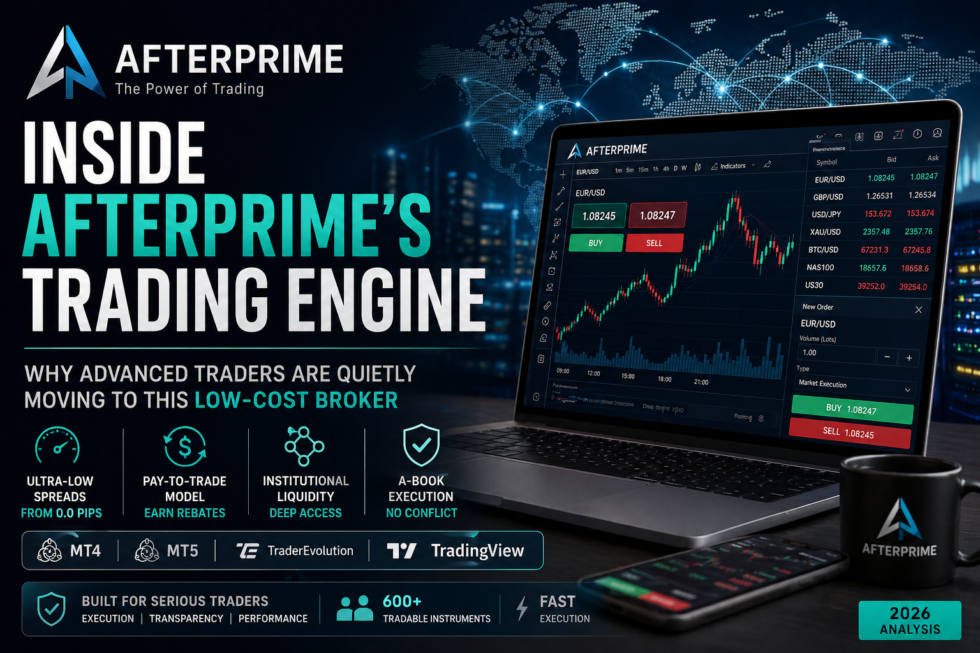
This is where AfterPrime positions itself differently. Instead of competing on marketing, it focuses on institutional-grade liquidity, A-book execution, and a unique pay-to-trade model.
But does it actually deliver?
AfterPrime Review: Quick Data Snapshot
- Best for: Advanced traders, scalpers, algorithmic users
- Spreads: From 0.0 pips
- Commission: Around $7 per lot
- Execution model: A-book, no dealing desk
- Unique feature: Flow Rewards, offering rebates for trading volume
- Platforms: MT4, MT5, TraderEvolution, TradingView
- Minimum deposit: No fixed minimum
AfterPrime is built for execution quality and cost efficiency, not beginner-friendly features.
The Reality Most Traders Miss About Brokers
Most traders obsess over indicators, strategies, and signals, but ignore one of the biggest factors affecting trading performance: the broker.
Your broker directly impacts your profitability.
Even small differences in spread, execution latency, and slippage can compound over time. A difference between 0.3 pips and 1.2 pips may look minor on one trade, but it can become significant for scalpers, high-frequency traders, and algorithmic systems.
This is exactly where AfterPrime tries to outperform traditional brokers.
What Makes AfterPrime Different?
1. A-Book Execution With No Conflict of Interest
AfterPrime routes trades directly to liquidity providers instead of taking the opposite side of client trades.
This means the broker does not profit from client losses, pricing reflects real market conditions, and execution is more transparent than with many market-maker models.
Expert insight: A-book brokers are generally preferred by experienced traders because their incentives are better aligned with client success.
2. Institutional-Grade Liquidity
AfterPrime connects traders to institutional liquidity sources, including prime brokers, ECNs, and dark pools. This structure is designed to provide deeper liquidity, better pricing, and faster execution.
This is particularly important for scalpers, high-frequency traders, and traders who rely on tight spreads during volatile market conditions.
3. Pay-to-Trade Model Through Flow Rewards
One of AfterPrime’s most distinctive features is its Flow Rewards model.
Instead of only charging traders through commissions and spreads, AfterPrime shares part of its revenue with active users. Traders can earn rebates based on trading volume, which may reduce overall trading costs for high-volume users.
This model is especially relevant for scalpers and algorithmic traders, where cost per trade has a major impact on long-term profitability.
Platforms and Trading Environment
MetaTrader 4 and MetaTrader 5
AfterPrime supports both MT4 and MT5, two of the most widely used trading platforms in the forex and CFD industry.
These trading platforms are suitable for traders who rely on Expert Advisors, custom indicators, backtesting, and automated trading systems.
TraderEvolution
TraderEvolution is AfterPrime’s more institutional-style platform. It offers advanced order execution, depth-of-market tools, and a professional trading interface.
This platform is better suited for traders who want more detailed market visibility and execution control than a basic retail trading app can provide.
TradingView Integration
AfterPrime also supports TradingView integration, making it easier for discretionary traders to use clean charting, web-based access, and multi-device analysis.
Expert insight: Platform choice matters, but for serious traders, execution quality and pricing consistency are often more important than interface design alone.
Fees, Spreads, and Real Trading Costs
Pricing Structure
- Spreads: From 0.0 pips
- Average spreads: Around 0.2 pips on major markets, depending on conditions
- Commission: Around $7 per lot
- Rebates: Available through Flow Rewards for qualifying trading volume
What This Means in Practice
For active traders, lower spreads reduce the cost of entering and exiting trades. Rebates can further reduce the effective cost per trade, especially for users who trade high volumes.
This makes AfterPrime potentially cost-efficient at scale. However, low costs only matter if traders also manage risk properly. Cheap execution does not make a poor strategy profitable.
Execution Quality
Execution quality is one of AfterPrime’s strongest selling points. The broker emphasizes ECN-style execution, low latency, no requotes, and high fill rates.
This structure is designed for scalping, algorithmic trading, high-frequency strategies, and professional-style trading systems.
Expert insight: Execution quality matters more than platform design for serious traders because slippage, delays, and poor fills can quickly erode profits.
Markets and Instruments
AfterPrime offers access to more than 600 instruments across multiple asset classes, including forex pairs, indices, commodities, stock CFDs, and cryptocurrencies.
This range is sufficient for most short-term trading strategies, especially for forex and CFD traders. However, it is not designed for long-term investors seeking real asset ownership, ISA accounts, or traditional investment portfolios.
Regulation and Safety
Regulatory Structure
AfterPrime operates through offshore and international regulatory structures, including entities linked to the FSA Seychelles, BVI FSC, and ASIC-related arrangements.
Safety Features
AfterPrime offers safety features such as segregated client funds and negative balance protection.
Important Consideration for UK Traders
AfterPrime is not FCA-regulated. This is one of the most important factors UK traders need to consider before opening an account.
The trade-off is clear: AfterPrime may offer strong execution quality and low trading costs, but it does not provide the same regulatory strength as FCA-regulated brokers such as IG or Pepperstone.
Real User Reviews and Sentiment
Trustpilot Feedback
Trustpilot reviews commonly mention customer support, withdrawals, platform usability, and pricing transparency. Positive reviewers often highlight responsive service and a smooth trading experience.
As with any broker, users should read both positive and negative reviews carefully. Broker reviews can vary depending on trader experience, expectations, account type, and market conditions.
ForexPeaceArmy Feedback
ForexPeaceArmy user feedback focuses heavily on execution quality, ECN-style trading conditions, and the broker’s suitability for experienced traders.
The overall sentiment suggests that AfterPrime appeals more strongly to traders who already understand spreads, commissions, leverage, and execution mechanics.
Overall User Sentiment
AfterPrime appears to have a stronger reputation among experienced traders than among beginners. Its appeal is based less on education and simplicity, and more on trading infrastructure, cost transparency, and execution-focused features.
AfterPrime vs Competitors
| Feature | AfterPrime | IG | Pepperstone |
|---|---|---|---|
| Spreads | Ultra-low | Moderate | Very low |
| Execution | Institutional-style | Strong | Very fast |
| Regulation | Offshore/international | FCA | FCA |
| Best For | Advanced traders | All-round traders | Scalpers and forex traders |
| Beginner Suitability | Low | Medium | Medium |
Advantages of AfterPrime
- Ultra-low spreads from 0.0 pips
- Institutional-style execution quality
- Unique Flow Rewards rebate model
- Support for MT4, MT5, TraderEvolution, and TradingView
- Strong liquidity access
- Suitable for scalping and algorithmic trading
Limitations of AfterPrime
- Not beginner-friendly
- Not FCA-regulated
- Limited educational resources
- Primarily CFD-focused
- No real asset ownership for long-term investors
- Requires strong risk management and trading experience
Who Should Use AfterPrime?
AfterPrime Is Best For
- Scalpers
- Algorithmic traders
- High-frequency traders
- Experienced forex traders
- Traders focused on execution and cost efficiency
AfterPrime Is Not Ideal For
- Beginners
- Long-term investors
- Traders who need extensive education
- UK traders who only want FCA-regulated brokers
- Investors looking for real share ownership or ISA accounts
What You Need to Be Aware Of Before Using AfterPrime
AfterPrime may offer attractive trading conditions, but traders should understand the risks before opening an account.
CFDs are high-risk instruments. Leverage can amplify losses as well as gains. Offshore regulation may not suit every trader, especially those who prioritize FCA protection. The platform is also designed for experienced users, meaning beginners may find it difficult to fully understand or benefit from its execution-focused model.
Before using AfterPrime, traders should test the platform, review all costs, understand the regulatory structure, and use strict risk controls.
Key Takeaways
- AfterPrime is built for execution-focused traders, not beginners.
- Its Flow Rewards model can reduce trading costs for active users.
- Execution quality is one of its strongest advantages.
- Its regulatory structure is weaker than FCA-regulated competitors.
- It is best suited for scalpers, algorithmic traders, and experienced forex traders.
People Also Ask
Why are traders switching to AfterPrime?
Traders are switching to AfterPrime because it focuses on execution speed, low spreads, and transparent pricing rather than marketing features. This makes it attractive for scalpers, algorithmic traders, and high-volume users who care about cost per trade and order execution quality.
Is AfterPrime better than traditional brokers?
AfterPrime can be better than traditional brokers for execution-focused traders who prioritize spreads, liquidity, and cost efficiency. However, it may not be better for beginners or risk-averse UK users because it is not FCA-regulated and does not offer the same level of educational support as some mainstream brokers.
Is AfterPrime good for beginners?
AfterPrime is not the best choice for beginners. The platform is designed for experienced traders who understand CFDs, leverage, spreads, commissions, and execution models. Beginners may be better served by brokers with stronger education, simpler interfaces, and FCA regulation.
Does AfterPrime offer low spreads?
Yes, AfterPrime offers spreads from 0.0 pips, which makes it attractive for active traders. However, traders must also consider commissions, slippage, and overall execution quality when calculating real trading costs.
Is AfterPrime FCA-regulated?
No, AfterPrime is not FCA-regulated. This is an important consideration for UK traders because FCA regulation offers a higher level of local oversight and investor protection than offshore regulatory structures.
Final Verdict
AfterPrime is not trying to be everything to everyone. It is a specialized trading environment designed for serious traders who care about execution, cost, and performance.
For beginners, it may be too advanced and lacks the educational structure needed to build confidence safely. For experienced traders, especially scalpers and algorithmic users, AfterPrime offers a compelling combination of low spreads, institutional-style execution, and a rare rebate-based pricing model.
The biggest drawback is regulation. UK traders who prioritize FCA protection may prefer IG, Pepperstone, or other FCA-regulated brokers. Traders who prioritize execution and cost efficiency may find AfterPrime worth serious consideration.
Expert Take
AfterPrime is one of the few brokers attempting to align incentives with traders rather than profit directly from client losses. That makes it an interesting broker in today’s market, but only for traders who understand risk, leverage, and execution mechanics.
Final Rating
| Category | Rating |
|---|---|
| Fees | 5/5 |
| Execution | 5/5 |
| Platforms | 5/5 |
| Ease of Use | 3/5 |
| Regulation | 3/5 |
| Overall | 4/5 |
About the Author
Christopher Haymon is a financial markets analyst specializing in trading platforms, execution infrastructure, and broker evaluation. His research focuses on helping traders make data-driven decisions based on transparency, cost efficiency, and real-world performance.
Final Thought
The broker you choose is not just a tool. It is part of your trading edge.