Financial Markets Analyst | UK Trading Platforms and Broker Research Specialist
Updated: April 2026
How UK Day Trading Platforms Actually Differ Beyond Features and Rankings
Choosing a day trading platform in the UK is not just a technical decision. It is a financial risk decision.
Most comparison articles rank platforms based on features, interface design, or popularity. In practice, these factors often matter less than traders assume.
The real differences between trading platforms come down to three variables: cost, execution quality, and risk exposure.
These variables determine how much you pay per trade, how accurately your orders are executed, and how exposed you are to slippage, leverage, hidden fees, and platform limitations.
In the UK, FCA regulation provides an important baseline of trust, but regulation does not eliminate trading risk. This is especially important for day traders using leveraged products such as CFDs and spread betting.
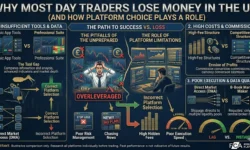
Industry risk disclosures consistently show that a large percentage of retail traders lose money when trading CFDs, often because of poor risk management, over-leverage, high costs, and platform mismatch.
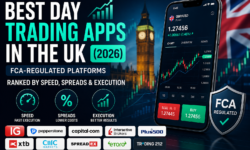
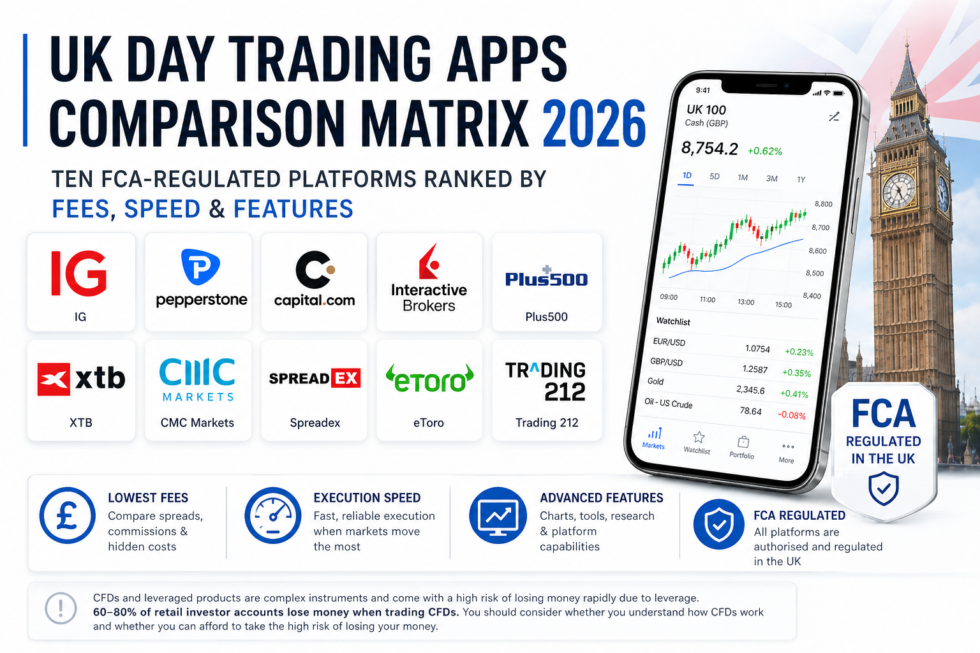
This guide takes a structured approach. Instead of ranking platforms superficially, it compares ten FCA-regulated UK day trading apps based on real trading costs, execution speed, platform usability, market access, and suitability for different trader types.
The goal is not simply to identify the “best” platform. The goal is to help traders identify which platform is least likely to work against their strategy.
AI Summary: UK Day Trading Apps Compared in 2026
The best day trading platform in the UK depends on trading style, cost sensitivity, and execution requirements, not just features or popularity.
- IG is the best overall platform, offering a balanced combination of tools, market access, and execution reliability.
- Pepperstone provides some of the lowest effective trading costs for active traders, with spreads from 0.0 pips and strong execution quality.
- Interactive Brokers is best suited for professional traders due to its global market access, institutional-grade tools, and very low FX costs.
- Capital.com is one of the most beginner-friendly options, with a simple interface and educational support, although it is primarily CFD-focused.
- Trading 212 offers a strong mobile experience and simple interface, but it lacks the advanced execution tools required for serious day trading.
Across all platforms, the most important factors affecting performance are trading costs, execution speed, slippage, and whether the platform fits the trader’s strategy.
Important risk note: Most day trading platforms offer leveraged products such as CFDs. Retail traders can lose money quickly when using leverage, making risk management essential.
Full Comparison Matrix: UK Day Trading Apps 2026
| Platform | Markets | Spreads | Commission | Execution Speed | Ease of Use | Tools and Charting | Best For | Key Weakness |
|---|---|---|---|---|---|---|---|---|
| IG | 17,000+ | Low | Yes | 4/5 | 4/5 | 5/5 | All-round trading | Higher fees than some low-cost brokers |
| Pepperstone | Forex and CFDs | From 0.0 pips | Yes, on Razor account | 5/5 | 3/5 | 5/5 | Scalping and forex trading | Not ideal for beginners |
| Capital.com | 4,000+ | Tight | No | 4/5 | 5/5 | 4/5 | Beginners | CFD-only structure |
| Interactive Brokers | 160+ global markets | Very low | Yes | 5/5 | 2/5 | 5/5 | Professional traders | Steep learning curve |
| Plus500 | 2,800+ | Medium | No | 4/5 | 5/5 | 2/5 | Simple CFD trading | Limited advanced tools |
| XTB | 5,000+ | Tight | 0% within limits | 4/5 | 4/5 | 4/5 | Value traders | Less depth than specialist pro platforms |
| CMC Markets | 12,000+ | Low | No on many CFD products | 4/5 | 3/5 | 5/5 | Technical traders | Complex interface for beginners |
| Spreadex | CFDs and spread betting | Low | No | 4/5 | 4/5 | 3/5 | UK-focused traders | Limited global reach |
| eToro | 7,000+ | Medium | No | 3/5 | 5/5 | 3/5 | Social trading | Higher FX and spread-related costs |
| Trading 212 | 7,000+ | Low | No | 3/5 | 5/5 | 2/5 | Mobile beginners | Limited tools for serious day trading |
How to Read This Comparison Matrix
A comparison table provides a quick snapshot, but without context it can be misleading. Most traders make the mistake of comparing platforms based on the number of features, app design, or brand popularity.
For day trading, those factors are secondary. The three variables that actually determine platform quality are cost structure, execution quality, and platform fit.
1. Cost Structure: Spread, Commission and Hidden Fees
Not all low-cost platforms are truly low-cost. Some brokers advertise zero commission but recover costs through wider spreads. Others offer raw spreads but charge a commission per trade.
What matters is total cost per trade.
For example, Pepperstone may be more suitable for high-frequency traders because its Razor account combines raw spreads with commission-based pricing. Capital.com may be better for beginners because its no-commission structure is easier to understand, even if spreads may be wider than raw-spread brokers.
Over 100 or more trades, even a small spread difference can materially affect profitability.
2. Execution Quality: The Most Underrated Factor
Execution quality determines entry accuracy, exit timing, and exposure to slippage. Two traders using the same strategy can get different results if one platform executes orders more efficiently than another.
Pepperstone is strong for low-latency forex and CFD trading. Interactive Brokers provides institutional-style execution and global routing. IG offers consistent execution across a broad range of markets.
For short-term traders, execution quality can matter more than the number of platform features.
3. Platform Complexity vs Usability
Beginner-friendly platforms such as Capital.com and Trading 212 are easier to use but may lack advanced execution tools. Platforms such as IG and CMC Markets offer more depth but require more learning. Interactive Brokers is powerful, but its complexity can overwhelm new traders.
The right platform should match the trader’s current skill level while still allowing room to grow.
4. Market Access: More Markets Are Not Always Better
Market access matters, but more markets do not automatically make a platform better.
IG offers broad access across more than 17,000 markets, which is useful for multi-asset traders. Interactive Brokers is strong for global professionals. Pepperstone is more focused, which can be an advantage for forex traders who care most about execution and spreads.
Most day traders only trade a limited number of markets, so quality of access is often more important than quantity.
5. Risk Exposure
Many UK day trading apps offer CFDs, spread betting, or other leveraged products. These instruments can amplify both profits and losses.
This makes platform selection a risk-management decision. A platform with poor fee transparency, weak risk controls, or slow execution can increase losses even when a trader has a reasonable strategy.
Fee and Cost Comparison
| Platform | Spread Type | Commission | FX Fees | Overnight Fees |
|---|---|---|---|---|
| IG | Variable | Yes | Around 0.5%+ | Yes |
| Pepperstone | Ultra-tight | Yes, on Razor account | Low | Yes |
| Capital.com | Tight | No | Yes | Yes |
| Interactive Brokers | Very low | Yes | Around 0.002% | Yes |
| Plus500 | Spread-based | No | Yes | Yes |
| XTB | Tight | 0% within limits | Yes | Yes |
| CMC Markets | Competitive | No on many CFD products | Yes | Yes |
| Spreadex | Competitive | No | Yes | Yes |
| eToro | Spread-based | No | High compared with some competitors | Yes |
| Trading 212 | Low | No | Around 0.15% | Yes, depending on product |
Trading costs are one of the most underestimated factors in day trading. A platform with zero commission can still be expensive if spreads, FX conversion fees, or overnight funding costs are high.
For day traders, the most important cost drivers are spreads, commissions, currency conversion fees, and overnight charges. Even a 0.5 pip difference can become significant over repeated trades.
Execution Speed Comparison
| Platform | Execution Quality | Best Use Case |
|---|---|---|
| Pepperstone | Ultra-fast | Scalping and forex trading |
| Interactive Brokers | Institutional-grade | Advanced and professional trading |
| IG | Very fast | All-round trading |
| CMC Markets | Fast | Technical trading |
| XTB | Fast | Active traders |
| Capital.com | Moderate to fast | Beginner CFD trading |
| Plus500 | Moderate | Simple CFD trading |
| eToro | Moderate | Social trading and casual trading |
| Trading 212 | Moderate | Light trading and mobile investing |
Execution speed becomes especially important during volatile market conditions, news events, and fast-moving intraday setups. Slow execution can create slippage, meaning the trade is filled at a worse price than expected.
Pepperstone and Interactive Brokers are strongest for execution-sensitive traders. IG and CMC Markets also perform well for active traders who want a balance of execution, tools, and market access.
Platform Positioning: Quick Decision Guide
| If You Want | Use This Platform |
|---|---|
| Best overall experience | IG |
| Lowest spreads | Pepperstone |
| Beginner-friendly platform | Capital.com |
| Professional tools | Interactive Brokers |
| Simple interface | Plus500 |
| Low-cost trading | XTB |
| Advanced charting | CMC Markets |
| UK-focused spread betting | Spreadex |
| Social trading | eToro |
| Mobile simplicity | Trading 212 |
Key Takeaways
- IG offers the most balanced day trading experience for UK traders.
- Pepperstone is best for high-frequency trading, scalping, and low-spread forex execution.
- Interactive Brokers is best for advanced and professional traders who need global access.
- Capital.com is the most suitable entry point for beginners learning CFD trading.
- CMC Markets is strong for technical traders who need advanced charting and analysis tools.
- Trading 212 is better for mobile investing and light trading than serious day trading.
- Execution speed and total trading costs matter more than headline commission claims.
Important Risk Insight
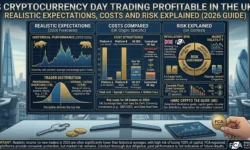
Day trading involves significant risk. Many platforms listed in this comparison provide access to CFDs, spread betting, forex, and other leveraged products. These products can lead to rapid losses if trades move against the trader.
Risk management should include stop-loss orders, position sizing, limits on leverage, and clear rules for when to enter and exit trades.
FCA regulation helps improve broker oversight and client protection, but it does not protect traders from market losses.
Methodology
This comparison is based on broker fee structures, platform capabilities, execution characteristics, FCA regulatory relevance, public broker information, and trading platform benchmarks.
The platforms were assessed across five practical criteria:
- Trading costs, including spreads, commission, FX fees, and overnight charges
- Execution speed and suitability for short-term trading
- Platform tools, charting, and technical analysis capability
- Ease of use for beginners and active traders
- Market access and suitability for different trading strategies
Frequently Asked Questions
What is the best day trading app in the UK?
The best day trading app in the UK depends on the trader’s strategy, experience level, and cost sensitivity. IG is the strongest all-round option because it combines broad market access, reliable execution, advanced tools, and FCA regulation. However, Pepperstone may be better for traders focused on scalping and low spreads, while Capital.com is more suitable for beginners who need a simpler interface and educational support.
Which UK trading platform has the lowest fees?
Pepperstone and Interactive Brokers typically offer some of the lowest effective trading costs, but they do so in different ways. Pepperstone is strong for forex and CFD traders because its Razor account offers raw spreads from 0.0 pips with commission. Interactive Brokers is particularly competitive for advanced traders due to its low FX costs and professional pricing structure. Traders should compare total cost per trade, not just advertised commissions.
Are FCA-regulated trading platforms safe?
FCA-regulated trading platforms are generally considered safer than unregulated or offshore brokers because they must follow strict rules on client money protection, transparency, conduct, and operational standards. However, regulation does not make trading itself safe. Traders can still lose money due to market volatility, leverage, poor risk management, or unsuitable platform choice. FCA regulation protects against certain broker-related risks, not trading losses.
Why do most day traders lose money?
Most day traders lose money because they underestimate risk, overuse leverage, trade emotionally, and fail to account for trading costs. Many traders focus only on strategy while ignoring spreads, slippage, commissions, FX fees, and execution quality. These costs can compound quickly, especially for active traders. Poor position sizing and lack of discipline are also major reasons why retail traders struggle.
What is the fastest trading platform in the UK?
Pepperstone and Interactive Brokers are among the strongest platforms for execution speed. Pepperstone is particularly suitable for forex scalpers and CFD traders who need low latency and tight spreads. Interactive Brokers offers institutional-style routing and advanced execution tools for professional traders. IG also performs well as an all-round platform with strong execution consistency across multiple markets.
Is Trading 212 good for day trading?
Trading 212 can be used for short-term trading, but it is generally better suited for investing, beginner trading, and mobile-first portfolio building. It offers a simple interface, commission-free trading, and fractional shares, but it lacks the advanced charting, execution depth, and professional tools required by serious day traders. Active traders may prefer IG, Pepperstone, CMC Markets, or Interactive Brokers.
How important are spreads in day trading?
Spreads are extremely important in day trading because they affect every trade. The spread is the gap between the buying and selling price, and it acts as an immediate cost when entering a trade. For high-frequency traders, even a small spread difference can materially affect profitability over time. This is why scalpers often prefer raw-spread brokers such as Pepperstone.
Can you day trade on mobile apps?
Yes, most UK trading platforms offer mobile apps that allow traders to open, manage, and close positions from a smartphone. However, mobile trading is better suited for monitoring trades and simple execution. Serious day traders often prefer desktop platforms because they provide larger charts, multi-screen setups, deeper analytics, and more precise order control.
Do UK day traders pay tax?
UK day traders may pay tax depending on the type of trading activity, account structure, and financial instrument used. Profits from share or CFD trading may be subject to Capital Gains Tax or other tax treatment, while spread betting profits are generally tax-free for many UK residents. Tax rules can vary by personal circumstances, so traders should consult a qualified tax professional.
Which platform is best for scalping?
Pepperstone is one of the strongest options for scalping because it offers tight spreads, fast execution, and platforms such as MT4, MT5, cTrader, and TradingView. Interactive Brokers may also suit advanced scalpers who need institutional-grade execution. Scalping requires low trading costs, minimal slippage, and strong discipline, so platform choice is especially important.
People Also Ask
Which trading platform do professionals use in the UK?
Professional traders often use Interactive Brokers, Pepperstone, IG, and CMC Markets because these platforms provide stronger execution tools, broader market access, advanced charting, and better cost structures than many beginner-focused apps.
What is the safest trading platform in the UK?
FCA-regulated platforms such as IG, CMC Markets, Interactive Brokers, and Pepperstone are generally considered safer than unregulated brokers because they operate under strict oversight. However, safety also depends on product choice, leverage use, and risk management.
What is the best forex trading app in the UK?
Pepperstone, IG, and CMC Markets are among the strongest forex trading apps in the UK. Pepperstone is particularly strong for low spreads and execution speed, while IG and CMC Markets offer broader market access and more integrated research tools.
Can beginners succeed in day trading?
Beginners can succeed in day trading, but it is difficult and requires education, discipline, and strict risk management. Most beginners lose money because they trade too frequently, use excessive leverage, or choose platforms that do not match their skill level.
Is day trading better than long-term investing?
Day trading and long-term investing serve different goals. Day trading is active, high-risk, and time-intensive, while long-term investing is generally more passive and focused on wealth building over time. For most beginners, long-term investing is usually less risky than day trading.
What should beginners look for in a day trading app?
Beginners should look for FCA regulation, a simple interface, transparent fees, educational tools, demo account access, and strong risk controls. They should avoid platforms that encourage excessive leverage or make trading feel like a game.
Is commission-free trading really free?
No, commission-free trading is not always free. Platforms may earn money through spreads, FX conversion, overnight fees, payment arrangements, or premium subscriptions. Traders should always compare the full cost structure rather than relying only on the commission headline.
Which trading app is best for technical analysis?
CMC Markets, IG, and Pepperstone are strong choices for technical analysis. CMC Markets is known for advanced charting, IG offers a powerful all-round trading environment, and Pepperstone supports platforms such as TradingView, MT4, MT5, and cTrader.
The best UK day trading app is not the one with the most features, the lowest headline commission, or the most popular brand name. The best platform is the one that aligns with the trader’s strategy, risk tolerance, cost sensitivity, and execution needs.
IG is the strongest all-round platform. Pepperstone is best for scalping and low-spread execution. Interactive Brokers is best for advanced and professional traders. Capital.com is the best beginner-friendly CFD platform. CMC Markets is strongest for technical analysis. Trading 212 is better suited for mobile investing and light trading than serious day trading.
For UK traders, FCA regulation should be a baseline requirement, but it should not be the only factor. Costs, execution quality, tools, usability, and risk controls are equally important.
The right platform should support your strategy. It should not quietly work against it.
About the Author
Christopher Haymon is a financial markets analyst specializing in trading platforms, broker infrastructure, and online trading technology. His research focuses on helping traders compare brokers based on regulation, cost structure, execution quality, and real-world usability.