ECN vs Market Maker Brokers in the UK: Which Execution Model is Better for Day Traders?
When choosing among UK trading platforms, most day traders focus on spreads, commissions, and execution speed—but the broker’s execution model plays an equally critical role in determining your actual trading costs and performance.
In the UK, regulated by the Financial Conduct Authority (FCA), brokers typically operate under two main models: ECN (Electronic Communication Network) and Market Maker. Understanding how these models affect fees, slippage, and execution risk can directly impact your profitability.
This guide breaks down both models in detail, helping you decide which is best for your day trading strategy in 2026.
What Are ECN Brokers?
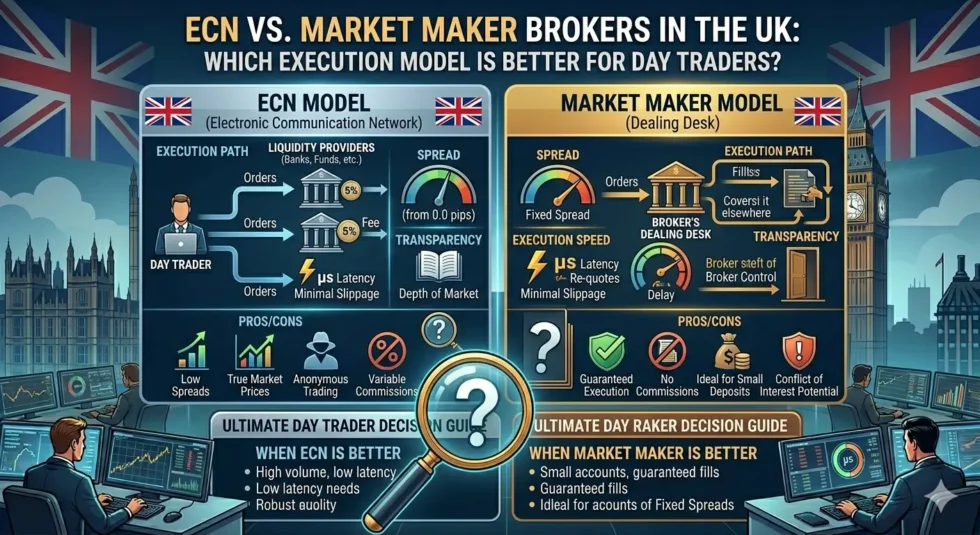
ECN brokers connect traders directly to a network of liquidity providers (banks, hedge funds, and institutions). Instead of taking the opposite side of your trade, they act as intermediaries.
Key Features of ECN Brokers:
- Raw spreads (often near 0.0 pips)
- Fixed commission per trade
- No dealing desk intervention
- Fast execution speeds
- Access to deep liquidity pools
Cost Structure (High-Intent Insight)
- Spread: Extremely low (can be 0.0–0.3 pips)
- Commission: £3–£7 per lot (varies by platform)
- Slippage: Possible during volatility but often transparent
Pros for Day Traders:
- Lower total cost for high-volume trading
- Better suited for scalping strategies
- Transparent pricing (no hidden markups)
Cons:
- Commissions can add up for small trades
- Requires higher capital to maximize efficiency
- Execution depends on market liquidity
What Are Market Maker Brokers?
Market maker brokers create their own market by taking the opposite side of your trades. They provide liquidity internally and profit from the spread.
Key Features of Market Maker Brokers:
- Fixed or slightly wider spreads
- No or low commissions
- Instant execution (in many cases)
- Internal order matching
Cost Structure (High-Intent Insight)
- Spread: Typically 1.0–2.5 pips
- Commission: Usually £0
- Hidden Cost: Spread markup (this is where brokers earn)
Pros for Day Traders:
- Simple pricing structure (spread-only)
- Lower barrier to entry (small accounts friendly)
- Stable spreads in normal market conditions
Cons:
- Potential conflict of interest
- Requotes or execution delays
- Less transparency in pricing
ECN vs Market Maker: Cost & Execution Comparison
| Feature | ECN Brokers | Market Makers |
|---|---|---|
| Spread | Very low (raw) | Wider (marked-up) |
| Commission | Yes | No (usually) |
| Execution Speed | Very fast (market-based) | Fast but can be controlled |
| Slippage | Market-driven | Sometimes managed internally |
| Transparency | High | Moderate |
| Best For | High-frequency/day traders | Beginners/casual traders |
For a full breakdown of trading costs across FCA-regulated platforms, see our complete guide: The UK Day Trading App Cost Map 2026.
Which Execution Model Is Better for UK Day Traders?
The answer depends on your trading style, capital, and strategy.
Choose ECN Brokers If:
- You are a high-frequency day trader or scalper
- You trade during high liquidity sessions (London/New York overlap)
- You want tight spreads and transparent pricing
- You can handle commission-based pricing
For serious day traders, ECN platforms often result in lower total trading costs despite commissions.
Choose Market Maker Brokers If:
- You are a beginner or low-volume trader
- You prefer simple, predictable costs
- You trade with small capital
- You want commission-free trading
For casual traders, market makers provide ease of use and accessibility, though at a slightly higher hidden cost.
FCA Regulation and Why It Matters
Regardless of the execution model, always choose brokers regulated by the Financial Conduct Authority (FCA).
Why FCA Regulation Is Critical:
- Segregation of client funds
- Protection under the Financial Services Compensation Scheme (FSCS)
- Strict transparency and reporting requirements
- Reduced risk of broker manipulation
This ensures that whether you choose ECN or market maker platforms, your capital is protected under UK law. Always verify FCA authorisation before depositing funds at register.fca.org.uk.
Hidden Costs Day Traders Often Miss
Even experienced traders underestimate these cost factors:
1. Slippage Costs
- More common in ECN during volatile markets
- Can increase real trading cost significantly
2. Spread Widening
- Market makers may widen spreads during news events
3. Overnight Fees (Swaps)
- Even day traders can incur swaps if positions are held longer
4. Execution Delays
- A fraction of a second delay can impact scalping profits
From a practical trading perspective, ECN brokers tend to outperform market makers in cost efficiency for active traders, particularly when executing multiple trades per day.
However, not all ECN brokers are equal—some advertise “ECN-like” conditions while still applying hidden markups. Always verify:
- Real spread data (not advertised minimums)
- Commission structure
- Execution speed metrics
- Liquidity provider transparency
Final Verdict: ECN vs Market Maker in 2026
- Best for Professional Day Traders: ECN Brokers
- Best for Beginners & Small Accounts: Market Makers
Ultimately, the “better” model depends on how often you trade and how sensitive your strategy is to spreads and execution speed.
Conclusion
Choosing between ECN and market maker brokers isn’t just about preference—it’s about cost efficiency, execution quality, and trading performance.
For most serious UK day traders in 2026, execution speed and spread precision matter more than zero commissions, making ECN brokers the preferred choice.
But if you’re just starting out, a market maker platform can still provide a practical entry point into the world of trading.
Frequently Asked Questions
1. What is the difference between ECN and market maker brokers in the UK?
ECN brokers connect traders directly to liquidity providers and charge a commission with very tight spreads, while market maker brokers create their own market and earn through wider spreads without charging commissions.
2. Which broker type is cheaper for UK day traders?
For high-frequency traders, ECN brokers are usually cheaper due to lower spreads despite commissions. Market makers may appear cheaper initially but often include hidden costs in wider spreads.
3. Are ECN brokers better for scalping in the UK?
Yes, ECN brokers are generally better for scalping because they offer faster execution speeds, tighter spreads, and direct market access—key factors for short-term trading strategies.
4. Do market maker brokers manipulate prices?
FCA-regulated market makers must follow strict rules, so outright manipulation is unlikely. However, they may widen spreads or requote orders during volatility, which can impact trade outcomes.
5. What are the hidden costs in UK trading platforms?
Hidden costs may include spread markups, slippage, overnight swap fees, inactivity fees, and execution delays—all of which can affect profitability.
6. Are ECN brokers regulated in the UK?
Yes, many ECN brokers are regulated by the Financial Conduct Authority (FCA), which ensures transparency, fund protection, and fair trading practices.
7. Can beginners use ECN brokers in the UK?
Yes, but ECN brokers are more suitable for experienced traders. Beginners may find market maker brokers easier due to simpler pricing and lower capital requirements.
8. Do ECN brokers have zero spreads?
ECN brokers can offer spreads as low as 0.0 pips, but they charge a fixed commission per trade, which is their primary source of revenue.
9. What execution model is best for day trading in 2026?
ECN execution is generally better for active day traders due to lower trading costs, faster execution, and greater transparency.
10. How do I choose between ECN and market maker brokers?
Choose based on your trading volume, strategy, and capital. High-frequency traders benefit from ECN, while beginners may prefer market makers for simplicity.
People Also Asked
• Is ECN better than a market maker for day trading?
Yes, ECN brokers are typically better for day trading because they offer tighter spreads, faster execution, and direct access to liquidity, reducing overall trading costs.
• Why do ECN brokers charge commission?
ECN brokers earn through commissions instead of spread markups, ensuring transparent pricing and alignment with trader interests.
• Are market maker brokers safe in the UK?
Yes, as long as they are regulated by the Financial Conduct Authority, they must follow strict compliance rules to protect traders.
• What is the main disadvantage of ECN brokers?
The main disadvantage is the commission fee and potential slippage during high volatility, which can slightly increase trading costs.
• Do market makers offer fixed spreads?
Some market makers offer fixed spreads, but they may widen during major news events or low liquidity conditions.
• Can ECN brokers have slippage?
Yes, since ECN brokers use real market pricing, slippage can occur, especially during fast-moving market conditions.
• Which broker type has faster execution?
ECN brokers generally have faster and more reliable execution because orders are routed directly to liquidity providers.
• Are there no commissions on UK trading platforms?
Some platforms offer zero-commission trading, but they usually compensate through wider spreads or other hidden fees.