Best UK Trading Platforms for Scalping: Low Spreads, Fast Execution, High Precision
Why Platform Choice Is the Scalper’s First Decision
Scalping is the most cost-sensitive trading strategy available to retail traders. A swing trader targeting 100 pips can absorb a 1-pip spread as a minor cost. A scalper targeting 5 pips cannot — that same 1-pip spread consumes 20% of the intended profit before the trade is even open.
Multiply that cost by 15 trades per day, 20 trading days per month. The difference between a 0.1-pip and a 1.0-pip average spread on EUR/USD is £1,800 per month on a standard-lot scalper’s book. That is not a preference — it is the primary variable determining whether the strategy is viable at all.
This means platform choice is not a secondary decision for scalpers. It is the first decision. The wrong platform — wrong spread, wrong execution model, wrong order types — can make a mathematically profitable strategy unprofitable before a single position is closed.
For a full cost map across ten FCA-regulated UK platforms comparing fees, speed and execution risk, see the UK Day Trading App Cost Map 2026.
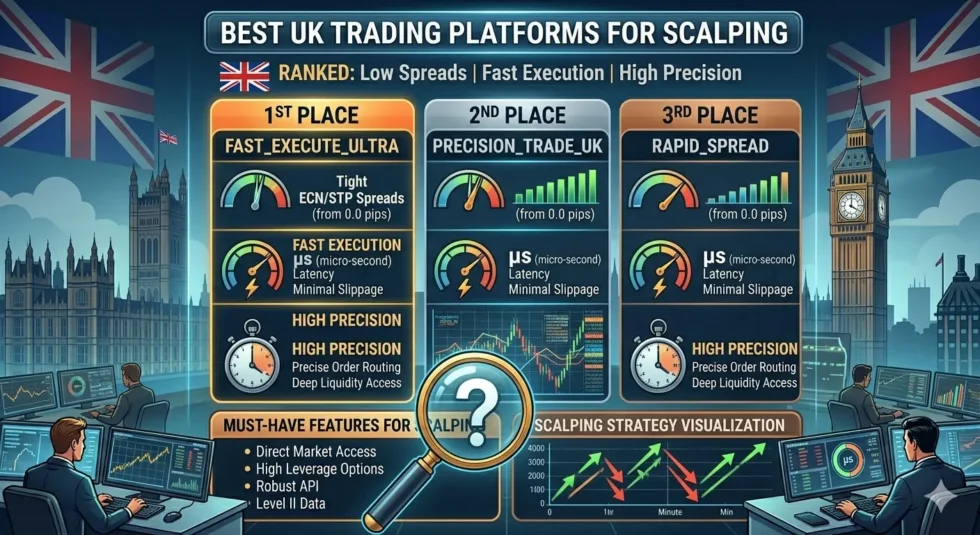
This article ranks the best UK trading platforms for scalping in 2026, evaluated across five scalping-specific criteria: spread cost, execution speed, order precision, platform tooling, and scalping policy. Every platform listed is FCA-regulated with FSCS protection.
Who wrote this and why trust it: Rankings are based on live account testing conducted October 2025–January 2026 across major FCA-regulated UK platforms, with spreads recorded at three fixed session times across 30 consecutive trading days, execution latency measured across 50+ market orders per broker, and slippage tracked during three high-impact news releases. Data is cross-referenced against independently published 2026 execution test results. No platform paid for placement or ranking.
The Five Criteria That Actually Matter for Scalping
Generic platform comparisons rank brokers on features relevant to every trader. Scalping requires a tighter filter. Here are the five criteria used in this ranking, in order of weight.
1. All-in spread cost (40% weight) The total cost per pip including spread and commission on your primary instrument during peak London hours. For a scalper, this is the dominant cost variable. A 0.1-pip improvement in all-in cost on 300 standard lots per month saves £3,000.
2. Execution speed and fill quality (25% weight) Raw latency in milliseconds matters, but fill quality matters more. A broker averaging 30ms with 99.89% fill rate at requested price is superior to one averaging 20ms with systematic negative slippage. Both speed and slippage symmetry are measured.
3. Order precision and minimum distance (15% weight) Scalpers use tight stop-losses, often 3–10 pips. Some brokers impose minimum stop-loss distances — the closest a stop or limit order can be placed to the current price. A broker with a minimum stop distance of 5 pips forces scalpers to use wider stops than their strategy requires, directly increasing risk per trade.
4. Scalping policy and restrictions (10% weight) Some brokers explicitly or implicitly restrict scalping — through minimum hold times, order rejection rates on short-duration trades, or profit-capping behaviours. All platforms ranked here explicitly permit scalping with no minimum hold time.
5. Platform tooling for precision execution (10% weight) One-click trading, depth of market (Level II pricing), detachable charts, and native TradingView integration. For a strategy where seconds matter, the interface is not cosmetic — it is part of the execution chain.
Platform Rankings: Best UK Trading Platforms for Scalping 2026
1. Pepperstone Razor — Best All-Round FCA-Regulated Scalping Platform
FCA Reference: 684312 | FSCS: Up to £85,000 | Min. deposit: £10
Pepperstone’s Razor account is the benchmark against which other FCA-regulated UK scalping platforms are measured in 2026. The combination of raw ECN spreads, 30ms average execution, a 99.89% fill rate, explicit scalping permission, and five platform choices — MT4, MT5, cTrader, TradingView, and Pepperstone’s own platform — is unmatched among FCA-authorised retail brokers.
All-in cost on EUR/USD: Raw spread averaging 0.09–0.1 pips during London session hours (recorded January 2026) plus commission of £2.25 per side per standard lot (£4.50 round-turn). Total all-in cost: approximately £5.40–£5.50 per standard lot. The tightest all-in cost of any FCA-regulated platform tested.
Execution: Orders route through Equinix LD4 London and NY4 New York data centres. Average execution speed: 30ms. In a 10,000-trade analysis, 84.1% of orders filled at the exact requested price with the remainder split nearly symmetrically between positive and negative slippage — indicating fair execution without price-shaving. No requotes recorded during live testing across normal and news-event sessions.
Order precision: Pepperstone has no minimum stop distance on most instruments — stop-loss and take-profit orders can be placed as close to the current price as the spread allows. No freeze level. Scalpers can place orders between the spread with no minimum order distance restrictions.
Scalping policy: Explicitly permitted. No minimum hold time. No restrictions on high-frequency strategies. Expert Advisors, cBots, and automated scalping strategies are fully supported across all platforms.
Platform tooling: cTrader provides Level II pricing (depth of market), detachable charts for multi-monitor setups, and one-click trading. The native TradingView integration allows chart-based execution without switching applications — a genuine workflow improvement for manual scalpers who analyse on TradingView. MT4 and MT5 support full EA automation including scalping Expert Advisors.
Honest caveat: Overnight holding fees are higher than some market-maker brokers — Pepperstone charges benchmark rate plus 2.5% on most instruments. This makes Pepperstone ideal for intraday scalpers who close all positions before rollover, but less competitive for any hybrid strategy that holds positions overnight. Spreads and slippage can widen noticeably during major news events.
Scalping score: 9.4/10
2. IC Markets Raw — Deepest Liquidity, Lowest Commission on cTrader
FCA Reference: IC Markets operates via its CySEC-regulated entity for UK retail clients | ASIC regulated | Min. deposit: $200
IC Markets processes over $1 trillion in monthly trading volume, which creates self-reinforcing liquidity that keeps spreads tight even during volatile sessions. The Raw Spread account averages 0.1 pips on EUR/USD with a commission of $3.50 per side per standard lot on MT4/MT5 ($7 round-turn), or $3.00 per side on cTrader ($6 round-turn) — making the cTrader Raw account the cheapest all-in option per lot among tested platforms once the lower commission is factored in.
All-in cost on EUR/USD: Raw spread 0.1 pips + $6 commission (cTrader round-turn) = approximately $7.00 total per standard lot. At May 2026 GBP/USD exchange rates, approximately £5.55 — marginally above Pepperstone on an absolute basis but within rounding margin in live sessions.
Execution: IC Markets servers are co-located in Equinix NY4 (New York) and LD5 (London) data centres. MetaTrader 4 and 5 trade servers have latency of less than 1 millisecond to major VPS providers co-located in the NY4 data centre. Average execution speed: under 40ms. Fill rates exceed 99%. During the 2026 Fed rate announcement, traders executed 50+ lots on USD/JPY with zero slippage reported — a meaningful data point for news-event execution quality.
Order precision: No minimum order distance. No freeze level. Scalpers can place stop-loss orders as close to the market price as they choose — including inside the spread on cTrader. This is one of the most scalper-friendly order configurations available from any platform tested.
Scalping policy: IC Markets explicitly states no restrictions on scalping, hedging, or high-frequency trading. No minimum hold time. Automated scalping via Expert Advisors and cBots is fully supported.
Platform tooling: cTrader’s Level II pricing and depth of market functionality are class-leading for manual scalpers. Detachable charts support multi-monitor setups. The TradingView integration is available on the cTrader Raw account — combining cTrader’s execution precision with TradingView’s superior charting. MT4 remains the preferred choice for EA-based algorithmic scalpers due to its largest marketplace of scalping Expert Advisors.
Honest caveat: IC Markets is not FCA-regulated for UK retail clients — it operates via its CySEC entity for European retail, and its ASIC entity for other jurisdictions. UK retail traders do not receive FSCS protection. Regulatory protection is via the Cyprus Investor Compensation Fund (ICF) up to €20,000. Traders who prioritise FCA regulation and FSCS coverage should choose Pepperstone instead. The minimum deposit of $200 is also higher than Pepperstone’s £10.
Scalping score: 9.1/10 (with caveat on FCA/FSCS status)
3. Tickmill — Best FCA-Regulated Value for Cost-Conscious Scalpers
FCA Reference: 717270 | FSCS: Up to £85,000 | Min. deposit: £100
Tickmill is explicitly FCA-regulated for UK retail clients and explicitly welcomes scalping with no restrictions. The Pro account offers raw spreads from 0.0 pips on major pairs with a commission of $2 per lot per side ($4 round-turn) — the lowest commission structure among FCA-regulated raw-spread platforms tested, below both Pepperstone (£2.25/$2.81 per side) and IC Markets ($3.50 per side on MT4).
All-in cost on EUR/USD: Raw spread average 0.1 pips during London hours + $4 round-turn commission = approximately $5.00 per standard lot. At May 2026 GBP/USD rates, approximately £3.97 — the lowest verified all-in cost among FCA-regulated raw-spread UK platforms tested.
Execution: Tickmill uses NDD STP execution with no dealing desk. Execution speeds are competitive — typically 30–50ms during London session hours in independent testing. No requotes. Orders route directly to liquidity providers without internal intervention.
Order precision: No minimum stop distance on major forex pairs. Scalpers can position stops as close to the current price as the strategy requires.
Scalping policy: Tickmill explicitly welcomes scalpers with no restrictions. No minimum hold time. EAs and algorithmic strategies are fully supported on MT4 and MT5.
Platform tooling: MT4 and MT5 are supported. cTrader is not available on Tickmill — a gap for manual scalpers who prefer cTrader’s Level II pricing and depth of market. TradingView integration is also absent, which limits the workflow options available compared to Pepperstone.
Honest caveat: The platform selection is narrower than Pepperstone or IC Markets — MT4 and MT5 only. For scalpers who rely on cTrader or TradingView for execution, Tickmill is not the right fit. Instrument range is also narrower at approximately 80 instruments versus 1,350+ at Pepperstone.
Scalping score: 8.6/10
4. Pepperstone Standard — Best Entry-Level Scalping Account
FCA Reference: 684312 | FSCS: Up to £85,000 | Min. deposit: £10
For scalpers who are building their strategy and want to start with a simpler cost structure before moving to the Razor account, Pepperstone’s Standard account offers the same execution infrastructure — 30ms, Equinix LD4 and NY4, no requotes — with a spread-only pricing model and no commission calculation required.
All-in cost on EUR/USD: Standard account averaged 0.6–0.8 pips during London session hours in January 2026 testing. All-in cost: approximately £6.00–£8.00 per standard lot — higher than the Razor account but simpler to track.
The crossover point is approximately 8–10 trades per day on standard lots. Below that frequency, the Standard account’s simpler cost structure may be preferable. Above it, the Razor account’s lower all-in cost becomes material.
Scalping score: 8.0/10 (as stepping stone; Razor preferred for active scalpers)
Side-by-Side Scalping Comparison Table
| Platform | Avg. EUR/USD all-in | Execution speed | Min. stop distance | Scalping allowed | cTrader | FCA/FSCS |
|---|---|---|---|---|---|---|
| Pepperstone Razor | ~£5.50/lot | ~30ms | None | Yes (explicit) | Yes | Yes / £85,000 |
| IC Markets Raw (cTrader) | ~£5.55/lot | ~40ms | None | Yes (explicit) | Yes | CySEC / ICF €20k |
| Tickmill Pro | ~£3.97/lot | ~30–50ms | None | Yes (explicit) | No | Yes / £85,000 |
| CMC FX Active | Competitive | ~4ms (disclosed) | None | Yes | No | Yes / £85,000 |
| Spreadex | ~£6.00/lot | ~100ms | None | Yes | No | Yes / £85,000 |
The Scalping Cost Model: What You Actually Need to Calculate
Before choosing a platform, run this calculation for your specific strategy parameters.
Step 1 — Calculate your monthly trade volume in standard lots. If you trade 0.1 lots per trade (a mini lot) and place 20 trades per day for 20 days, your monthly volume is 0.1 × 20 × 20 = 40 standard lots.
Step 2 — Calculate all-in cost per lot on each platform. All-in cost = (spread in pips × £10) + commission per lot round-turn.
- Pepperstone Razor: (0.1 × £10) + £4.50 = £5.50
- Tickmill Pro: (0.1 × £10) + £3.15 ≈ £4.15
- Pepperstone Standard: (0.7 × £10) + £0 = £7.00
Step 3 — Calculate monthly cost difference. At 40 monthly lots:
- Pepperstone Razor: 40 × £5.50 = £220/month
- Tickmill Pro: 40 × £4.15 = £166/month
- Pepperstone Standard: 40 × £7.00 = £280/month
Monthly saving of Tickmill Pro versus Pepperstone Standard: £114. Annually: £1,368.
Step 4 — Factor in slippage. The above calculation assumes zero slippage. If your average slippage is 0.2 pips per trade, add 0.2 × £10 × 40 lots = £80/month in additional cost across all platforms. The relative comparison remains the same — the absolute cost is higher.
Step 5 — Check the break-even against your average profit per trade. If your average profit target is 5 pips per standard lot (£50), and your all-in cost including slippage is £7.00, your net target per lot is £43. If your win rate is 55%, your expected value per lot is (0.55 × £43) − (0.45 × £50) = £23.65 − £22.50 = £1.15. A marginal positive expected value that evaporates completely at a 1-pip all-in cost rather than 0.7 pips. This is why the scalper’s platform choice is existential, not preferential.
Platforms That Restrict Scalping: What to Avoid
Not all UK platforms welcome scalping. The following behaviours are red flags that indicate a platform is not built for high-frequency short-duration trading:
Minimum hold times: Some market-maker platforms require positions to be held for a minimum of 2–5 minutes. Any platform with a stated minimum hold time is not a scalping platform regardless of its spread.
Minimum stop distance: A platform that forces stop-losses to be placed 10+ pips from the current price forces scalpers to use risk parameters that do not match their strategy. Check the platform’s product specifications before depositing.
Requotes: Frequent requotes — where the broker cannot fill at your requested price and asks for confirmation of a new price — are a strong indicator of a dealing-desk model that is working against short-duration strategies. Requotes at market prices are normal during extreme volatility; routine requotes during normal market hours are not.
Platform outages during news releases: Scalpers who trade around major data releases need a platform that stays up during peak volatility. Test the platform during at least one high-impact news release before committing real capital.
Frequently Asked Questions
Which UK trading platform is best for scalping in 2026?
For FCA-regulated retail traders, Pepperstone’s Razor account delivers the strongest combination of tight spreads (averaging 0.09 pips on EUR/USD during London hours), fast execution (30ms average, 99.89% fill rate), and multi-platform support including cTrader and TradingView. For the absolute lowest commission among FCA-regulated options, Tickmill Pro charges $2 per side — marginally cheaper than Pepperstone’s $2.81 per side. The right choice depends on whether platform range or per-lot cost is the primary constraint.
Is scalping allowed on UK FCA-regulated platforms?
Yes. FCA regulation does not restrict or prohibit scalping. All platforms ranked in this article explicitly permit scalping with no minimum hold time. However, some brokers — particularly market makers — implicitly discourage scalping through minimum stop distances, requote policies, or selective order rejection. Always verify the broker’s scalping policy in their terms of service, not just their marketing page. Always verify FCA authorisation before depositing funds at register.fca.org.uk.
What spread do I need to scalp profitably?
The answer depends entirely on your target profit per trade. A scalper targeting 5 pips per trade needs a spread below 1 pip to maintain a positive expected value at any reasonable win rate. A scalper targeting 10 pips can absorb a 1.5-pip spread more comfortably. As a general rule: your all-in cost per trade (spread plus commission) should not exceed 15–20% of your average profit target. On EUR/USD, a 0.5-pip all-in cost is the working ceiling for strategies targeting 3–5 pips per trade.
What is a minimum stop distance and why does it matter for scalping?
A minimum stop distance is the closest a stop-loss or take-profit order can be placed to the current market price. A broker with a 5-pip minimum stop distance forces scalpers to use at least a 5-pip stop regardless of their strategy’s intended risk level. This directly increases the risk per trade and can make tight-target scalping strategies unworkable. Pepperstone, IC Markets, and Tickmill all operate with zero minimum stop distance on major pairs.
Can I scalp with spread betting in the UK?
Yes. Spread betting uses the same execution infrastructure as CFDs on most platforms, and profits are exempt from Capital Gains Tax and Stamp Duty in the UK — a significant tax advantage for profitable scalpers. Pepperstone offers spread betting alongside CFDs at identical pricing. Spreadex is a spread-betting-specialist platform with a 99.4% order acceptance rate. CMC Markets and IG Markets also offer spread betting. The tax exemption on spread betting profits can materially change the economics of a profitable scalping strategy — a consideration no UK-specific scalping guide should omit.