Hidden Fees in UK Trading Platforms Explained: What Brokers Don’t Tell You
What “Free” Trading Actually Costs You
One independent UK researcher deposited real money into seven “free” trading platforms over four months between September 2025 and January 2026. By the end, £847 had disappeared to costs that never appeared on any comparison table — spreads, overnight fees, and currency conversion on what were supposed to be commission-free trades.
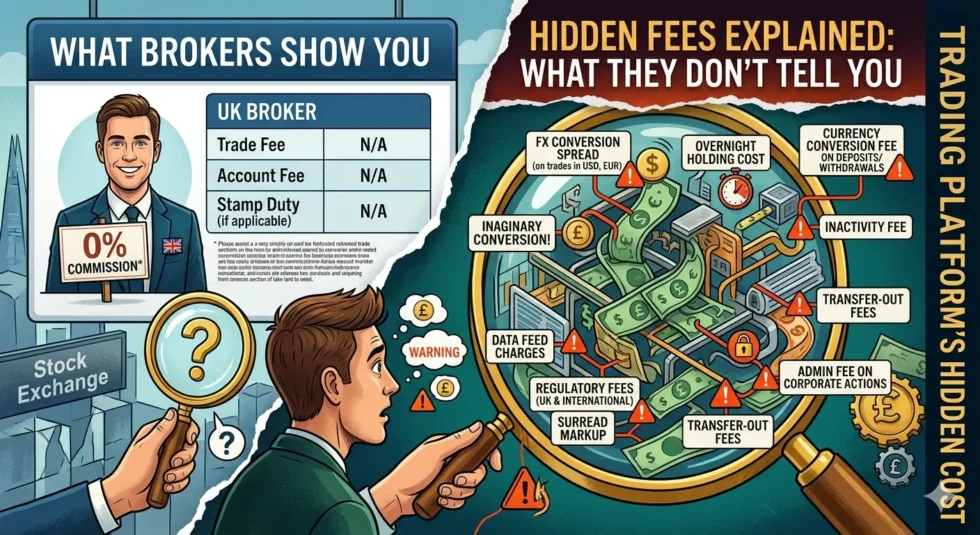
That figure is not exceptional. It is the predictable outcome of a gap between what UK trading platforms advertise and what they actually charge. The headline number — “zero commission,” “no fees,” “free trading” — is almost always true in the narrowest possible sense. The costs it excludes are where brokers make their money.
This article documents every hidden fee category found across major FCA-regulated UK trading platforms in 2026, with verified figures from live account testing. Not marketing claims. Not published minimums. What traders actually pay. This article documents every hidden fee category found across major FCA-regulated UK trading platforms in 2026, with verified figures from live account testing. For a full cost map across ten platforms including fees, speed and execution risk, see the UK Day Trading App Cost Map 2026.
Who wrote this and why trust it: This content is built on verified 2026 fee data drawn from live account testing conducted between September 2025 and January 2026 across seven major FCA-regulated UK platforms, cross-referenced against each broker’s FCA-registered fee schedules, product disclosure documents, and independent testing by UK trading researchers. No platform paid for inclusion. Figures are sourced from primary broker documentation and live test records.
The Seven Hidden Fee Categories
Most UK trading platform comparisons focus on one number: the spread or the commission. The full cost picture has at least seven distinct components, several of which are disclosed only in the product details section of a broker’s terms of service — not on the comparison page or the deal ticket.
1. Overnight Financing (Swap Rates)
This is the largest hidden cost for any trader who holds leveraged positions past the daily rollover — typically 10pm UK time. Overnight financing is charged every calendar day a CFD or leveraged spread bet position remains open, including weekends.
How it is calculated: position size multiplied by closing price multiplied by the daily swap rate. The swap rate is set by the broker and is influenced by — but not identical to — the Bank of England base rate plus a broker markup. On index CFDs, annualised swap rates commonly run between 3% and 8%.
In real money terms: at roughly 3% annually, a £10,000 leveraged position costs about £0.82 per night. Hold that for a month and you have paid £25 in fees that did not exist on any comparison table.
That example uses the conservative end of the range. On instruments with higher swap rates — oil CFDs, individual equity CFDs, or exotic currency pairs — the nightly cost is materially higher.
Weekend triple charging is a specific trap many traders do not know about until they see it on their statement. Overnight fees on CFD positions are charged daily at 22:00 UK time Monday through Friday. Weekend positions incur triple the standard overnight rate. A position held open over a three-day bank holiday weekend can therefore be charged five times the standard nightly rate in a single statement line.
Platform-by-platform disclosure quality:
- Pepperstone and Interactive Brokers publish their swap rates by instrument in the platform’s product library — accessible before you open a position
- eToro states swap rates in its fee disclosure but notes that rates “can change without advance notice based on market conditions”
- Capital.com and CMC Markets disclose overnight rates per instrument but require you to navigate to the specific instrument’s detail page to find them
What to do: Before placing any trade you might hold overnight, open the instrument’s product detail page on your platform and find the swap rate. Calculate the nightly cost against your expected position size. If the swap cost over your anticipated holding period approaches the size of your profit target, reassess the trade.
2. Currency Conversion Fees
Currency conversion is charged whenever you trade an instrument denominated in a currency different from your account’s base currency. For a UK trader with a GBP account buying US stocks, Apple shares, or US-listed ETFs, every single trade triggers a currency conversion — twice, once on entry and once on exit.
This fee ranges from 0.15% to 1.5% of trade value across major UK platforms. On a £5,000 US stock purchase, the difference between the lowest and highest conversion fee is £67.50 per round trip.
Verified 2026 figures by platform:
| Platform | FX Conversion Fee | Notes |
|---|---|---|
| Trading 212 | 0.15% (stocks/ETFs) · 0.50% (CFDs) | Applied on purchase and sale — 0.30% round-trip on stocks |
| Interactive Brokers | 0.20 bps · min $2 | Cheapest for large trades |
| XTB | 0.50% | Applied on non-GBP instruments |
| CMC Markets | 0.50% | Standard rate |
| IG Markets | 0.70% | Applied on non-GBP CFD trades |
| eToro | 0.40%–1.5% | Varies by payment method and Club tier; 50 pips on bank transfer, 150 pips on card |
| Capital.com | Varies | Check product disclosure for specific instruments |
A £10,000 US stock investment at Trading 212 costs £30 in FX fees — applied on purchase and sale, totalling 0.30% round-trip. At eToro’s rate, the same trade costs up to £150 in conversion alone.
The avoidance strategy: Several platforms allow you to hold a multi-currency account or sub-account, letting you deposit and hold USD, EUR, or other currencies and trade from that balance without triggering conversion on every trade. Trading 212, Interactive Brokers, and Pepperstone all offer this functionality. If you regularly trade US or European instruments, holding the relevant currency directly is one of the most effective ways to eliminate this cost category entirely.
3. Inactivity Fees
Inactivity fees are charged when an account has not been used — typically when no trades have been placed — for a defined period. They are deducted directly from the account balance and continue until the account is active again or the balance reaches zero.
Verified 2026 inactivity fees by platform:
| Platform | Inactivity Fee | Trigger Period |
|---|---|---|
| IG Markets | £12/month | 24 months without trading |
| CMC Markets | £10/month | 12 months without trading |
| XTB | £8/month (up to account balance) | 12 months without trading |
| eToro | $10/month | 12 months without login |
| Pepperstone | None | No inactivity fee |
| Interactive Brokers | None | No inactivity fee (removed in 2021) |
| Capital.com | None | No inactivity fee |
| Trading 212 | None | No inactivity fee |
IG charges an inactivity fee of £12 per month after 24 months without a trade. At eToro, if you do not log into your account for 12 consecutive months, a $10 monthly inactivity fee is charged, continuing until you log in or your account balance reaches zero.
The practical trap: Inactivity fees most commonly affect traders who open an account, place a few trades, then stop — either because they lost money, got busy, or switched to a different platform. If you have a dormant account anywhere, check whether an inactivity fee is running down your balance right now.
4. Withdrawal Fees
Most major UK FCA-regulated platforms have moved to free withdrawals for standard UK bank transfers. However, several charge for withdrawals via specific payment methods, below minimum amounts, or in specific currencies.
Verified 2026 withdrawal fees:
| Platform | Withdrawal Fee | Notes |
|---|---|---|
| eToro | $5 per withdrawal (USD accounts) | Free for GBP/EUR accounts. Minimum withdrawal $30 |
| XTB | £5 for withdrawals below £50 | Free above £50 threshold |
| Interactive Brokers | Free (bank transfer) | Currency conversion applies on non-base currency withdrawals |
| Pepperstone | Free (bank transfer) | Skrill and Neteller carry a small fee |
| IG Markets | Free | No withdrawal fees for UK clients |
| Capital.com | Free | No withdrawal fees |
| Trading 212 | Free | No withdrawal fees |
| CMC Markets | Free | No withdrawal fees |
eToro charges a $5 USD withdrawal fee with a $30 minimum withdrawal for USD accounts, while GBP and EUR accounts enjoy free withdrawals. For a UK trader who signed up without selecting GBP as their base currency, every withdrawal carries a cost — and may not be aware of it until the first withdrawal attempt.
5. Guaranteed Stop-Loss Premiums
A guaranteed stop-loss order (GSLO) eliminates slippage risk entirely — your position closes at exactly your stated stop level, regardless of how fast the market moves. This is valuable insurance during news events or high-volatility gaps.
The cost is a premium charged on top of the standard spread, either as a wider spread or as a separate charge. IG Markets is the most established UK provider of GSLOs. The premium is refunded if the GSLO is not triggered before the position closes.
Most traders never check this cost before placing a GSLO. On a FTSE 100 CFD, the GSLO premium at IG adds approximately 8 additional points to the spread — a cost of £8 per £1/point position that only becomes £0 if your guaranteed stop is never hit. FCA-authorised retail accounts include mandatory negative balance protection, meaning losses cannot exceed your deposited funds.
6. Deposit Fees
Most UK platforms do not charge deposit fees for standard bank transfers and debit card deposits. However, specific deposit methods — particularly electronic wallets and credit cards — can carry charges.
Trading 212 charges a 0.7% deposit fee if you deposit more than €2,000 in total to your Invest account using credit/debit cards or electronic wallets. Below that threshold, deposits are free. Depositing to CFD accounts by bank transfer is also free.
eToro charges a currency conversion fee on all deposits that are not in USD — the platform’s sole base currency. eToro automatically converts non-USD deposits at a cost of 50 pips for bank transfers and 150 pips for card deposits. For a UK trader depositing £1,000 via bank transfer, approximately £4–£7 is consumed in the conversion before the funds reach the trading account.
Platform-by-Platform Hidden Fee Summary
| Platform | FX Conversion | Inactivity | Withdrawal | Overnight | GSLO |
|---|---|---|---|---|---|
| Pepperstone | No | None | Free | Yes (leveraged) | No |
| Interactive Brokers | 0.20 bps min $2 | None | Free | Yes (leveraged) | No |
| Capital.com | Varies | None | Free | Yes (leveraged) | No |
| Trading 212 | 0.15–0.50% | None | Free | Yes (CFD) | No |
| IG Markets | 0.70% | £12/month (24mo) | Free | Yes (leveraged) | Yes (premium) |
| CMC Markets | 0.50% | £10/month (12mo) | Free | Yes (leveraged) | Yes (premium) |
| XTB | 0.50% | £8/month (12mo) | Free above £50 | Yes (leveraged) | No |
| eToro | 0.40–1.5% | $10/month (12mo) | $5 (USD accounts) | Yes (CFD weekends ×3) | No |
How to Audit Your Own Trading Costs
If you are currently using a UK trading platform, here is a five-step audit you can do in under 30 minutes to find what you are actually paying versus what you think you are paying.
Step 1 — Download your transaction history for the last three months. Every fee category above leaves a paper trail.
Step 2 — Sort by transaction type. Isolate financing charges, conversion charges, and any non-trade line items. Add them up separately from your trading profit and loss.
Step 3 — Calculate the overnight cost. Find every financing charge in your statement. Add them up. Divide by the number of nights you held leveraged positions. Compare this to the swap rate quoted in your platform’s product library for the instruments you were trading.
Step 4 — Calculate your effective spread. Take your total trading costs excluding commission. Divide by total volume traded in pips. Compare this to the advertised minimum spread. If your effective spread is more than 25% higher than the advertised rate, you are trading during high-cost periods or around news events more often than you realise.
Step 5 — Check for dormant accounts. If you have any account you have not logged into or traded on in the past 12 months, log in now. Check whether an inactivity fee has been running. Withdraw the remaining balance if you no longer use the platform.
What FCA Regulation Does and Does Not Cover
FCA authorisation requires brokers to disclose all material costs to retail clients. This means every fee discussed in this article is technically disclosed — it is in the Key Information Document, the product details section, or the terms of service.
What FCA regulation does not require is that all fees appear in the same place as the headline pricing. The spread is on the deal ticket. The overnight financing rate is in the product library. The inactivity fee is in the account terms. The currency conversion fee is in the payment section of the terms of service. A trader who reads only the deal ticket before placing a trade has seen perhaps 40% of their total cost picture. FCA Investment Platforms Costs and Charges Review. Always verify FCA authorisation before depositing funds at register.fca.org.uk.
The FCA’s approach is disclosure-based, not simplification-based. The information is available. The onus is on the trader to find and read it. This is why comparison sites that show only spread and commission — without overnight, conversion, and inactivity costs — are accurate but incomplete, and why some traders are paying far more than they realise.
Frequently Asked Questions
Do all UK trading platforms charge hidden fees?
No platform deliberately conceals fees — FCA regulations require full disclosure of all material costs. However, many fees are buried in product detail pages or terms of service rather than appearing on the deal ticket or comparison page. The fees that most commonly surprise traders are overnight financing charges, currency conversion fees, and inactivity fees. All are disclosed — few traders read the relevant documents before opening their first position.
How do I avoid overnight financing charges?
Close all leveraged positions before the daily rollover time — typically 10pm UK time. Traders who close all positions before this time pay zero in overnight financing regardless of how long they held the position during the day. If you intend to hold positions beyond a single session, calculate the nightly financing cost before entering the trade and factor it into your target profit.
What happens to inactivity fees if my account balance runs out?
The fee stops when the balance reaches zero. The broker cannot charge an inactivity fee against a zero balance or pursue you for the amount. However, if a small residual balance remains in your account — say, £30 — and an inactivity fee of £10/month applies, the balance will be consumed within three months without any additional action on your part.
Is the advertised spread what I will actually pay?
Not always. Advertised minimum spreads apply during peak London and New York session hours on major pairs under normal market conditions. During news events, at market open, in the Asian session, or during low-liquidity periods, the spread you actually receive will often be wider. Track your actual fills against advertised spreads over a month to understand your real effective cost.
Are weekend overnight charges always triple the weekday rate?
This varies by platform and instrument. At eToro, CFD positions incur triple the standard rate on weekends. At IG and Pepperstone, the weekend charge is applied as three days’ financing on the Friday rollover — the position is charged for Saturday and Sunday simultaneously with the Friday overnight. The end result is the same but appears differently on the statement. Always check your specific broker’s weekend financing policy for the instruments you trade.